49 works in this view — arrow keys or swipe to move between them.
Dance in Art
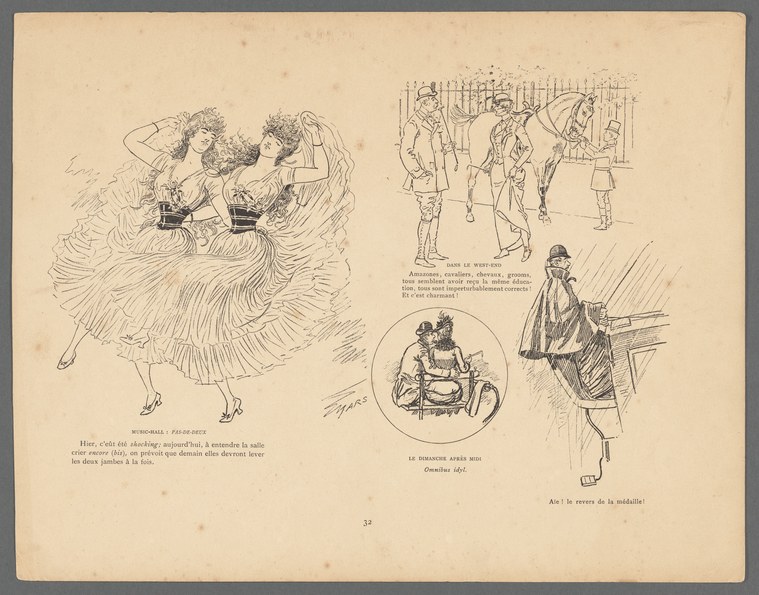
Music-hall : Pas-de-deux
Unknown artist
- Collection:
- Prints depicting dance
- Source:
- New York Public Library
- Rights:
- Public domain — free to use, share and adapt.
- Recorded as:
- Public Domain
This image preserves evidence of ballet as a fixture of commercial music-hall performance in the late 19th century—a context that shaped the development of theatrical dance between the decline of Romantic ballet and the emergence of 20th-century modernism. The intimate physical partnering between the two dancers also documents the evolving language of female-female pas-de-deux during this period.
What you are looking at
This is a composite print showing three distinct scenes of theatrical entertainment, each framed separately on the page. At left is a pair of female dancers in flowing tulle skirts rendered in delicate ink line, their bodies entwined as if mid-embrace or mid-lift, with voluminous skirts dominating the composition. The upper right shows a stable or indoor venue with several figures in period dress (appearing to be late 19th or early 20th century) standing near a saddled horse; the spatial treatment is sketchy and atmospheric. Below that is a circular vignette of a figure in elaborate theatrical costume seated or posed, and at lower right a standing figure in period dress with a hat and cloak, rendered in a more finished illustrative manner. The overall layout suggests this is a page from a theatrical or entertainment publication, with annotations in French beneath each image.
The dancing
The central female pair shows two dancers in close physical relationship, their arms raised and intertwined in a way that suggests either a supported turn, a lift preparation, or an embrace. Both wear the long tutus and fitted bodices standard to late 19th-century ballet practice. Their bodies lean into one another with considerable intimacy of contact. The other figures in the composite are not clearly ballroom dancers: they are theatre characters or performers in street dress, posed rather than executing recognizable dance steps.
The dance depicted
The title promises a pas-de-deux from a music-hall context, and the paired female figures at left match the structure and dress of a romantic or classical ballet pas-de-deux—a duet between two dancers with close partnering. The music-hall attribution suggests this is likely from a late 19th-century theatrical context where ballet was performed as part of variety entertainment. The intimate, entwined pose and the costumes point to a romantic duet in the idiom of classical ballet, though the designation as 'music-hall' suggests a commercial theatre rather than a court or opera-house setting. The exact identity of the work cannot be confirmed from the image alone.
How it was made
This is a pen-and-ink illustration or engraving printed on cream-toned paper, showing fine linear detail and hatching to suggest form and fabric texture. The figure at left is rendered in particularly delicate linework that captures the flow of fabric; the other scenes employ varying degrees of finish, from sketch-like to more detailed. The technique suggests reproduction in a periodical or illustrated book, likely late 19th or early 20th century. The composite layout and French captions indicate this was made for a French-language publication.
About this work
This is an illustration from a theatre or entertainment publication, presenting a music-hall pas-de-deux alongside related theatrical scenes. The central image captures two female ballet dancers in the intimate partnered pose of a classical duet, their costumes and embrace placing them within the romantic ballet tradition. The composite format and mixed level of finish suggest this is a page proof, study sheet, or publication layout gathering scenes related to a single performance or performer. The work documents the presence of ballet within commercial music-hall entertainment during the early modern period, a significant but often overlooked context for dance practice outside opera and court theatres.
How to look at it
Attend first to the central pair: notice the formal mirror-image symmetry of their pose and the careful articulation of the lifted arms and inclined torsos—these are conventions of the classical pas-de-deux. The abundant tulle creates a visual accent on the lower body, conventional for female ballet dancers of the period. The pose itself captures a moment of suspension or support, holding the partnership at a moment of visual climax rather than narrative action. The sketchy treatment of the surrounding scenes suggests these are ancillary to the main focus on the dance pair.
The period
The image dates from an era (approximately 1880–1910, estimated from dress and illustration style) when ballet was undergoing significant transformation. The music-hall context is crucial: theatrical dance in this period was not confined to opera houses or aristocratic venues but was a major draw for commercial entertainment, particularly in Paris. Female performers dominated music-hall dance, and the pas-de-deux remained a key structural form even as performers and audiences pushed towards novelty, spectacle, and variety. The illustration style is consistent with French theatrical journalism and criticism of this era.
Where it lives
This work is held in the New York Public Library's collection of prints depicting dance. It appears to be a page from a larger publication, likely French, given the captions and layout conventions.
Dance in this work
Questions about this work
Is this a ballet or modern dance?
This is ballet, identifiable by the tulle skirts, the fitted bodices, the turn-out of the legs, and the supported partnering pose. The 'music-hall' context indicates it was performed as commercial entertainment in a variety theatre rather than a court or opera setting, but the dance form itself is classical ballet.
What are the other scenes in the image?
The surrounding vignettes appear to show related theatrical scenes—performers, a horse, figures in period costume—likely gathered to illustrate different aspects of a single entertainment or performer. They are not dance in the same sense as the central pas-de-deux, but rather context or supporting material.
Why is the print called 'Music-hall: Pas-de-deux'?
A pas-de-deux is a duet for two dancers, one of the fundamental forms of ballet. 'Music-hall' indicates the venue—a commercial theatre offering mixed entertainment (dance, acrobatics, comedy, etc.) rather than a dedicated opera or dance house. This was the dominant context for seeing ballet in cities like Paris during the late 19th century.
More dance artwork





