49 works in this view — arrow keys or swipe to move between them.
Dance in Art
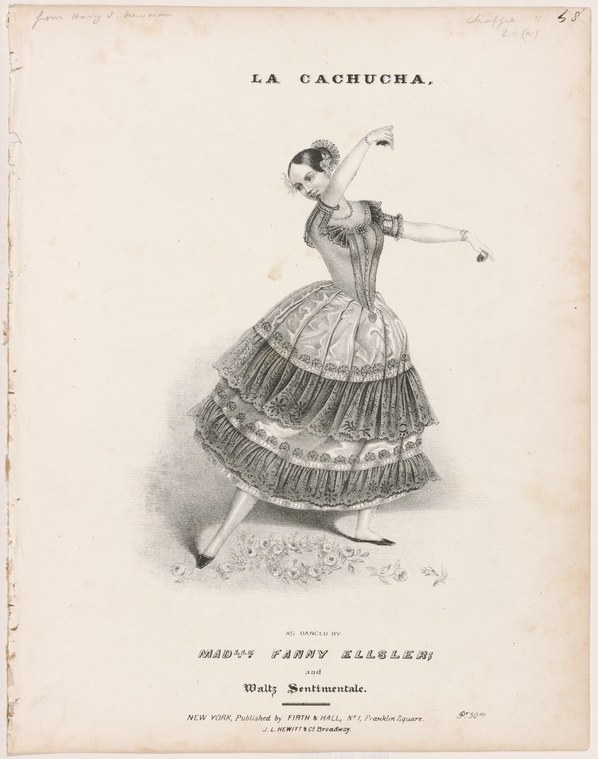
La cachucha, as danced by Madlle Fanny Elssler; and Waltz sentimentale
Unknown artist
- Collection:
- Prints depicting dance
- Source:
- New York Public Library
- Rights:
- Public domain — free to use, share and adapt.
- Recorded as:
- Public Domain
Fanny Elssler was a transitional figure who brought non-balletic movement vocabularies and character pieces into the mainstream Romantic stage, and La Cachucha was the vehicle that made her name. This print is one of the few detailed visual records of how this canonical piece was actually performed and dressed, offering dancers and historians direct access to the physical and sartorial language of a celebrated but now undocumented performance tradition.
What you are looking at
A young woman in theatrical dress performs a solo dance, captured mid-movement in a three-quarter pose that emphasizes the drama of her costume. She wears a fitted bodice with short puffed sleeves and a dramatically full skirt composed of multiple tiers of fabric, each edge trimmed with decorative ruffles or pleats. The skirt extends to mid-calf, revealing her legs and feet in the characteristic position of a classical dancer. Her right arm is raised gracefully above her head, while her left arm extends outward, and her torso leans backward with her gaze turned upward—a pose that conveys both effort and elegance. The figure is rendered in fine detail against a plain background with subtle shading beneath her feet suggesting a stage floor. The engraving is clean and precise, with careful attention to the texture of the fabric and the musculature of her limbs.
The dancing
A single female dancer isolated on stage in a moment of extension and lift. Her right leg appears to be supporting her weight while her left leg extends, and her posture suggests an upward, backward arch characteristic of Romantic-era ballet. The arm positions—one overhead, one extended to the side—create an open, expansive frame. Her torso shows the controlled flexibility and elongation expected of a trained classical dancer of this period. The positioning suggests a movement caught mid-phrase rather than a held static pose.
The dance depicted
This print documents La Cachucha, a popular theatrical dance of the 1830s–1840s performed here by Fanny Elssler, one of the most celebrated dancers of the Romantic era. The cachucha was a Spanish-derived solo dance that became a showpiece for virtuoso dancers, known for its combination of rapid footwork, dramatic arm movements, and the striking visual spectacle of the costume. Elssler was particularly famous for her performance of this number, which was distinct from ballet's formal classical vocabulary and emphasized earthy Spanish flavor alongside balletic technique. The title also notes a "Waltz sentimentale," suggesting the print may document both pieces or offer a musical pairing.
How it was made
This is a lithographic or engraved print, rendered in black ink on cream paper with fine linear work and careful tonal shading to model the figure and suggest fabric texture. The technique allowed for mass reproduction and distribution, making this an accessible and affordable way for audiences who had not seen Elssler perform to possess an image of the famous dancer in her signature role. The inscription and publication information at the bottom—naming Elssler and crediting a New York publisher—indicate this was circulated as both a commercial entertainment product and a keepsake of a major theatrical event.
About this work
This print preserves a moment from one of the 1830s–1840s' most celebrated theatrical performances: Fanny Elssler's rendition of La Cachucha. The image functions as both a documentation of a specific dancer and role and as a record of how this exotic, Spanish-inflected dance was visualized and marketed in the early American theatrical press. The work sits at an intersection of dance history, theatrical celebrity, and printmaking tradition—part of a wider culture of dance illustration that allowed performances to circulate beyond the theater and reach a broad public. For historians of Romantic dance, it offers concrete visual evidence of costume, carriage, and the aesthetic values that made Elssler one of her era's defining performers.
How to look at it
Notice the costume's construction: the tiers of the skirt and the fitted bodice are rendered with precision to show how the garment would move and reveal the body beneath. The arm and leg positions show what kinds of movement the dancer achieved—the extension and control expected of a trained classical artist, but executed with a different carriage and rhythm than pure ballet. The upward gaze and arched back convey a moment of effort and display, not repose. The clarity of the engraving allows you to read fine details of execution that later photographs would blur or simplify.
The artist
The artist is not recorded in the catalogue. The work was published by Firth & Hall in New York and J.L. Hewitt on Broadway, indicating it was produced as a commercial theatrical print for the American mass market, likely created by a staff engraver or lithographer working in the theater-print industry of the 1830s–1840s.
The period
This print dates to the height of the Romantic ballet era, when European virtuoso dancers—particularly women—toured America and became subjects of intense popular fascination. Fanny Elssler's 1840–1842 American tour was a cultural phenomenon, and prints like this were part of the machinery of theatrical publicity and fan culture. The cachucha itself was part of a broader vogue for Spanish and "exotic" dance elements in the Romantic stage, a fascination that also drove interest in nationalist and character dances alongside the ethereal, supernatural ballets that defined the period.
Where it lives
This work is held in the New York Public Library's Prints Depicting Dance collection, one of the most comprehensive archives of dance imagery in America. As a commercial lithographic print, it was designed for public circulation and affordability, part of a vast print culture of theatrical celebrity.
Dance in this work
Questions about this work
Who was Fanny Elssler?
Fanny Elssler (1810–1884) was an Austrian dancer who became one of the most celebrated performers of the Romantic era. Unlike her rival Marie Taglioni, Elssler was known for brilliant footwork and a more earthy, sensual style. She famously toured the United States in 1840–1842, where she became a sensation and helped establish ballet as a mass cultural phenomenon in America.
What is La Cachucha?
La Cachucha is a Spanish-derived solo dance that became a theatrical showpiece in the Romantic era. It combines rapid, precise footwork with dramatic arm and torso movement, and sits at the intersection of Spanish folk idiom and classical ballet technique. Elssler's performance was the most famous version, and the piece remained part of the classical repertory well into the twentieth century.
Why is the costume so elaborate?
The full, tiered skirt and fitted bodice were central to the visual spectacle and the dancer's ability to execute rapid turns and changes of direction. The costume also served to signal the dance's Spanish or exotic character, distinguishing it from the ethereal, pale tutus of supernatural ballet. The ruffles and layers created dramatic visual effects as the dancer moved.
Was this printed during Elssler's lifetime?
The cataloguing information does not supply a precise date, but the publication information and print style suggest it was made during or shortly after her American tour of 1840–1842, when her fame was at its height. Such prints were typically issued to capitalize on a dancer's celebrity while performing or immediately after a major engagement.
More dance artwork





