49 works in this view — arrow keys or swipe to move between them.
Dance in Art
L'Opéra au XIXème siècle
Unknown artist
- Collection:
- Prints depicting dance
- Source:
- New York Public Library
- Rights:
- Public domain — free to use, share and adapt.
- Recorded as:
- Public Domain
For a historian of ballroom culture, this image crystallizes the social machinery of the 19th-century ball: the asymmetry of power and agency between man and woman, the role of the chaperone, the coded language of invitation and acceptance. For a dance historian, it documents not steps but the social frame in which ballroom dances occurred—the asking, the acceptance, the moment before movement began. The image reminds us that 'ballroom dance' was not only a set of techniques but a social institution with rigid etiquette.
What you are looking at
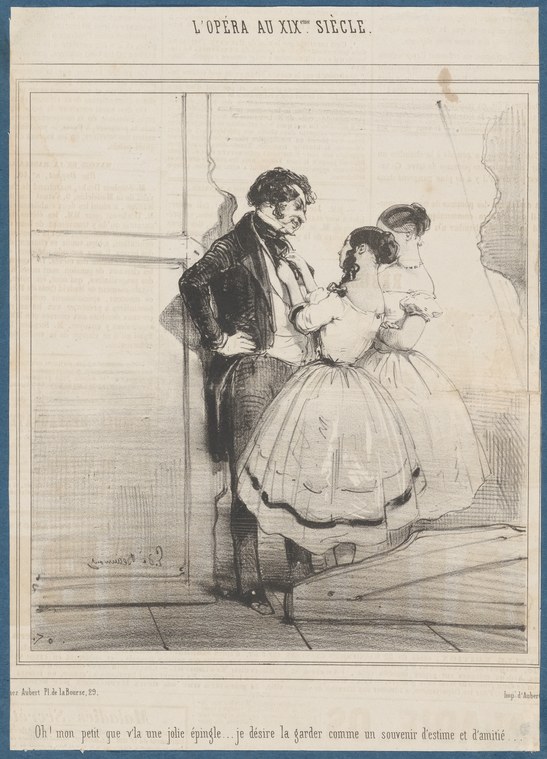
A man in dark formal evening dress stands at the center-left of the composition, leaning forward in an attitude of courteous attention toward a woman in an elaborate white ball gown. The woman faces him with her body angled slightly away, her voluminous skirt dominating the lower half of the frame. A second woman in similar formal dress stands behind and to the right, her posture more upright and reserved. The setting appears to be an interior space, suggested by vertical architectural elements (walls or pilasters) in the background rendered in light wash. The foreground is occupied by the expansive white drapery of the woman's skirt, which fills the composition with its scale and detail. The entire scene is rendered in a tonal lithographic technique with areas of gray wash and fine linear detail, creating a sense of theatrical lighting and spatial depth characteristic of 19th-century society portraiture.
The dancing
The man's frame is open and his upper body leans into the space between himself and the woman, his arm extended in a gesture that suggests solicitation or invitation—possibly requesting a dance or offering a hand. The woman's carriage is more formal: her torso held upright, her arm position uncertain in the grainy reproduction but her body language conveying social reserve or polite consideration. The second woman stands as an observer or chaperone, maintaining greater distance. None of the figures display the close contact or partnered frame of a waltz or quadrille in motion; the moment captured is one of social negotiation rather than active dance.
The dance depicted
This is a scene of courtship or social negotiation at a 19th-century ball, rendered at the moment before dance rather than during it. The caption (in French) reads 'Oh! mon petit gas via une pile étincelle...je désire la garder comme un souvenir d'estime et d'amitié' (Oh! my little boy, by a spark... I wish to keep it as a memento of esteem and friendship), indicating a moment of flirtation or romantic exchange. The women's costume—full white gowns with defined waists and voluminous skirts—and the man's evening coat date this to the mid-19th century, the era of Romantic ballet and high society ballrooms. The image documents not the dance itself but the social ritual of asking and accepting, a convention of ballroom culture that structured who danced with whom.
How it was made
This is a lithograph, identifiable from the characteristic tonal range, the grainy texture of the stone, and the combination of drawn line with wash effects. Lithography allowed rapid, affordable reproduction and was the dominant medium for social satire, theatrical documentation, and popular prints in the 19th century. The technique's capacity for fine detail and atmospheric tone made it ideal for capturing the texture of fabric—here, the play of light on the woman's skirt—and the nuance of facial expression and posture that convey social meaning. The title and caption suggest this is a sheet from a series documenting operatic and ballroom society.
About this work
This lithograph documents a moment of social choreography at a 19th-century ball, capturing the formal ritual of a gentleman soliciting a dance from a lady. The image is not action but negotiation: the woman's composed posture and the man's deferential lean embody the social codes that governed who danced, with whom, and on what terms. The work belongs to a tradition of satirical and observational prints of Parisian society life, a genre that understood ballroom culture as performance—one with strict protocols, high stakes, and abundant comedy. The title, 'L'Opéra au XIXème siècle' (Opera in the 19th Century), suggests this sheet is one of a suite documenting the social life surrounding Parisian opera and ballet houses, where the audience's conduct on the dance floor was as carefully choreographed as the performances onstage.
How to look at it
Look first at the posture of the woman's body—note the upright carriage, the slight turning-away, the way her skirt occupies so much visual space that her own agency becomes ambiguous. Then observe the man's lean: the vulnerability of his posture, the openness of his gesture. Together they show how 19th-century ballroom protocol rendered both figures dependent on invisible social rules. The lithographer has chosen to freeze the moment of asking, not the dance itself—a choice that emphasizes that the real choreography was social, not physical. The scale and detail of the woman's skirt is not mere fashion documentation; it is a visual statement of her importance and her constraint.
The period
This print dates from the mid-19th century, an era of fervent ballroom culture in Paris. The Romantic era had elevated the waltz and the quadrille to supreme importance in aristocratic and bourgeois society. Simultaneously, the Romantic ballet—with its emphasis on ethereal, impossible grace—was at its height. The distinction between theatrical dance (ballet) and social dance (ballroom) was absolute, yet they existed in the same cultural moment and often the same venues. Prints documenting society balls were popular merchandise, sold as satirical commentary on fashion, behavior, and the absurdities of courtship. The caption's flirtatious tone is typical of this genre.
Where it lives
This work is part of the New York Public Library's collection of prints depicting dance. It is one sheet from a larger suite titled 'L'Opéra au XIXème siècle,' which documented social life around Parisian opera and ballet houses. The series appears to be a work of social satire and observational humor rather than formal portraiture.
Dance in this work
Questions about this work
Is this image showing people actually dancing?
No. It captures the moment just before a dance—the solicitation and acceptance. The choreography here is social rather than physical. The real dance, if it occurred, would have happened after this moment of negotiation.
What dance would they have danced?
Given the date (mid-19th century) and the formal ballroom setting, most likely a waltz or a quadrille. Both were dominant at Parisian balls. The print does not show us, but the social protocol it depicts—man asking, woman considering—applied to both.
Why is the woman's skirt so large?
The voluminous skirt was typical of mid-19th-century fashion and was essential to ballroom dance. It moved dramatically during the waltz and quadrille, and its scale was a marker of social status and femininity. The lithographer has given it enormous visual prominence, suggesting both its importance to the visual spectacle of the ball and the way it constrained the woman's movement and autonomy.
What does the French caption mean?
It translates roughly as 'Oh! my little boy, by a spark... I wish to keep it as a keepsake of esteem and friendship.' It is a flirtatious or coy response—the woman is playing hard to get or establishing that any dance will be offered only as a gesture of friendly regard, not romantic interest. It is typical of the humorous tone of this series.
More dance artwork





