49 works in this view — arrow keys or swipe to move between them.
Dance in Art
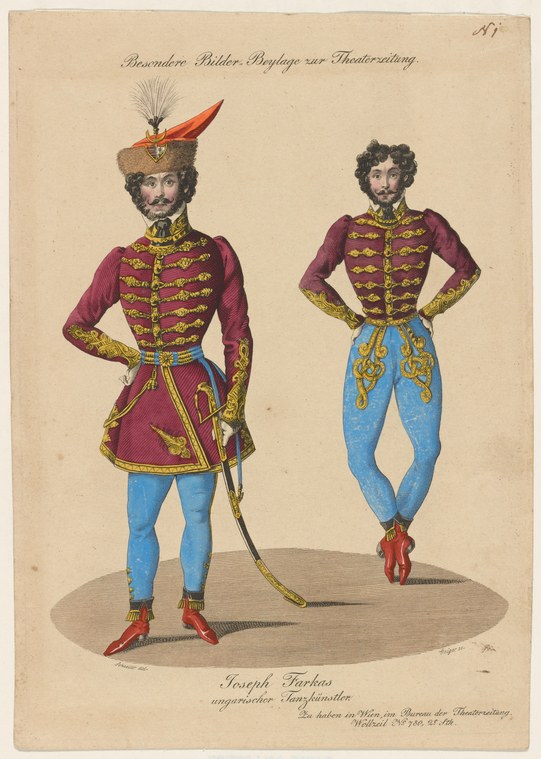
Joseph Farkas ungarischer Tanzkünstler
Unknown artist
- Collection:
- Prints depicting dance
- Source:
- New York Public Library
- Rights:
- Public domain — free to use, share and adapt.
- Recorded as:
- Public Domain
This print documents a named performer and his specific role(s), rare evidence of how Hungarian dancers and Central European character dances were staged and presented to metropolitan audiences in the Romantic era. The dual-role composition and military styling offer insight into the dramatic and physical vocabulary of early 19th-century theatrical dance beyond the French and Italian centers usually documented in print.
What you are looking at
Two male dancers in military dress stand on a shallow platform against a plain tan background. The figure on the left wears an elaborate uniform of deep burgundy with ornate gold frogging and braid across the chest, a short decorative skirt, bright blue tights, and red heeled shoes; a tall feathered headdress crowns his head. His right arm extends downward holding a curved sword or sabre, his left hand rests on his hip in a commanding pose. The second figure, positioned slightly to the right and behind, wears an identical uniform tunic and blue tights but is shown in a different stance—legs crossed or in a pronounced stepping position, with both hands on his hips. His hair is dark and curled; he lacks the headdress. Both dancers wear gold-trimmed jackets with distinctive military frogging that suggests Hungarian or Central European cavalry uniform. The composition presents them as a pair, likely demonstrating positions or moments from the same choreographic work.
The dancing
Both figures are in upright, commanding poses with weight distributed on the balls of the feet—suggesting a trained dancer's carriage rather than a soldier's stance. The left figure's extended arm and sword-holding gesture indicates either a preparatory or display position, while the right figure's crossed-leg stance and hip placement suggest forward momentum or a stepping action. Both maintain formal upper body alignment with shoulders drawn back, and their arm positions—one active with the sword, one planted at the hips—create an asymmetrical but balanced composition. The footwork appears deliberate and controlled, consistent with early 19th-century theatrical dance training.
The dance depicted
This appears to document Joseph Farkas, identified in the inscription as a Hungarian dance artist (ungarischer Tanzkünstler). The inscription notes a performance or demonstration 'in beiden Rollen der Szenendarstelungen' (in both roles of the scene representation), suggesting this work shows two distinct positions or characters from a single theatrical piece—possibly a dramatic or character dance. The military costume, the sabre, and the Central European styling suggest a Romantic-era dance featuring Hungarian or Slavic themes, common in early 19th-century ballet and theatrical dance. However, without the specific work title or date, the exact dance form cannot be confirmed; the formal stance and trained deportment point to theatrical rather than folk dance, and the paired presentation suggests either a pas de deux or a showcase of contrasting character roles.
How it was made
This is a hand-colored engraving or aquatint, characteristic of early 19th-century theatrical documentation. The fine line work defining the costume details, the delicate rendering of the feathers and gold braid, and the subtle wash of color on the uniforms and tights indicate a skilled theatrical print maker. The monochromatic base with selective hand coloring was the standard method for circulating images of celebrated dancers and performances to a middle- and upper-class audience; such prints were sold as souvenirs at theaters and collected as records of notable performers. The technique allowed for both precision in costume detail and broad distribution, making this a document of both artistic practice and performer celebrity.
About this work
This is a hand-colored engraving documenting the Hungarian dancer Joseph Farkas performing or demonstrating two positions from an early 19th-century theatrical dance work. The inscription indicates both roles are his own, suggesting either a character dance with multiple episodes or a showcase piece in which he displayed contrasting personas. The precise military costume, trained carriage, and formal composition place this work within the Romantic theatrical dance tradition of Central Europe, capturing a moment when dance artists were increasingly celebrated as individual performers and their roles were immortalized in widely distributed prints. For historians of Romantic dance, this is a rare visual record of a performer and work that might otherwise be forgotten; for dancers, it preserves information about the posture, stance, and costume of early 19th-century theatrical practice.
How to look at it
Notice the careful distinction between the two figures: the left dancer in the moment of action or attack, with the sabre extended and the body deployed, and the right in a stepping or preparation position. The artist has frozen two instants from a continuous action, allowing the viewer to read the progression of movement. Observe the precision of the costume rendering—every button, braid, and feather is distinct—indicating that the visual identity of the character and role was as important as the movement. The plain background and elevated platform present the dancer as a theatrical subject on display, a convention of early Romantic dance documentation that emphasizes the performer's formal training and visual presence over narrative context.
The artist
The artist is not recorded in the catalogue, but the quality of the engraving and the hand coloring suggest a specialized theatrical print workshop, likely based in a major German or Austrian city. Such works were commonly produced by anonymous artisans working in high-volume theatrical portrait studios that supplied the market for performer images during the Romantic period. The inscription in German (Besondere Bilder: Beylage zur Theater-zeitung) indicates publication as part of a series for a theater periodical, suggesting institutional rather than independent production.
The period
This print dates from the early to mid-19th century, when Romantic ballet and theatrical dance were at their height across Europe. Hungarian and Central European character dances were fashionable in metropolitan theaters during this period, often presented as exotic and dramatic alternatives to classical ballet. The proliferation of hand-colored theatrical prints in this era reflects both the celebrity status of individual dancers and the expansion of an urban audience for dance. Farkas's prominence enough to warrant publication suggests he was a noted performer in his time, though the continental rather than international circulation of his image suggests his fame was primarily regional.
Where it lives
The work is held in the New York Public Library's collection of prints depicting dance. The German inscription indicates publication as part of a theater-periodical series (Besondere Bilder: Beylage zur Theater-zeitung), suggesting it was a commercial theatrical print distributed to subscribers or sold in theaters.
Dance in this work
Questions about this work
Who was Joseph Farkas and why was he important?
Farkas is identified as a Hungarian dance artist (ungarischer Tanzkünstler) of the early 19th century. He was significant enough to be documented in a published theatrical print series, indicating he was a celebrated performer in Central European theaters. However, detailed biographical information does not survive in standard dance historical sources; this print may be one of the primary remaining records of his work and celebrity.
What dance is he performing?
The inscription states he is shown in both roles ('beiden Rollen') of a scene representation (Szenendarstelungen), but does not name the specific work. The military costume, sabre, and Central European styling suggest a dramatic character dance or a Romantic-era work with Hungarian or Slavic themes. Without additional documentation, the exact title and choreography cannot be determined from the image alone.
What does the costume tell us?
The deep burgundy tunic with gold frogging, feathered headdress, blue tights, and red heeled shoes indicate a high-ranking military or nobleman character, likely from a Romantic ballet or dramatic dance work set in Central Europe. The precision of the costume rendering in the print reflects the importance of visual spectacle and character identification in early 19th-century theatrical dance.
Why are two positions shown?
The inscription's reference to both roles suggests the artist is demonstrating either two distinct character positions from the same work or two moments of action in a sequence. This double-figure format was common in theatrical prints to show range, progression, or contrasting moods, allowing audiences to understand the dramatic or physical arc of a performance.
More dance artwork





