49 works in this view — arrow keys or swipe to move between them.
Dance in Art
Taglioni
Unknown artist
- Collection:
- Prints depicting dance
- Source:
- New York Public Library
- Rights:
- Public domain — free to use, share and adapt.
- Recorded as:
- Public Domain
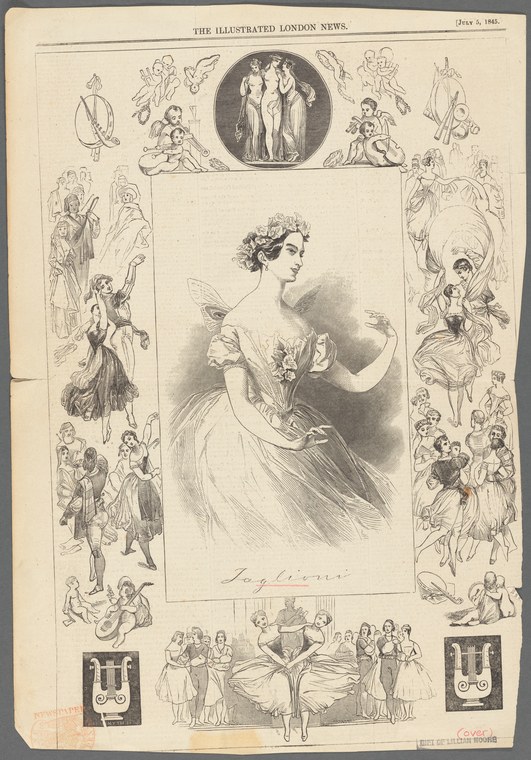
Taglioni was a revolutionary figure in dance history, and her influence on the aesthetics and technique of ballet cannot be overstated; this engraving is contemporary evidence of her celebrity and the visual language used to honour her. The work also demonstrates how nineteenth-century visual culture understood and represented dance—through allegorical reference and poetic suggestion rather than documentary notation, revealing the values of the Romantic movement.
What you are looking at
This is an ornamental engraving that frames a central portrait of a woman in Romantic-era dress with an elaborate decorative border. The woman stands in three-quarter view, her body angled to the left, wearing a long white gown with off-shoulder sleeves characteristic of the 1840s. Her dark hair is styled with flowers or ornamental pins. The border surrounding this portrait consists of at least twelve smaller vignettes arranged around the central image: figures in various attitudes of classical and allegorical dance—some winged (suggesting celestial or mythological subjects), others in flowing drapery, several appearing to float or leap. The compositions range from solo figures to pairs and small groups. At the top of the border sits a larger circular medallion showing three draped female figures in what appears to be a classical grouping. Below the central portrait is the inscription "Taglioni" in cursive script. At the bottom, two decorative vase-like symbols flank a scene of multiple figures in a formal gathering or courtly arrangement. The entire composition is rendered in black and white engraving technique.
The dancing
The central figure is posed statically and formally, appropriate to a portrait. The surrounding dancers display the extended, ethereal lines characteristic of Romantic ballet: elongated limbs, fluid arm positions, bodies in sustained positions of apparent weightlessness or mid-leap. Several figures appear en pointe or rising onto the balls of their feet. The dancers in the border vignettes are rendered in classical allegorical style rather than as naturalistic movement studies—the artist has chosen poses that suggest narrative or mythological significance rather than documentary of actual choreography. Pairs of dancers are shown in close proximity without the partnered holds of contemporary ballroom, and the women dominate compositionally.
The dance depicted
This is a commemorative engraving celebrating the dancer Marie Taglioni, whose name appears as the caption. The surrounding decorative border functions as a visual apotheosis, surrounding her portrait with allegorical and classical references to dancing nymphs, muses, and celestial figures—a convention of the period for honoring celebrated performers. Taglioni was the leading Romantic ballerina of the 1830s–40s, famous for her lightness and ethereal quality on stage; the imagery of floating, soaring figures in the border reflects how her contemporaries perceived her artistry. The vignettes do not depict specific choreography from her roles but rather create a poetic commentary on her status as the embodiment of Romantic ballet ideals.
How it was made
This is an engraving, identifiable by its fine parallel hatching and linear technique characteristic of steel or copper engraving. The precision of line and the ability to render both fine detail (in the portrait's facial features and fabric textures) and larger compositions suggests this was a commercial print, likely produced in London given the publication in The Illustrated London News. The ornamental frame format was characteristic of mid-nineteenth-century theatrical and portrait engravings, which often presented the subject as a composite of images—portrait plus allegorical context—to serve both commemorative and decorative purposes. This technique allowed for wide circulation and relatively inexpensive reproduction, making it accessible to middle-class art collectors and theatre enthusiasts.
About this work
This is a commemorative engraving celebrating Marie Taglioni, the dominant ballerina of the Romantic era, published in The Illustrated London News. The work combines a formal portrait of the dancer with an ornamental border populated by allegorical and classical figures engaged in various attitudes of dance—a visual strategy that elevates the sitter beyond the merely documentary into the realm of myth and immortality. The border functions as a graphic annotation on Taglioni's artistic legacy and the cultural meanings attached to her dancing.
The engraving is significant as evidence of how nineteenth-century print culture processed and celebrated the Romantic ballet, and how a single dancer could become a symbol of an entire aesthetic movement. It shows that dance was not confined to the theatre or to movement itself but extended into the visual arts and the commemorative practices of an emerging mass media.
How to look at it
Attend first to the central portrait: it is a formal, static likeness, showing the dancer not in performance but as a celebrated person. Then move outward to the border, observing how the surrounding figures create a narrative of elevation and otherworldliness. Note which figures appear to be rising or flying, which are paired, which are solitary. The artist has arranged these vignettes to suggest that Taglioni's art lifts her above ordinary time and space—she is framed by eternally dancing muses and spirits. The framing device itself is part of the meaning: the ornamental border was a convention for honouring the great and celebrated, so the physical containment of Taglioni's image within this classical and allegorical frame is an act of canonization.
The period
This engraving dates to the height of the Romantic ballet era, roughly 1830–1850. Marie Taglioni became famous in the 1830s, particularly for her role in *La Sylphide* (1832), which inaugurated the pointe-work and weightless aesthetic that defined Romantic ballet. By the 1840s, she was an international celebrity, and her image circulated widely in prints, lithographs, and theatrical publications. The Illustrated London News, a weekly magazine founded in 1842, was a major vehicle for bringing images of theatre, fashion, and society to a broad public. Taglioni's prominence in its pages reflects both her status as a public figure and the magazine's interest in performing arts. The allegorical and classical frame around her portrait reflects Romantic-era thinking about the arts: the notion that a great performer was a conduit for something transcendent or mythological, not merely a skilled technician.
Where it lives
This is a wood or steel engraving published in The Illustrated London News, a London-based illustrated weekly. The image is held in the New York Public Library's Prints collection, which preserves dance-related prints and theatrical imagery. As a published periodical illustration, it was produced in multiple copies for subscription and public sale, making it a document of popular taste and theatrical celebrity culture of the 1840s.
Dance in this work
Questions about this work
Is this a portrait of Marie Taglioni during a performance?
No. The central image is a formal, static portrait of Taglioni as a celebrated person. The surrounding border contains allegorical and classical dancing figures, which serve as a visual commentary on her artistry rather than as a record of any specific choreography or performance.
What do the figures in the decorative border represent?
They are allegorical and classical references—muses, nymphs, celestial or mythological figures engaged in various attitudes of dance. They function poetically to suggest the transcendent, otherworldly quality that audiences and critics attributed to Taglioni's performance. The floating and weightless poses reflect how her contemporaries described her lightness and ethereal stage presence.
Why would a dancer's portrait be printed in The Illustrated London News?
By the 1840s, The Illustrated London News was a major vehicle for circulating images of celebrities, including celebrated performers. Taglioni was an international star, and her image had significant commercial and cultural value. Publishing her portrait both celebrated the arts and appealed to readers' interest in theatre and fashionable society.
What does this print tell us about how the Romantic era understood dance?
The allegorical frame suggests that Romantic-era culture understood dance not as a technical or athletic practice but as a poetic and transcendent art form. The dancer was imagined as a medium for classical or mythological ideals, rather than simply as a skilled performer. Visual representation of dance emphasised otherworldliness, grace, and spiritual elevation.
More dance artwork





