49 works in this view — arrow keys or swipe to move between them.
Dance in Art
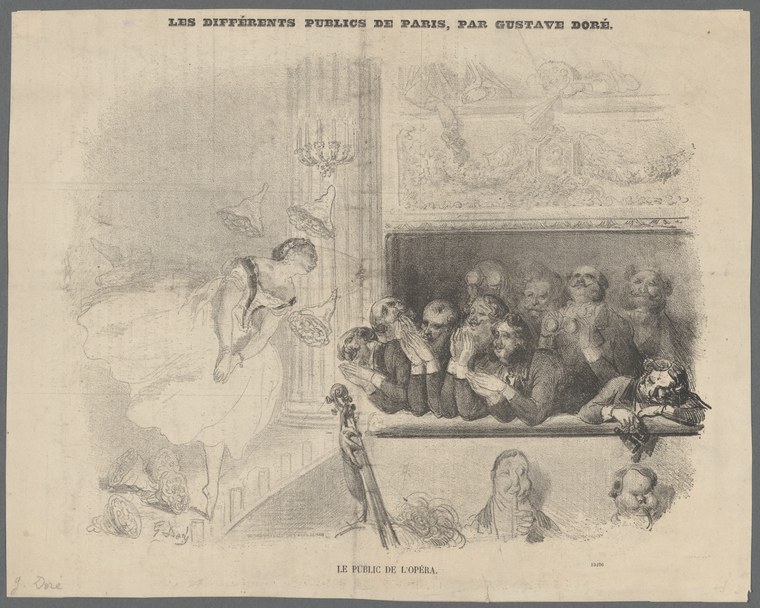
Le public de l'Opéra
Unknown artist
- Collection:
- Prints depicting dance
- Source:
- New York Public Library
- Rights:
- Public domain — free to use, share and adapt.
- Recorded as:
- Public Domain
This image is primary evidence for how Romantic ballet looked in practice—the actual body position, the costume, the pointe work—rather than a later reconstruction or memory. It also reveals the gendered spectatorship and bourgeois consumption of ballet in nineteenth-century Paris: the opera box full of fashionably dressed witnesses, mostly male, watching a solitary female body. For historians of theater, gender, and performance, it documents the material conditions in which this dance was seen and what an educated Paris audience was meant to understand about ballet's meaning.
What you are looking at
A crowded opera box fills the right half of the composition, packed with well-dressed spectators in nineteenth-century formal dress—men in tailcoats and women in bonnets and low-necked evening gowns, their faces turned in rapt attention toward the stage. The left side shows a classical stage setting with a balustrade and draped scenery. On stage, a single female dancer in a diaphanous white romantic tutu and pointe shoes executes a graceful, weightless arabesque or similar elevated classical pose, her body seeming to float with ethereal ease. The contrast between the dense, earthbound crowd and the solitary, ethereal dancer creates the central visual drama. Sketchy architectural elements and ornamental details frame the scene in the style of nineteenth-century theatrical illustration. The artist's line is loose and expressive, with selective shading emphasizing the dancer's luminous figure against the darker mass of the audience.
The dancing
The dancer's body is extended in a classical vertical line—one leg raised behind or beside her, arms positioned in the formal épaulement of classical ballet, her torso held with the upright carriage demanded by the technique. Her pointe shoes are clearly rendered as the foundation of the pose. The spectators are rendered more summarily, seated closely in a box with varied head positions and expressions, their formal dress (men's high collars, women's decolletage) identifying them as Parisian bourgeoisie. The choreography and deportment read as thoroughly trained classical ballet.
The dance depicted
This is a Romantic-era ballet scene, almost certainly depicting a moment from a famous work of that period—the single diaphanous ballerina performing for an entranced paying audience was the defining image of 1840s Paris, particularly associated with works like La Sylphide or the dream-scene variations of Giselle. The image captures the cult of the ethereal, otherworldly ballerina that defined Romantic ballet aesthetics. The dancer's body demonstrates the classical technique of the period: turnout, elevation, pointed feet, and the illusion of weightlessness that the Romantic ballet dancers of the Paris Opéra were celebrated for achieving. The audience gazing up at the stage speaks to ballet's status as fashionable entertainment for the Parisian elite.
How it was made
This is a lithograph or engraving, rendered in the style of mid-nineteenth-century theatrical illustration. The title at the bottom—'LE PUBLIC DE L'OPÉRA' (The Opera Audience)—and the print source (NYPL) confirm this is a published broadsheet, one of many circulated to commemorate performances or to serve as souvenir images of celebrated dancers and scenes. The technique's loose, atmospheric quality—particularly the suggestion of depth and movement through selective line and wash—was well suited to theatrical reproduction and captured something of the spectacle of gaslit stage performance. The partial identification with text (title, possibly artist signature or publication mark) and the accessible medium suggest wide circulation among Parisian audiences.
About this work
Le Public de l'Opéra is a nineteenth-century lithographic depiction of a Romantic-era ballet performance at the Paris Opéra, the most prestigious ballet venue in Europe during the 1830s–1850s. It divides the composition between stage and audience: a single ballerina in a classical romantic tutu and pointe shoes performs for an elegant, crowded box of Parisian spectators. The work is a document of both the dance and the social consumption of ballet—it shows us not only what Romantic ballet looked like in motion, but the context of fashion, wealth, and leisure in which it was performed. It belongs in a dance archive because it captures a specific choreographic moment (the weightless arabesque or similar elevation) that was signature to the ballet aesthetic of its era, and because it records the performer-audience relationship that was central to ballet's cultural meaning.
How to look at it
Attend first to the dancer's body: the position of her limbs, the extension of her legs, the line of her torso and arms. These are not idealized fantasies but the actual technical vocabulary of classical ballet as it was danced. Notice how the artist has positioned her in profile or three-quarter view—a choice that lets us read the full line of the body and the geometry of the pose. Then look at the audience: how the theater box frames and contains the crowd, how the density of seated figures contrasts with the solitary, airborne dancer. This contrast—between the mundane, earthbound spectators and the ethereal, elevated performer—was central to Romantic ballet ideology. The sketch-like, expressive linework gives the scene immediacy and movement despite being a frozen image.
The artist
The catalogue record lists no artist, and no signature is clearly visible in the image. The title at the bottom reads 'LES DIFFÉRENTS PUBLICS DE PARIS, PAR GUSTAVE DORÉ' (The Different Publics of Paris, by Gustave Doré) at the top of the print. If this is from Doré's series on Parisian society, it would place the work in the 1860s, within Doré's period of maximum productivity as an illustrator and social satirist. Doré was celebrated for his dense, dramatic compositions and his ability to capture social types and moments; his theatrical scenes were widely reproduced and circulated.
The period
The Romantic ballet era (1830s–1850s) saw the apotheosis of the ballerina as a principal subject of aesthetic and erotic fascination. Marie Taglioni's debut in La Sylphide (1832) established the ethereal, weightless, pointe-dancing ballerina as the reigning ideal. The Paris Opéra was the epicenter of European ballet, and performances there were major social events. By the 1860s, when Doré was likely producing this image, Romantic ballet had begun to decline in favor of the more spectacular, pantomime-heavy ballets of the Second Empire, but the image of the solitary ballerina in white was still iconic. This print sits in the tradition of theatrical illustration and social documentation that flourished with lithography: it was cheap to produce and distribute, reaching a wide middle-class audience.
Where it lives
The work is held in the New York Public Library's collection of prints depicting dance (Prints depicting dance collection). It was likely published as a broadsheet or in a series in nineteenth-century Paris and entered a collection (possibly in America) as a historical document of theatrical culture. The presence in NYPL and its formal cataloguing as a dance-related print indicates it was valued as evidence of performance practice.
Dance in this work
Questions about this work
Is this a real performance or an imagined scene?
It is almost certainly based on a real performance or type of performance, but not a documentary photograph. The artist (Gustave Doré, if the attribution at the top of the print is correct) worked from observation and memory, capturing a recognizable moment—a ballerina performing a classical variation for an opera-house audience. The specific dancer and performance may or may not be identifiable, but the scene itself is reportorial rather than purely invented.
What dance is being performed?
The print does not identify a specific ballet, and the pose alone—though it closely resembles an arabesque or similar classical elevation—could appear in many Romantic-era works. Given the era (1830s–1860s) and the Paris Opéra setting, the work is likely one of the canonical Romantic ballets: La Sylphide, Giselle, La Péri, or Paquita. The ethereal white tutu and pointe work are signature to this period and aesthetic.
Why is the audience shown as much as the dancer?
The print's title—'The Public of the Opera'—signals that the audience is as much the subject as the performance. This was characteristic of Doré's social documentary work: he was interested in representing Parisian society as much as individual spectacles. The crowded opera box, the fashionable dress, the rapt attention—these document what it meant to be a consumer of ballet in nineteenth-century Paris.
How do I know this is ballet and not some other kind of dance?
The pointe shoes are the definitive marker. The dancer is clearly en pointe—standing on the tips of her toes in specially reinforced shoes, a technique unique to classical ballet and essential to the Romantic ballet aesthetic. The vertical carriage, the turnout, and the classical arm positions confirm this is trained ballet technique as practiced in Europe in the nineteenth century.
More dance artwork





