49 works in this view — arrow keys or swipe to move between them.
Dance in Art
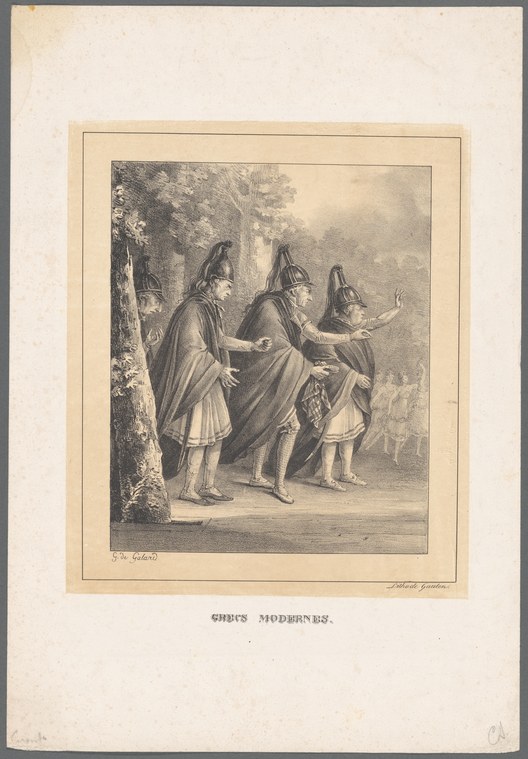
Grecs modernes
Unknown artist
- Collection:
- Prints depicting dance
- Source:
- New York Public Library
- Rights:
- Public domain — free to use, share and adapt.
- Recorded as:
- Public Domain
This work documents a crucial moment in European dance history when choreographers and artists actively sought to recover or reimagine classical movement practices. The careful attention to classical drapery and the idealized natural setting reflect how deeply Romantic-era dance drew on visual and textual traditions of antiquity, shaping the aesthetics of theatrical dance well into the 20th century.
What you are looking at
Three figures in classical dress stand in a wooded setting, their poses suggesting mimetic or interpretive movement. The leftmost figure, in profile, gestures with an extended arm toward a gnarled tree trunk at the left edge of the composition. The central figure, also in profile, adopts a contrapposto stance with one arm raised. The rightmost figure, smallest in scale and positioned deeper in space, mirrors aspects of the central pose. All three wear draped garments—tunics or chitons—that fall to the knee or mid-calf, with their legs bare. The setting is rendered in soft, atmospheric tones with heavy foliage in the background and middle distance, creating a classical idyll. The figures occupy a cleared foreground, standing on level ground. The overall mood is contemplative and graceful rather than vigorous.
The dancing
The three bodies are arranged in a loose diagonal line receding into space. Each maintains an upright carriage with a notable emphasis on the arms and upper body. The leftmost figure's extended arm and turned head suggest speech or declaration. The central figure's raised arm and shifted weight suggest a lyrical, almost ecstatic attitude. None adopt the closed holds or partnered frames of ballroom dance; instead, each body occupies its own space, with gesture and posture as the primary language. The poses suggest practiced elegance and deliberate control rather than athletic exertion.
The dance depicted
This is almost certainly a depiction of Greco-Roman dance or a Romantic-era imagining of classical movement, aligned with the title *Grecs modernes* (Modern Greeks). The poses—the contrapposto stance, the raised arm, the gesture toward the tree—evoke classical sculpture and the aesthetic principles of antique dance as understood in 19th-century Europe. The three figures may represent nymphs, bacchantes, or idealized classical dancers performing a processional or mimetic scene. The work sits within a tradition of neoclassical and romantic theatrical dance that drew on textual and visual sources to reconstruct or imagine Greek and Roman movement practices. Whether this depicts an actual stage work or a more generalized classical fancy cannot be determined from the image alone.
How it was made
This is a tonal engraving or etching, identifiable by the fine hatching and cross-hatching visible across the composition, particularly in the foliage and drapery, and the characteristic gray-on-cream tonality of a printed impression. The technique allowed for precise rendering of both form and atmospheric effect, with soft gradations achieved through careful control of line density. The work was likely produced for circulation among educated audiences interested in classical aesthetics, theatrical subjects, and the fine arts. The print's scale and technique suggest it was made for bound publication or as a standalone artistic print.
About this work
This engraving depicts three figures in classical dress performing or posing in a wooded setting, titled *Grecs modernes*. The work represents a 19th-century engagement with the aesthetics of ancient Greek and Roman dance, imagined or reconstructed through the artistic and theatrical conventions of the period. It belongs to a broader movement in European art that sought to revive and reinterpret classical culture, particularly in the context of Romantic dance and theatrical performance. The specificity of the title suggests it may reference a known performance or choreographic work, though the image alone does not confirm which.
How to look at it
Attend to the careful positioning of the arms and the distribution of weight in each figure. The raised arm of the central dancer and the extended gesture of the leftmost figure are classical conventions signifying grace, emotion, and status rather than steps or spatial pathways. The artist has chosen a moment of stillness or transition rather than kinetic momentum, emphasizing pose and carriage over movement. Notice how each figure is individually composed yet part of a unified scene—a formal principle of classical choreography. The soft atmospheric rendering of the setting creates a sense of timelessness, placing the dancers in an imagined antiquity rather than a specific historical moment.
The period
The 19th century saw intense European fascination with reconstructing ancient Greek and Roman culture, fed by archaeological discoveries, philological scholarship, and Romantic philosophy. In dance, this manifested in neoclassical ballets and pantomimes that sought authenticity through careful study of visual evidence—sculpture, vase paintings, and ancient texts. Works like Carlo Blasis's *Code of Terpsichore* (1828) and the rise of the ballet d'action created a climate in which staged interpretations of classical myths and movement practices proliferated. The title *Grecs modernes* suggests an intersection of archaeological aspiration and contemporary theatrical practice: these are not ancient Greeks, but modern performers embodying classical ideals. This engraving likely circulated among artists, dancers, and educated patrons interested in the theoretical and practical foundations of theatrical dance.
Where it lives
The work is held in the New York Public Library's Prints collection, which documents theatrical and dance imagery from the 16th century onward. It is one of many prints of dance subjects acquired to serve scholars of performance history and the visual culture of dance.
Dance in this work
Questions about this work
Is this a real historical dance or an artist's invention?
Almost certainly an artistic interpretation. The title *Grecs modernes* suggests it depicts performed or choreographed work referencing classical ideals, but ancient Greek and Roman dance cannot be fully recovered—only imagined through surviving visual and textual evidence. This engraving reflects 19th-century ideas about what classical dance might have looked like.
What is the significance of the clothing?
The draped tunics and bare legs are classical Greek costume, worn in 19th-century theatrical productions to signal antiquity and refinement. The careful rendering of the drapery—how it falls, how it reveals and conceals the body—was central to neoclassical aesthetic theory and to how dancers were trained to move in such garments.
Why are there three figures?
The grouping may represent a mythological ensemble—nymphs, muses, or bacchantes—or it may simply illustrate compositional balance and the social nature of dance. The staggered positioning in space creates visual and thematic interest while allowing each dancer to be individually observed.
Who made this print?
The artist is not recorded in the catalogue entry. The signature marks visible on the engraving itself may identify the printmaker, but archival research would be needed to confirm attribution.
More dance artwork





