49 works in this view — arrow keys or swipe to move between them.
Dance in Art
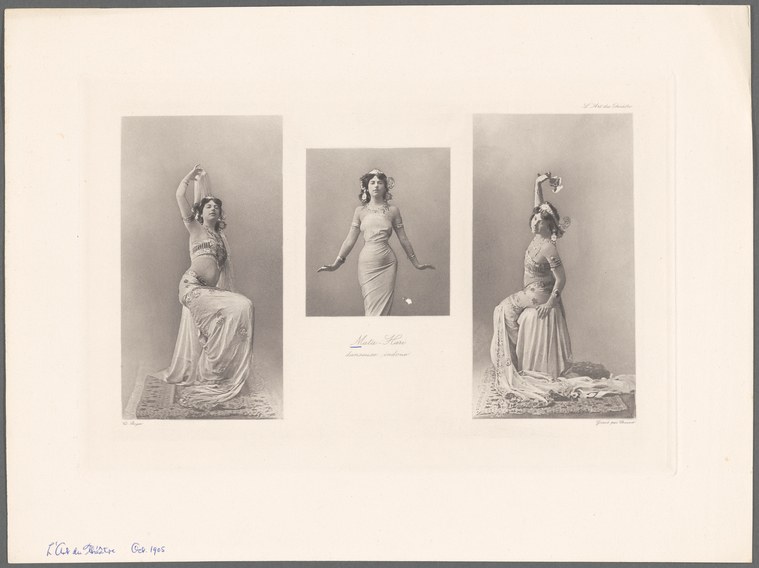
Mata Hari, danseuse indoue
Unknown artist
- Collection:
- Prints depicting dance
- Source:
- New York Public Library
- Rights:
- Public domain — free to use, share and adapt.
- Recorded as:
- Public Domain
The work documents a critical moment in European visual culture when dance—particularly exotic or non-Western dance—became a subject for high-art reproduction and circulation, while also revealing how thoroughly that documentation was filtered through European academic training and fantasy. For historians of orientalism and the representation of non-European dancers, it shows the gap between the title's claim and the image's actual content, exposing how European art institutions aestheticized and reframed non-Western movement.
What you are looking at
Three female figures in classical draped costumes arranged across a single sheet in a formal compositional study. The central figure stands frontally in a simple white gown with her arms extended at shoulder height in a pose of balanced repose. To her left, a seated figure in elaborate drapery reclines with one arm raised overhead in a languid, contemplative gesture; to her right, a kneeling figure mirrors this arrangement, her torso twisted and one arm lifted, the opposite knee grounded. All three wear classical-style hair arrangements and light, clinging fabrics rendered in fine grayscale tones. The background is plain and neutral, focusing attention entirely on the bodies and their spatial relationships. The prints are mounted on cream paper with printed cartouches identifying the subjects in small italic script below each figure. The work is executed as fine-art lithography or engraving, with careful attention to light, shadow, and the fall of fabric.
The dancing
The three poses progress from stillness to movement: the center figure is upright and frontal, with arms held at shoulder height in an open, receptive frame; the left figure is seated with torso reclined and weight supported by one arm, the other raised in an expressive overhead arc; the right figure is in a deep kneel with the torso twisted and arms lifted asymmetrically, suggesting rotational or balletic momentum. All three maintain the long, lifted spine and elongated limbs characteristic of neoclassical and romantic dance training. The poses do not appear to represent a single continuous movement or a group dance, but rather a study of individual expressive attitudes.
The dance depicted
The title indicates these are meant to represent an Indian temple dancer ("danseuse indoue"), though the poses, costumes, and framing are entirely European neoclassical conventions. The image reflects early-to-mid 19th-century European fascination with non-Western dance as filtered through academic art training and romantic orientalism. The figures embody poses more consistent with European theatrical ballet or classical pantomime than with Indian temple dance practice; they function as studies of the female body in states of grace and emotion rather than representations of an actual dance tradition. No specific Indian dance vocabulary—mudra, footwork, rhythmic pattern—is evident.
How it was made
The work is executed as a tonal print, likely lithography or engraving, with soft gradations of gray and careful use of shadow to model the female forms and suggest the volume and texture of classical drapery. The technique allows for wide circulation as a reproductive print and suggests an audience of educated patrons, art students, and collectors of classical imagery. The mounted presentation on cream paper with printed titles indicates this was a commercial art print, probably one in a series or portfolio of studies of dance, costume, or classical poses. The fine detail and tonal range suggest a mid-19th-century production, possibly French.
About this work
This is a three-part academic study of idealized female poses arranged as a single print sheet, presented under a title claiming Indian dance provenance but executed in the formal language of European neoclassical art. The work sits at the intersection of theater, fine art, and orientalism: it claims to document non-Western dance while actually depicting European romantic ideals of the female body in motion and repose. The artist—anonymous in the catalogue—presents these figures not as performers or practitioners of a named tradition, but as abstractions of grace, contemplation, and emotional expression. This was commercial fine-art publishing, circulating among audiences who valued classical poses and orientalist themes as equally legitimate subjects for artistic study.
How to look at it
Attend to the stillness within each pose: the artist has chosen moments of balance, extension, and emotional readiness rather than dynamic action. Each figure embodies a different quality—the center figure's open, frontal composure; the left figure's dreamy recline; the right figure's tense, twisted aspiration—as variations on a theme of idealized feminine grace. Note how the classical drapery is rendered to show both the weight and the flow of fabric, and how the plain background isolates each figure, treating them as discrete studies in the tradition of academic life drawing rather than as part of a narrative or social dance.
The period
This work dates to the era of romantic ballet in Europe (likely 1830s–1860s) when the idealized female body, classical drapery, and poses of emotional and spiritual elevation were central to both dance and academic visual art. European interest in non-Western dance was intense but largely mediated through fantasy and the orientalist imagination; actual performances by Indian or other Asian dancers in Europe were rare, so images like this served to define and circulate European ideas about exotic dance. The work coincides with the rise of commercial fine-art printing and the distribution of dance studies, pose studies, and costume documentation as standard subjects for educated collectors.
Where it lives
The work is held in the New York Public Library's Prints collection, which documents performing arts, visual culture, and commercial reproductive prints. The mounted presentation and style indicate this was a commercial fine-art print, likely from a publisher's portfolio or series of dance and costume studies.
Dance in this work
Questions about this work
Is this actually about Indian dance?
The title claims so, but the image contradicts it. The poses, costumes, and compositional style are entirely European neoclassical and romantic. This reflects the common 19th-century practice of labeling European academic studies of the female body with exotic titles to add prestige and interest. What you are seeing is how European artists imagined or fantasized about non-Western dance, not how it was actually performed.
What is the artist trying to show?
The three poses appear to be studies in feminine grace and emotion: contemplation, dreamy repose, and aspiration or yearning. They function like academic figure studies or dance pose studies that students or collectors would use to understand the principles of elegant body positioning and expressive gesture in the European classical tradition.
Why is this mounted as three separate prints on one sheet?
This was a common format for commercial art distribution in the 19th century. Portfolios of dance poses, costume studies, and classical figures were published as sheets with multiple related images, allowing buyers to collect, frame, and study the poses individually or as a set. It made production more economical and gave buyers flexibility in how they displayed and used the images.
More dance artwork





