49 works in this view — arrow keys or swipe to move between them.
Dance in Art
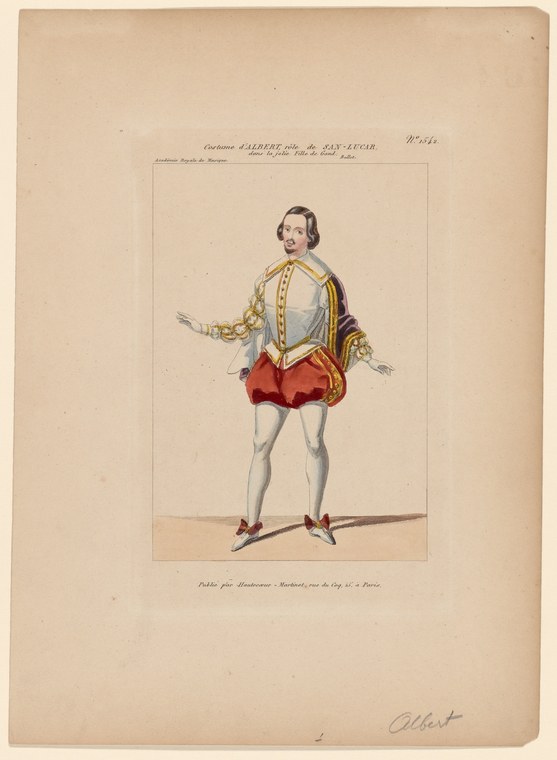
Costume d'Albert, role de San-Lucar, dans La jolie fille de Gand, ballet
Unknown artist
- Collection:
- Prints depicting dance
- Source:
- New York Public Library
- Rights:
- Public domain — free to use, share and adapt.
- Recorded as:
- Public Domain
This print documents the aesthetics of male Romantic ballet costume and the theatrical convention of presenting dancers in character roles through formal costume studies rather than action poses. The work shows how 19th-century ballet integrated historical and exotic narrative elements into costume design, using sumptuous fabrics and ornamental detail to signal character and status.
What you are looking at
A single male dancer stands in a three-quarter pose against a plain background, weight distributed evenly on both legs in a neutral stance. He wears an ornate court costume consisting of a pale blue-grey doublet embellished with gold braid and ribbon trim, a short red silk skirt or culottes, pale stockings, and dark heeled shoes with red heels. His right arm extends diagonally downward with fingers splayed in a graceful gesture; his left arm hangs naturally at his side. The costume is richly decorated with gold thread and ribbon work forming ornate patterns across the chest and sleeves. His bearing is upright and dignified, with his head turned slightly toward the viewer. The figure is rendered in colored ink or watercolor, with careful attention to the luxurious textures of the fabrics and the precision of his posture. The composition is frontal and formal, presenting the dancer as a model for the costume itself.
The dancing
A single dancer displayed in an almost heraldic frontal stance, feet apart and firmly planted, suggesting a moment of address or presentation rather than active movement. The extended right arm with open palm and splayed fingers creates a graceful but controlled gesture—neither a balletic extension nor a folk gesture, but rather a courtly address or demonstration pose. The body is elongated and elegant, with particular attention paid to the line of the leg and the articulation of the torso within the fitted doublet. The dancer's posture suggests training in courtly deportment rather than theatrical virtuosity.
The dance depicted
This is a costume study for a role in *La jolie fille de Gand* (The Pretty Girl of Ghent), a ballet from the Romantic era. The figure represents the character San-Lucar, apparently a male courtier or cavalier role. The name *San-Lucar* suggests Spanish or Moorish influence, and the rich, ornamental costume is consistent with exotic or historical character roles in Romantic ballet. The stance is characteristic of theatrical presentation—a demonstration pose for a dancer and choreographer rather than an action captured mid-movement. The gesture is courtly rather than balletic, placing this within the vocabulary of pantomime and character work that framed many Romantic ballet narratives.
How it was made
This is a hand-colored engraving or etching, evident from the fine linear work defining the costume's decorative elements and the careful crosshatching visible in shaded areas. The coloring—applied by hand in watercolor or ink wash—renders the blue-grey doublet, crimson skirt, and gold ornament with precision. This technique of hand-colored theatrical prints was standard in the 19th century for disseminating costume designs and serving as records of notable performances. Such prints were produced for dancers, choreographers, theatre patrons, and collectors, and the refined execution here suggests a work of some prestige. The print's formal presentation implies it was issued as a separate sheet or as part of a costume portfolio.
About this work
This is a costume study for a male character role in a Romantic-era ballet, rendered as a hand-colored theatrical print in the 19th-century tradition of documenting dancers in their roles. The figure of San-Lucar in *La jolie fille de Gand* appears in exotic or historical costume appropriate to the narrative interests of the Romantic ballet. The print documents both the aesthetic of Romantic male costume—ornamental, silken, and courtly—and the standard theatrical presentation method of the period, showing the dancer in a dignified pose suited to a character requiring pantomime and courtly decorum alongside dance.
As a theatrical document, this print preserves information about male costume in Romantic ballet, the conventions of character role, and the visual language used to present dancers to the public. It exemplifies the 19th-century practice of commissioning and circulating costume engravings to establish a dancer's repertoire and fame, functioning as a kind of theatrical calling card.
How to look at it
Observe the dancer's stillness and frontal presentation—this is not a moment of dynamic movement but a formal display. Notice how the costume overwhelms the body's actual lines: the gold ornament reads as a flattened pattern on the doublet; the skirt's volume suggests static display rather than the movement a skirt would show in actual dancing. The extended arm with open palm is a gesture of courtly address, related to pantomime conventions of the era. The refined rendering of fabric texture—the sheen suggested in the silk, the precise pattern of the braid—indicates that the print's primary purpose is to document and celebrate the costume as much as the performer.
The artist
The artist is not recorded in the catalogue. The style and quality of the engraving suggest a professional theatrical print-maker active in early-to-mid 19th-century France or Europe, likely working under commission from a ballet company or the dancer himself. The signature or attribution mark visible in the lower right corner has not been transcribed.
The period
This work dates to the era of Romantic ballet (roughly 1830–1860), when male dancers in Europe transitioned from purely virtuosic roles to more character-driven, narrative parts. Male costume in this period drew heavily on historical and exotic references—Moorish, Spanish, Eastern—often signaled through ornamental richness and silhouette. The print format itself reflects the commercial and promotional infrastructure of 19th-century theatrical dance: lithographs and engravings of famous dancers and roles were collected, sold, and circulated as evidence of a dancer's fame and the spectacle of contemporary ballet.
Where it lives
This print is held in the New York Public Library's collection of prints depicting dance. The work appears to be a standalone theatrical costume print, likely issued as a separate sheet by a Parisian or European publisher during the Romantic ballet era. Such prints were sold to theatre-goers, collected by dance enthusiasts, and maintained by ballet companies as records of notable roles.
Dance in this work
Questions about this work
What was La jolie fille de Gand?
La jolie fille de Gand was a Romantic-era ballet, now largely lost except through theatrical records and prints such as this. Like many ballets of the period, it featured exotic or historical narrative elements, with character roles defined partly through sumptuous costume. The title suggests a Flemish or Dutch setting or theme.
Why is the dancer posed like this rather than dancing?
Theatrical costume prints of the 19th century were commissioned to show the complete costume under ideal viewing conditions. A formal stance allowed the artist to display the full silhouette, the ornamental detail, and the proportions of the garment without the distortion that would occur in active movement. This served both promotional and documentary purposes.
What do the colors tell us?
The crimsoned-silk skirt and pale blue-grey doublet with gold ornament are consistent with historical or exotic male costume in Romantic ballet. The richness of the color and ornament signal the character's status and the ballet's investment in visual splendor. The color choices also followed conventions: red and gold suggested nobility, warmth, or exoticism.
More dance artwork





