49 works in this view — arrow keys or swipe to move between them.
Dance in Art
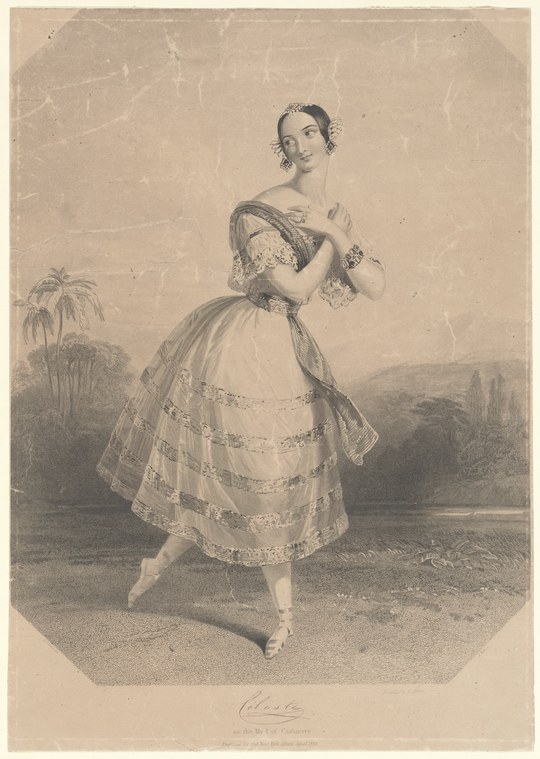
Celeste [facsimile signature] as the maid of Cashmere
Unknown artist
- Collection:
- Prints depicting dance
- Source:
- New York Public Library
- Rights:
- Public domain — free to use, share and adapt.
- Recorded as:
- Public Domain
This print documents a crucial moment in ballet history when the dancer became the central artistic subject and when exotic narrative and nationalism drove choreographic innovation. For dance historians, it provides concrete visual evidence of Romantic-era costume, technique, and the iconic poses that defined the period. For the general viewer, it illustrates the emotional and aesthetic ideals that shaped 19th-century dance.
What you are looking at
A young woman in Romantic-era theatrical costume stands alone in a stylised landscape, posed in a moment of reverie or character portrayal. She wears a fitted dark bodice with short puffed sleeves trimmed in lace, and a pale skirt of multiple layers gathered at the waist and decorated with horizontal bands of ornamental trim. A dark drapery sweeps across her torso and falls from one shoulder. The setting is minimal but evocative: a distant palm tree and Mediterranean or North African vegetation suggest an exotic locale—consistent with the title's reference to Kashmir, interpreted through 19th-century European theatrical convention. The background is soft and atmospheric, rendered in a muted tone that emphasises the figure. Her pose is balletic: she stands in what appears to be a turned-out position, one arm raised gracefully, the other held across her body, and her weight appears distributed to allow motion. Her head is tilted slightly, her gaze directed away, embodying the sentimental distance characteristic of Romantic ballet.
The dancing
The dancer is shown in a single, elegant contrapposto stance with turned-out legs and a composed upper body. Her raised arm is extended with a softly curved wrist; the other arm crosses her torso. Her weight appears centred but ready to move, the posture suggesting a woman suspended between stillness and motion—a moment of pantomime rather than active dancing. The positioning of her feet and the turned-out orientation of her legs indicate training in the ballet vocabulary of the period. Her expression is focused inward, a hallmark of Romantic ballet's emphasis on emotion and otherworldliness rather than technical display.
The dance depicted
This is a theatrical portrait of a Romantic ballet, most likely a scene of character or national dance from a ballet d'action popular in the 1830s–1840s. The title names the subject as 'the maid of Cashmere'—a stock exotic character type from Romantic ballet, appearing in works such as *La Bayadère* or in the numerous orientalist ballets of the era. The costume and pose are consistent with Romantic ballet's conventions: the soft skirt length, the fitted bodice, the sense of narrative character rather than pure classicism. The exotic setting reinforces the genre's fascination with distant lands and fantastical subjects. Without additional documentation, the specific ballet cannot be confirmed, but the aesthetic and the signature of 'Celeste' (likely the dancer herself) are consistent with mid-19th-century Parisian ballet culture.
How it was made
This is a lithographic print, a technique well suited to theatrical portraiture and mass circulation in the 19th century. The image shows the characteristic soft tonal gradations and fine linear detail possible in lithography, allowing both the subtlety of the figure's expression and the delicate rendering of fabric and landscape to coexist. The medium implies wide distribution to theatregoers, ballet enthusiasts, and collectors of theatrical memorabilia. The signature of the dancer is integral to the print, suggesting an autographed version or an intentional commemoration of a specific performer in a specific role—common practice in theatre souvenir prints of the period.
About this work
This is a lithographic print of a Romantic-era ballet dancer in character costume, likely from the 1830s–1840s. The subject—named in the inscription as Celeste performing the role of 'the maid of Cashmere'—exemplifies the Romantic ballet aesthetic: the emphasis on exotic narrative, the refined technique visible in posture and port de bras, the sentimental and otherworldly atmosphere conveyed through landscape and pose. The work belongs to a large tradition of theatrical portraiture that documented and celebrated the cult of the ballerina during the Romantic movement, offering both a record of a specific performer and a window into the visual and kinetic conventions of mid-19th-century ballet.
How to look at it
Observe the stillness and composure of the figure—this is not an action shot but a moment of characterisation and presence. The turned-out stance and raised arm are readable as ballet vocabulary to a trained eye, but the overall effect prioritises grace and emotion over technique. Note the exotic elements in the landscape and costume: these signal the narrative content and the Romantic era's fascination with the far away and fantastical. The signed name of the dancer anchors this as a specific performer in a specific role, not an abstract ideal—this is Celeste, on this night, in this character.
The period
The Romantic era in ballet (roughly 1830–1860) was defined by the rise of the ballerina as a quasi-divine figure, the supernatural and exotic as primary subjects, and the dominance of Paris as the world capital of dance. Ballets featuring oriental, medieval, or fantastical subjects proliferated: *La Sylphide* (1832), *Giselle* (1841), *La Péri* (1843), and numerous others. The 'maid of Cashmere' would have been a stock character, part of the period's orientalism and its appetite for stories of distant lands told through European aesthetic codes. Lithography was the primary medium for disseminating these images to a growing middle-class audience interested in ballet and theatre. The practice of printing and selling portraits of celebrated dancers in their signature roles was integral to the star system and the cult of personality that defined 19th-century performance culture.
Where it lives
This print is held in the Prints collection of the New York Public Library. It is a theatrical souvenir print, the type widely circulated in the 19th century to theatregoers and ballet enthusiasts. The facsimile signature of the performer is part of the original printing.
Dance in this work
Questions about this work
Who was Celeste and why would her portrait be printed?
Celeste was a celebrated dancer of the Romantic era, and it was standard practice in the 19th century to print and sell lithographic portraits of prominent performers in their famous roles. These served as souvenirs for theatre patrons, promotional material, and collectibles for dance enthusiasts. The inclusion of the dancer's signature enhanced the value and prestige of the print.
What is a 'maid of Cashmere' and why would a European ballet feature this character?
The 'maid of Cashmere' is a stock exotic character type from Romantic ballet, reflecting the era's fascination with distant lands and oriental subjects. European choreographers and audiences of the 1830s–1840s were captivated by tales of Asia, North Africa, and the Middle East, often rendered through European artistic conventions. Such characters offered narrative variety and a visual and kinetic contrast to classical European settings.
How can you tell this dancer was trained in ballet?
The turned-out position of the legs, the carriage of the upper body, the raised and curved arm, and the overall posture reveal rigorous classical training. The pose itself—a moment of balletic repose—would have been instantly recognisable to 19th-century ballet audiences as the vocabulary of the dance.
Why is this a lithograph rather than a painting or photograph?
Lithography was the ideal medium for theatrical portraiture in the 19th century because it allowed fine detail and tonal subtlety while remaining affordable and reproducible in quantities sufficient for commercial distribution. Photography, though invented in the 1830s, was not yet practical for such commercial theatre prints; oil paintings were too expensive and slow to produce.
More dance artwork





