49 works in this view — arrow keys or swipe to move between them.
Dance in Art
Luigia Porta
Unknown artist
- Collection:
- Prints depicting dance
- Source:
- New York Public Library
- Rights:
- Public domain — free to use, share and adapt.
- Recorded as:
- Public Domain
This work preserves a rare visual record of how a named professional dancer of the early 19th century was actually seen and represented—not as a classical abstraction but as a virtuoso body in motion. For dance historians and practitioners, the engraving documents the posture, carriage, and technique of the Romantic era with specificity that written sources alone cannot provide. The work is also significant as a print: it suggests the circulation and celebrity of professional dancers in the early 1800s and the role of mass-produced theatrical portraiture in shaping public taste.
What you are looking at
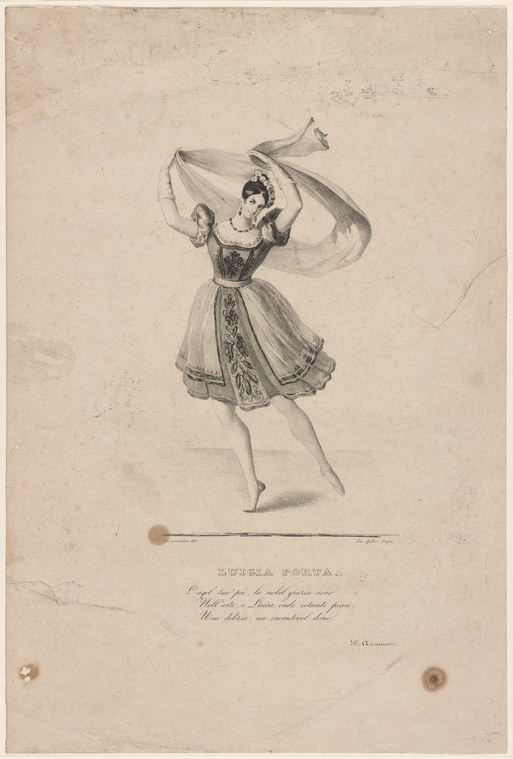
A single female dancer is pictured in a moment of energetic, buoyant movement. She wears a knee-length dress with a fitted bodice and a full skirt decorated with embroidered or patterned trim at the hem; the skirt appears caught mid-swirl, creating dramatic diagonal folds and movement lines. Her upper body is turned and lifted, arms raised and extended outward, palms open, suggesting a turn or a traveling step with upward extension. She wears her dark hair styled in the fashion of the early 19th century, gathered up with ringlets framing her face. Her legs are bare below the knee, and she stands en relevé on the balls of her feet—a technique that would become fundamental to Romantic ballet but here suggests a light, springing step. The pose conveys lift, rotation, and forward momentum, frozen at the apex of the movement. The background is a neutral wash, placing all focus on the figure and the dynamism of her pose. Below the image is an inscription in Italian: "LUIGIA PORTA" followed by what appears to be a verse or caption in Italian script.
The dancing
A single dancer occupies the entire composition. Her weight is lifted onto the balls of her feet, creating an impression of elevation and lightness. Her arms are raised to roughly shoulder height and extended outward, palms turned upward or outward—a gesture of openness and exultation. Her torso is rotated, creating a spiral or twist through the body; her head is held upright and turned slightly away from the viewer's direct line. The movement suggests a traveling turn or waltz step executed with Romantic-era virtuosity: the body rises through the vertical axis while the legs execute a turning or traveling step beneath. The technique visible here—the relevé position, the arm carriage, the tilt of the head—belongs to the early 19th-century ballroom and theatrical dance vernacular.
The dance depicted
This is almost certainly a Romantic-era theatrical dance, most likely a waltz or a solo variation from a theatrical work of the 1820s–1840s. The inscription identifies the subject as Luigia Porta, a professional dancer of that period. The pose—lifted, turning, with raised arms and an upright carriage—is consistent with the Romantic ballet idiom that emerged in the 1830s, though the fashion of the dress and the ballroom context suggest this may represent a theatrical or salon dance of slightly earlier date. The image captures the aesthetic of the Romantic era: an emphasis on weightlessness, upward lift, and a kind of ethereal yet controlled virtuosity. The dancer's bare legs below the knee were characteristic of theatrical dress in this period but would have been daring in strict social dance contexts.
How it was made
This is a black-and-white engraving or lithograph on paper, produced from a drawn or etched original. The technique relies on line work rather than tonal modeling, with careful hatching used to suggest the volume of the dress and the form of the body. The crisp outlines and the absence of color indicate a print designed for wide circulation—likely a theatrical portrait or a dance instruction manual illustration. The inscription below the figure and the formal composition suggest this was a published work, probably issued singly or as part of a series of dancer portraits. Such prints were common in 19th-century Europe and served as both promotional materials and documents of performing style.
About this work
This is a black-and-white engraved portrait of the dancer Luigia Porta, shown mid-movement in a pose characteristic of Romantic-era theatrical or ballroom dance. The work documents both the technique and the aesthetic of early 19th-century dance: the dancer is captured at the apex of a turning step, lifted onto the balls of her feet with arms raised and extended, embodying the lightness and upward thrust that defined the Romantic period. The print is a historical document of how a professional dancer of this era was seen and represented—as a figure of grace, elevation, and controlled virtuosity. It belongs to the tradition of theatrical portraiture that used the frozen moment to capture and celebrate a performer's distinctive style.
How to look at it
Attend first to the moment captured: the dancer is frozen at the instant of lift and rotation, when her body is at its most extended and weightless. Notice how the artist has conveyed upward momentum through the raised arms, the relevé position, and the slight backward tilt of the head and torso. The diagonal lines of the skirt—caught mid-swirl—reinforce the sense of rotation and forward motion. Look at the footwork: the bare feet are positioned to suggest a traveling turn or waltz step, a technique that required strength and control to execute while maintaining the appearance of effortlessness. The formal inscription below anchors the image as both a portrait and a historical document of a particular performer and her moment.
The period
This engraving dates from the era of Romantic ballet and the rise of the prima ballerina as a public figure. The 1820s–1840s saw the emergence of dancers like Marie Taglioni and Fanny Elssler as international celebrities, and theatrical dance—both ballet and ballroom—enjoyed unprecedented prestige and popularity across Europe. Prints and engravings of celebrated dancers were widely produced and sold; they functioned as promotional material, souvenirs, and instruction aids. The aesthetic represented here—the lifted posture, the turned-out position of the legs, the upward extension of the arms—reflects the technical vocabulary that was consolidating into what we now call classical ballet. At the same time, the ballroom waltz was at the height of its social fashion, and the boundary between theatrical and social dance was porous.
Where it lives
The work is held in the New York Public Library's Prints collection, catalogued as depicting dance. It is a single-leaf engraving, likely published as a theatrical portrait or part of a series of dancer portraits in the early 19th century.
Dance in this work
Questions about this work
Who was Luigia Porta?
Luigia Porta was a professional dancer active in the early 19th century, likely in Italy or the broader European context. Beyond this engraved portrait and the inscription bearing her name, little is documented here about her life or career. She appears to have been celebrated enough to merit a published print, suggesting she was a recognized performer of the era.
What dance is she performing?
The pose—lifted, turning, with raised arms—is consistent with a Romantic-era waltz, a theatrical variation, or a solo from a ballet of the 1820s–1840s. The exact choreography cannot be determined from the image alone, but the technique and carriage place it securely in the early 19th-century ballroom and theatrical dance tradition.
Why are her legs bare?
Bare legs below the knee were standard theatrical costume in this period, allowing the audience to see the footwork and the technique of the legs. In strict social dance contexts, such exposure would have been considered improper, but for professional performers on stage or in published portraits, it was the norm and served an educational and aesthetic function.
What is the text below the image?
The inscription reads "LUIGIA PORTA" and is followed by what appears to be a verse or caption in Italian, likely a poetic or laudatory text celebrating the dancer or the moment depicted. The text is difficult to read in reproduction but was a common feature of theatrical prints of this era.
More dance artwork





