49 works in this view — arrow keys or swipe to move between them.
Dance in Art
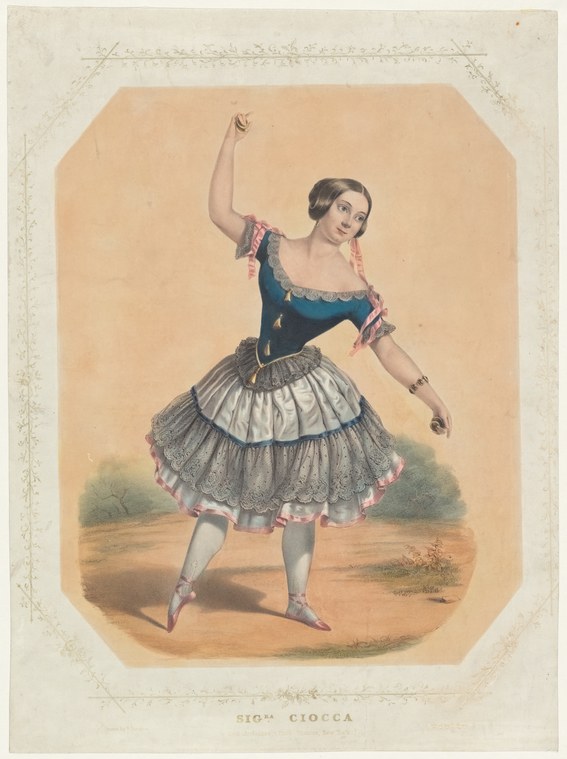
Sig'ra Ciocca nell' Andalusa (Park Theatre, New York)
Unknown artist
- Collection:
- Prints depicting dance
- Source:
- New York Public Library
- Rights:
- Public domain — free to use, share and adapt.
- Recorded as:
- Public Domain
This print documents a professional ballet dancer in America during the golden age of romantic ballet, preserving both the movement vocabulary and the costume standards of the 1840s–1860s. It is also evidence of how theatrical prints functioned as promotional materials and fan objects, making the bodies and names of performers widely known and accessible. For historians of American theater and dance, it offers concrete visual testimony to the presence and popularity of ballet in the United States before the major European tours of the late nineteenth century.
What you are looking at
A woman in theatrical costume stands alone against a warm beige background, posed in a balletic attitude. She wears a dark blue bodice with a low, square neckline trimmed in lace, and short puffed sleeves with pink ribbons; the bodice is tightly corseted. Below it hangs a voluminous skirt of layered, gathered white or pale silk gauze, gathered at the waist and trimmed with pink ribbon at the hem. She wears pink tights and pale pink pointe shoes. Her dark hair is parted in the center and styled close to her head in a fashion typical of the 1840s–1850s. Her right arm is raised to about shoulder height with the elbow slightly bent, palm facing inward in a graceful port de bras; her left arm hangs at her side. Her weight appears to rest on her left leg, with her right leg extended slightly forward and the body angled to engage the viewer. The printed border of the work is a simple, delicate rectangular frame with a faint decorative pattern at the corners. The figure is set within an octagonal mat or vignette that isolates her against the plain background, lending the image the character of a theatrical portrait or carte de visite.
The dancing
A single female dancer shown in a classical ballet pose. Her frame is open and upright, with the characteristic turnout of academic ballet visible in her stance. The raised arm demonstrates the soft, curved port de bras of romantic ballet rather than the angular positioning of later decades. Her weight distribution and the placement of her feet suggest she is either at the moment of release from a petit allègement or poised to begin a traveling movement. The pointe shoes and the soft articulation of the limbs confirm training in the classical vocabulary of the mid-nineteenth century.
The dance depicted
This is a representation of a professional ballet dancer, almost certainly documenting a performer in a romantic-era ballet role, likely from the mid-nineteenth century. The costume—the layered tulle skirt, the close-fitting bodice, and the ribboned pointe shoes—identifies her as a danseur of the period when Giselle, La Sylphide, and other works of that school were in active repertory. The title references a specific performance and theatre (Park Theatre, New York), suggesting this is a portrait of a named dancer, Sigra Ciocca, in a role called 'Andalusa' or 'L'Andalusa'—likely a character or divertissement piece rather than a full-length narrative work. The pose itself is not mid-action but rather a composed, flattering presentation of the dancer's trained body and costume.
How it was made
This is a hand-colored lithograph, as evidenced by the soft tonal transitions, the delicate chromatic layering particularly visible in the flesh tones and the fabric, and the characteristic lightness of line typical of the medium. The colored printing—possibly achieved through stone separation or tinted after black printing—allowed broad circulation of theatrical portraits, making such images affordable and popular among theater-goers and ballet enthusiasts. The technique permitted the reproduction of theatrical costume detail while maintaining a portrait-like intimacy; this would have been the standard medium for documenting performers and circulating their image to the public in the 1840s–1860s.
About this work
This work is a theatrical portrait of a professional ballet dancer, Sigra Ciocca, performing at the Park Theatre in New York in what appears to be a mid-nineteenth-century production. The image captures both the physical and social reality of ballet at that moment: the romantic vocabulary of the body, the costume conventions of the era, and the commercial apparatus of the theater that made such portraits commercially valuable. It belongs in the gallery as evidence of how ballet was performed and circulated in America during the romantic period, and how individual dancers—particularly female performers—were presented to the public through portraiture and print. The image documents a specific moment in the American reception of European ballet culture.
How to look at it
Attend to the moment the artist chose: not mid-movement, but a composed pause that displays the dancer's trained frame and costumed body to best effect. This is a portrait convention applied to the moving body—the dancer is 'at rest' but still in ballet position, demonstrating both grace and technical preparation. Notice the costume detail: the skirt is arranged to show the layered construction and volume that characterized romantic tutus, and the pointe shoes are clearly visible, signaling modernity and professional status. The artist has captured not a frozen moment from choreography but rather a studio or stage portrait that would have circulated as a souvenir or promotional image.
The period
This work dates to the era of romantic ballet, when the aesthetic emphasized ethereal femininity, pointe work, and ethereal, supernatural themes—the age of Taglioni, Elsler, and Cerrito. By the 1840s–1860s, ballet had become a major attraction in American theaters, particularly in New York, though performances often featured abbreviated versions or divertissements rather than full European productions. The Park Theatre was a significant venue in New York during this period. Lithographic portraiture of performers was an established commercial practice, allowing theaters and dancers themselves to market their work to the public. This image sits within a genre of theatrical portraiture that was as much about publicity and celebrity as about documentary record.
Where it lives
The work is held in the New York Public Library's collection of prints depicting dance. The title indicates a specific performance and theater, suggesting it was issued as a contemporary theatrical print, likely for sale to audiences or kept by the performer as a record of a role.
Dance in this work
Questions about this work
Who was Sigra Ciocca?
The title identifies her as a performer at the Park Theatre in New York, but beyond the information visible in this print—her training in classical ballet and her performance of a role called 'Andalusa'—little is documented here. Theater records and newspaper archives may contain further information about her career, performances, and background.
What is an 'Andalusa'?
This likely refers to a character piece or divertissement with Spanish or exotic themes, popular in the romantic era. It may be an original role created for the performer or a standard showpiece. Without access to theater programs from the Park Theatre, the specific choreography and musical accompaniment cannot be identified.
How do we know this is a lithograph?
The technique is evident from the soft tonal gradations, the hand-coloring quality visible in the fabric and flesh tones, and the characteristic delicate linework of the lithographic process. The color separation and the way the background is rendered are consistent with hand-colored lithography of the mid-nineteenth century.
What does the costume tell us about the dance?
The pointe shoes, the layered tulle skirt, the closely fitted bodice, and the overall silhouette are all characteristic of romantic ballet in the 1840s–1860s. The style and construction of the costume indicate professional, trained ballet rather than popular or vernacular dance, and the specific aesthetic points to the European romantic tradition that dominated ballet at that time.
More dance artwork





