49 works in this view — arrow keys or swipe to move between them.
Dance in Art
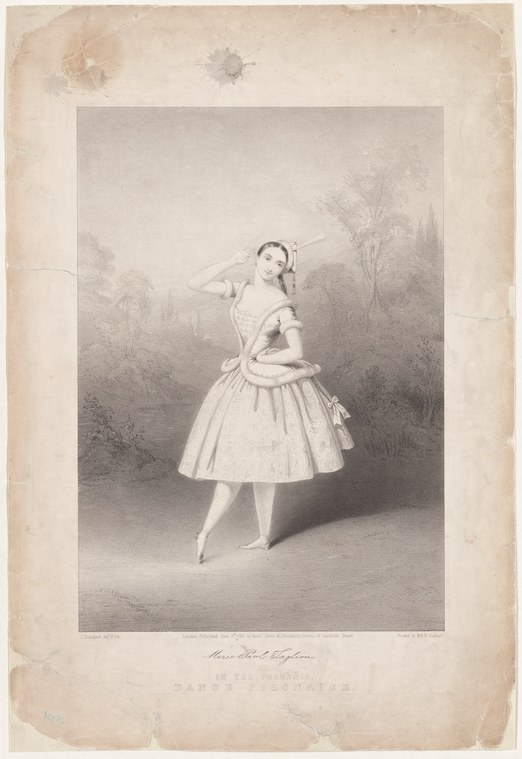
Marie Paul Taglioni [facsimile signature] in the Posnania, danse polonaise
Unknown artist
- Collection:
- Prints depicting dance
- Source:
- New York Public Library
- Rights:
- Public domain — free to use, share and adapt.
- Recorded as:
- Public Domain
Marie Taglioni is inseparable from the history of Romantic ballet and the development of pointe technique; this print documents her in a lesser-known role and testifies to the breadth of the 19th-century ballet repertoire beyond the famous romantic narratives. For scholars of theatrical fashion and dance iconography, this image is a primary source for how the mid-nineteenth-century ballet body was costumed and presented to the public.
What you are looking at
A young woman stands alone against a softly shaded background in a pose of classical grace. She wears a white Romantic-era ballet costume: a fitted bodice with off-the-shoulder sleeves and a voluminous knee-length skirt with multiple tiers. Her right arm is raised to her head in a gesture of contemplation or adjustment; her left arm hangs gracefully at her side. She stands in a balletic position with her weight forward and her body displaying the elongated line characteristic of mid-nineteenth-century ballet. The background is atmospheric and indistinct, rendered in soft grays and browns with vague suggestions of foliage or landscape, focusing all attention on the solitary figure. The composition is a formal portrait-type image, likely a theatrical publicity print or commemorative engraving.
The dancing
The dancer is positioned in a modified contrapposto stance, with her weight slightly favoring her left leg and her body turned at a subtle angle to the viewer. Her raised right hand touches or frames her head—a gesture suggesting a moment between movements or an introspective pose. The carriage of her shoulders and the alignment of her spine follow academic ballet posture of the period. Her feet are not clearly defined in the soft rendering, making exact foot position difficult to determine, but the overall line of the body reads as a trained classical dancer at ease or momentarily paused.
The dance depicted
This print commemorates Marie Taglioni in *La Posnania* (or *Posnanie*), a Polish dance that became a popular divertissement in the Romantic ballet era. The inscription attributes the image to Marie Paul Taglioni, the most celebrated ballerina of the 1830s–1840s. Taglioni specialized in ethereal, lightweight performances and is historically associated with the invention or refinement of the *en pointe* technique. The Polish national dance was a vehicle for character variation within the ballet repertoire, allowing her to display different facets of her artistry beyond the sylph roles for which she was most famous. This image appears to capture her in the role rather than mid-movement—a portrait pose rather than a kinetic moment.
How it was made
This is an engraving or lithograph, almost certainly a reproductive print made for theatrical circulation in the 1830s or 1840s. The soft tonal modeling, the subtle gradations of gray, and the lack of bold linear hatching suggest lithography rather than line engraving, a technology that allowed rapid, inexpensive production of publicity images for performers. The fine quality of the work and its monochromatic palette indicate it was aimed at a cultured audience of theatregoers and collectors of theatrical prints—a standard form of fan merchandise and documentation of celebrated roles in the Romantic era.
About this work
This is a commemorative theatrical print of Marie Taglioni, the era's dominant ballerina, in the role of a Polish national dance called *La Posnania*. The work documents both a celebrated performer and a moment when European ballet was absorbing national and character dances as formal repertoire. The print's gentle, romanticized rendering of the isolated figure reflects the aesthetic priorities of the 1830s–1840s, when ballet imagery celebrated the ethereal, weightless line of the Romantic ballerina.
The image is historically significant as evidence of how canonical ballet stars were merchandised and memorialized through prints, and as a record of the specific roles and variations that defined a dancer's fame. Taglioni's repertoire extended well beyond the celebrated sylph roles; character dances like this Polish number allowed her to display technical range and dramatic presence.
How to look at it
The artist chose a pose of apparent stillness or pause rather than a dynamic moment of action—a convention of theatrical portraiture that allowed the viewer to focus on the dancer's line, costume, and bearing rather than the technique of a step. The soft, atmospheric background with its indistinct landscape suggests the ethereal, otherworldly quality that defined Taglioni's stage persona. The hand raised to the head is characteristic of Romantic ballet and can be found in many portraits and lithographs of the period—a gesture that conveys thoughtfulness, grace, and an inward focus rather than directness toward the audience.
The artist
The artist is not recorded in the catalogue. Reproductive prints of this type were commonly produced by lithography workshops in Paris and London during the 1830s–1840s, often by unsigned journeymen or collaborative studios. Attribution would require comparison with documented series of theatrical prints or examination of inscriptions or marks on the original; many such prints were issued by theatrical publishers or the dancers' agents without attribution to an individual artist.
The period
The 1830s and 1840s were the height of Romantic ballet in Europe. Marie Taglioni's debut in 1822 and her triumph in *La Sylphide* (1832) established her as the preeminent ballerina of the era and the model for how a classical dancer's body should move and be costumed. During this period, ballet absorbed folk and national character dances—Polish, Spanish, Italian—as formal variations within the narrative ballet structure, allowing stars like Taglioni to demonstrate versatility and cultural knowledge. Lithographic printing technology, perfected in the previous decade, made theatrical prints affordable and widely circulated, creating a mass market for images of celebrated performers. This print belongs to the same ecosystem as playbills, costume sketches, and souvenir lithographs that documented and promoted Romantic-era theatre.
Where it lives
This lithograph or engraving is held in the *Prints depicting dance* collection at the New York Public Library, a comprehensive archive of theatrical and dance imagery from the eighteenth century onward. It is a representative example of the thousands of performance prints produced during the Romantic era for distribution to theatre patrons, collectors, and the general public.
Dance in this work
Questions about this work
What is the Posnania?
A Polish national dance, also called Posnanie or Poznańska, that became a popular character variation in Romantic-era ballet repertoire. European ballet companies of the 1830s–1840s incorporated national and folk dances from across Europe as divertissements within longer narrative ballets, allowing star dancers to demonstrate different facets of their artistry and to appeal to audiences' fascination with exotic cultures.
Was Marie Taglioni only famous for Romantic roles like the Sylph?
No. While Taglioni is most remembered for ethereal, weightless roles in ballets like *La Sylphide*, she was a versatile performer who danced character variations, national dances, and dramatic roles throughout her career. This print is evidence of the breadth of the nineteenth-century prima ballerina's repertoire.
Why are there stars at the top of the print?
The stars are decorative elements common in theatrical prints of the era, often used to frame or ornament the image and to reinforce the glamorous, celestial associations of the Romantic ballet aesthetic.
Is this a photograph or a drawing?
This is a lithographic print—a reproductive process that allowed artists to draw or paint an image on stone, which was then printed and distributed. It is not a photograph (photography was not in common use for theatrical portraiture in the 1830s) and not a unique drawing, but a mass-produced print intended for circulation.
More dance artwork





