49 works in this view — arrow keys or swipe to move between them.
Dance in Art
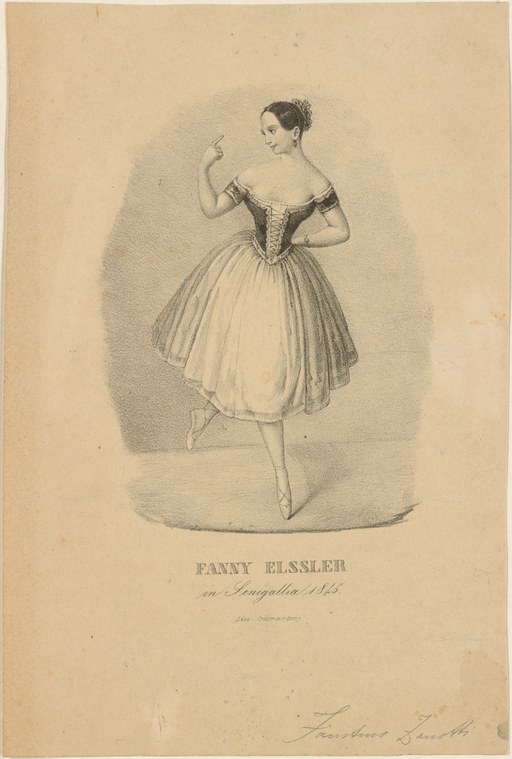
Fanny Elssler in Senigallia, 1845
Unknown artist
- Collection:
- Prints depicting dance
- Source:
- New York Public Library
- Rights:
- Public domain — free to use, share and adapt.
- Recorded as:
- Public Domain
Elssler was one of the two defining ballerinas of the Romantic era and a major star across Europe and the Americas; this print is evidence of how theatrical celebrity operated before photography. The image also reveals what Romantic ballet actually looked like to its contemporaries—not the pointe work and narrative of later classical ballet, but a language of gentle placement, soft arms, and the illusion of effortless weightlessness.
What you are looking at
A young woman in performance dress stands alone against a plain background, caught in a moment of elegant repose. She wears the canonical Romantic ballet costume: a fitted, boned bodice in black or dark silk with off-shoulder sleeves, and a full skirt of pale tulle that falls to mid-calf, revealing her legs and pale ballet slippers. Her posture is upright but relaxed, with her weight settled on her left leg while her right leg extends lightly forward in a soft pointe position. Her right arm is raised in a graceful port de bras, hand open at shoulder height, while her left arm hangs naturally at her side. Her hair is pulled back smoothly, and her gaze is directed upward and to the side—a characteristic Romantic-era convention suggesting an otherworldly reverie or aspiration. The figure is rendered with delicate shading in what appears to be a lithographic or engraved print, creating volume through subtle gradation of tone rather than hard outline.
The dancing
The dancer's frame is elongated and held with the squared shoulders and lifted posture essential to Romantic ballet technique. Her weight distribution and the placement of her right leg suggests a vocabulary of petit allegro or port de bras rather than a moment of dynamic travel across the stage—this is a study of stillness and line. The single figure fills the composition; there are no other dancers or props. Her arm position follows the classical five positions of the épaulement, with the raised arm soft rather than rigid, and the overall silhouette emphasises the vertical line from ankle through spine to the crown of the head that defined the ideal Romantic ballerina.
The dance depicted
This is a portrait of Romantic ballet in its canonical form, almost certainly representing a moment from a well-known solo or variation rather than a narrative scene. The costume, posture, and artistic convention all date to the 1830s–1850s peak of the Romantic movement in European ballet. Fanny Elssler was one of the two supreme ballerinas of this era (the other being Marie Taglioni), and this print celebrates her as the embodiment of the style. The subtitle mentions Senigallia (Senigallia, Italy), suggesting this may commemorate a specific performance or tour, though Romantic ballet at this period was remarkably consistent across Europe. The pose itself—neither fully landed nor fully aloft—shows understanding of the Romantic aesthetic: weightlessness achieved not through explosive jumps but through controlled placement and the visual illusion of effortlessness.
How it was made
This is a lithograph or possibly a tinted lithograph with hand-colouring, a medium perfectly suited to the circulation of theatrical celebrity in the mid-nineteenth century. Lithography allowed rapid, relatively affordable production of theatrical prints for sale to audiences and collectors, making star dancers into reproducible commodities. The technique enabled the artist to render flesh and delicate fabrics with soft gradation and subtle shadow—qualities essential to suggesting the ethereal ideal of Romantic ballet. The monochromatic or lightly tinted palette itself was conventional; colour prints of performers existed but were more expensive and less common for such purposes.
About this work
This is a print portrait of the celebrated Austro-Hungarian ballerina Fanny Elssler, one of the two great stars of Romantic ballet, shown in the canonical costume and pose of her era. It documents not only a famous performer but the aesthetic ideal of Romantic ballet itself: the ballerina as ethereal, weightless, and emotionally aspirant, achieved through a specific technical vocabulary of placement and port de bras. The print was likely produced for sale to theatregoers and collectors during or shortly after Elssler's Italian tour in 1845, making it a document of how ballet fame was disseminated and consumed in the nineteenth century. Elssler was known for a more earthy, sensual style of Romanticism than her rival Taglioni—qualities the posed stillness here does not fully convey—but this image records how she was marketed to the public.
How to look at it
This is a posed portrait, not a action shot, and should be read as such. The artist has chosen a moment of stillness that nonetheless conveys the essence of the Romantic style through costume and placement. Notice the delicate balance of the pose—weight settled, but the free leg positioned to suggest potential movement. The raised arm and upward gaze are not accidental: they follow a convention (the aspiring, ethereal ballerina) that was instantly legible to audiences of the time. The print itself, with its soft tonal modelling and lack of hard outline, mimics the visual effect Romantic ballet aimed for on stage—the illusion of lightness and evanescence.
The artist
The artist is not recorded in the catalogue, which is not unusual for theatrical prints of this period—many were produced by commercial printmakers for theatrical or publishing companies and attributed only to the publisher. The style is consistent with mid-nineteenth-century European lithographic practice; the attention to fabric and the delicate handling of light suggest a specialist in theatrical portraiture.
The period
Fanny Elssler danced at the absolute peak of the Romantic ballet movement, in the decades following Marie Taglioni's triumphs in La Sylphide (1832). Romantic ballet displaced earlier Neoclassical forms with a new aesthetic: ballerinas in gauzy skirts, pointe work, otherworldly or exotic subjects, and a vocabulary of port de bras that emphasised the arm as an extension of emotion. Lithographic and engraved prints of famous dancers were a standard form of theatrical merchandise and publicity in this era, circulating star images across Europe and the Atlantic. Elssler was notably popular in the United States and toured extensively; this Senigallia print may reflect her international fame.
Where it lives
This work is held in the New York Public Library's prints collection, part of their holdings of dance imagery. It is a commercial theatrical print, produced for public sale or distribution in connection with Elssler's performances.
Dance in this work
Questions about this work
Who was Fanny Elssler?
Elssler (1810–1884) was an Austro-Hungarian ballerina and one of the two supreme stars of Romantic ballet, alongside Marie Taglioni. She was known for a more dramatic and sensual style than Taglioni, and toured extensively throughout Europe and the Americas, becoming a major celebrity. She retired from ballet in the 1850s and spent her later life in Vienna.
What does the subtitle 'in Senigallia 1845' mean?
Senigallia is a port city on the Adriatic coast of Italy. The subtitle likely indicates that this print commemorates a performance Elssler gave there in 1845, or that it was produced during her Italian tour that year. Such location-and-date markings were common on theatrical prints to connect the image to a specific, celebrated event.
Why is she on pointe?
Pointe work (dancing on the tips of the toes, supported by reinforced shoes) became standard in Romantic ballet in the 1830s as a visual marker of weightlessness and ethereality. It was not an end in itself but a means of achieving the aesthetic ideal of the period. Elssler and Taglioni both used pointe, though it was still relatively new and remarkable to audiences.
Is this a photograph?
No. This is a lithograph or engraving, made by hand from stone or metal plate. Photography existed in 1845 but was not yet used widely for theatrical portraiture. Prints like this were the primary visual record of how famous dancers looked and performed.
More dance artwork





