49 works in this view — arrow keys or swipe to move between them.
Dance in Art
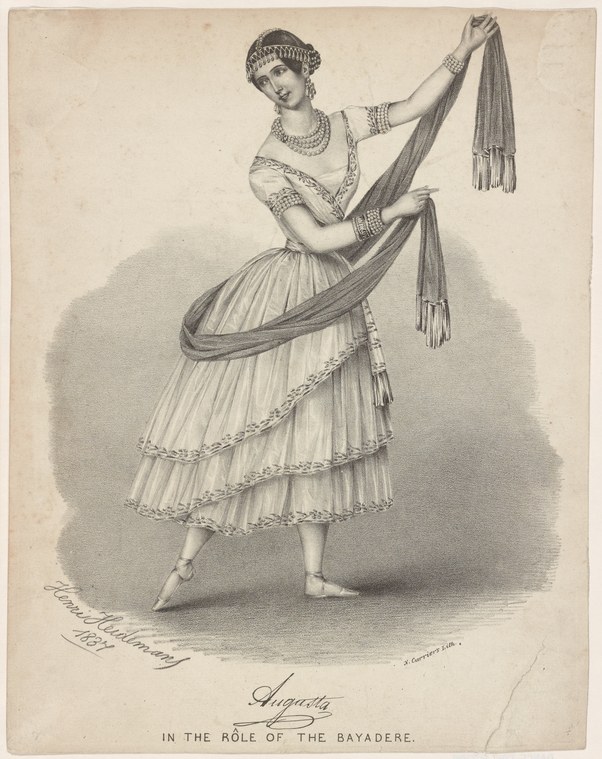
Augusta [facsimile signature] in the rôle of the bayadère
Unknown artist
- Collection:
- Prints depicting dance
- Source:
- New York Public Library
- Rights:
- Public domain — free to use, share and adapt.
- Recorded as:
- Public Domain
This print documents one of the most persistent and problematic fantasies in ballet history: the 'bayadère,' an Orientalist construction that shaped how European dancers performed and how audiences understood non-European dance for over a century. It shows how a named performer—Augusta—was marketed and commodified through her role, and it reveals the visual and bodily ideals that defined Romantic ballet at its height.
What you are looking at
A woman in Romantic-era theatrical costume stands alone against a plain background, her body twisted in a dramatic contrapposto pose. She wears a fitted bodice with off-shoulder sleeves trimmed in ornate beading or embroidery, and a voluminous skirt composed of multiple tiers of pleated or fluted fabric, each layer edged with decorative fringe or lace. A diaphanous shawl or scarf drapes across her raised arms—one arm lifted high, the other lower—the fabric caught mid-flutter. Her head is crowned with an ornate headpiece (likely representing a jeweled or Eastern-styled tiara), and multiple strands of beads or pearls encircle her neck and wrists. Her feet are bare or in soft slippers, one leg extended in a graceful line. The title identifies her as Augusta in the role of the bayadère, invoking the popular 19th-century Romantic ballet fantasy of the Indian temple dancer.
The dancing
A single female dancer, her weight shifted onto one supporting leg with the other extended in a relaxed line. Her torso rotates away from her hips—a serpentine S-curve typical of Romantic ballet. Her arms are raised and separated, the upper arm extended but the forearms soft and the hands open and expressive rather than rigidly held. The pose suggests a moment of stillness between movements, emphasizing the verticality and elongation of the body rather than an athletic leap or turn. There is no partner, no closed hold, no indication of the ballroom frame or folk formation that would suggest other dance genres.
The dance depicted
This is Romantic ballet, most likely the famous role of Nikiya or a similar bayadère character from works such as La Bayadère (first staged 1877, though bayadère ballets existed earlier). The bayadère was a stock character in 19th-century European ballet fantasy—an imagined Indian temple dancer rendered through the optics of Orientalism and clothed in a hybrid costume that bore little historical resemblance to actual Indian dance. The pose and costume are consistent with the vocabulary of Romantic ballet: the soft, turned-out frame; the emphasis on ethereal verticality and gentle arms; the off-shoulder neckline and tiered skirt derived from the ballet tutu. Augusta was likely a professional ballet dancer performing in a major opera house or ballet company; the formal nature of the print suggests she was a known performer whose image was distributed to the theatre-going public.
How it was made
This is an engraving or steel-plate engraving, a common reproductive medium for theatrical portraiture in the 19th century. The technique allowed for fine detail in the beading and drapery and was economical to distribute to audiences. The signature visible on the lower left and the notation of a publisher's mark indicate this was a commercial theatrical print, likely sold in the lobby or by subscription. The monochrome line-work and subtle stippling for shading are characteristic of mid-to-late 19th-century dance portraiture.
About this work
This is a theatrical celebrity portrait of a named ballerina, Augusta, in the role of the bayadère—the Orientalist fantasy figure that became a staple of Romantic ballet. The image captures the aesthetic vocabulary of mid-19th-century classical ballet: the elongated body, the soft arm port de bras, the tiered tutu, the turned-out legs, and the ideal of the dancer as a weightless, ethereal figure. It is not a record of how an actual Indian dancer moved or dressed, but rather a window into what European audiences imagined, desired, and paid to see. The work is a theatrical print, meant for circulation among theatregoers, and stands as evidence of the cult of the ballerina and the commercial machinery of 19th-century opera-house ballet.
How to look at it
Look closely at the pose: the dancer's body is organized around elongation and the soft rotation of the torso away from the hips, a distinctly classical ballet ideal rather than a naturalistic or folk stance. The bare feet and soft slippers, the turned-out legs, and the port de bras—the gentle, expressive carriage of the arms—all belong to ballet vocabulary. Notice how the costume is a fantasy: the tiara and necklaces, the beaded bodice, and the pleated skirt are designed to suggest 'India' to a European eye, but the silhouette and the way the body is positioned within it are pure Romantic ballet. The artist has frozen a moment of relative stillness, emphasizing the figure's grace and the theatre of display.
The artist
The artist is not recorded in the catalogue. The signature on the print itself is illegible in reproduction. This was likely produced by a commercial theatrical print-maker or engraver working for a major opera house or print publisher, a common practice in the 19th century. Many such prints were issued anonymously or with studio attributions rather than individual artist names.
The period
The bayadère became fashionable in European ballet after the 1830s, driven by colonial fascination with India and broader Orientalism in art, music, and theatre. Jules Perrot's Le Jardin Animé (1854) and later Marius Petipa's La Bayadère (1877) were landmark works, but the character appeared in many ballets and was a vehicle for star dancers throughout the mid-to-late 19th century. Romantic ballet was at its height, emphasizing weightlessness, melancholy, and supernatural or exotic subjects. The elaborate costume and jewellery visible in this print reflect the expense and spectacle of mid-century ballet production. Theatrical portraiture of this kind was a major form of visual culture, circulating via prints, cartes de visite, and lithographs.
Where it lives
This engraving is held in the New York Public Library's Prints collection, which documents performing arts history through theatrical portraiture, playbills, and commercial illustration. Such prints were typically issued by theatres, publishers, or entrepreneurial printers working with performers' agents, and were sold or distributed to audiences as souvenirs and promotional objects.
Dance in this work
Questions about this work
What is a bayadère?
A bayadère is a European Romantic-era fantasy of an Indian temple dancer, appearing frequently in 19th-century ballet. The character was shaped entirely by Orientalist imagination rather than ethnographic knowledge and became a vehicle for ballerinas to perform exoticism and supernatural femininity. The most famous bayadère roles are Nikiya in La Bayadère and similar characters in works by Perrot and other choreographers.
How do I know this is ballet and not another kind of dance?
The body position, the bare feet and soft shoe, the turned-out legs, the elongated verticality, and the soft port de bras (arm carriage) are all hallmarks of 19th-century classical ballet. There is no folk costume, no ballroom frame, no African or Asian dance vocabulary. The costume—while meant to evoke India—is worn on a body trained in European ballet technique.
Who was Augusta?
The catalogue and print do not provide biographical information. Augusta was a professional ballet dancer who performed the bayadère role, likely at a major European opera house, but without additional sources it is not possible to establish which Augusta this was or the dates of her career. The print itself is her fame—she was known enough to be marketed by name to theatre audiences.
When was this made?
The catalogue record does not provide a date. Based on the style of engraving, the costume details, and the conventions of theatrical printing, this was most likely made in the mid-to-late 19th century, roughly 1850–1890, when bayadère ballets were at their height and when theatrical celebrity portraiture was booming. A more precise date would require additional research into the printer's mark or publishing house.
More dance artwork





