49 works in this view — arrow keys or swipe to move between them.
Dance in Art
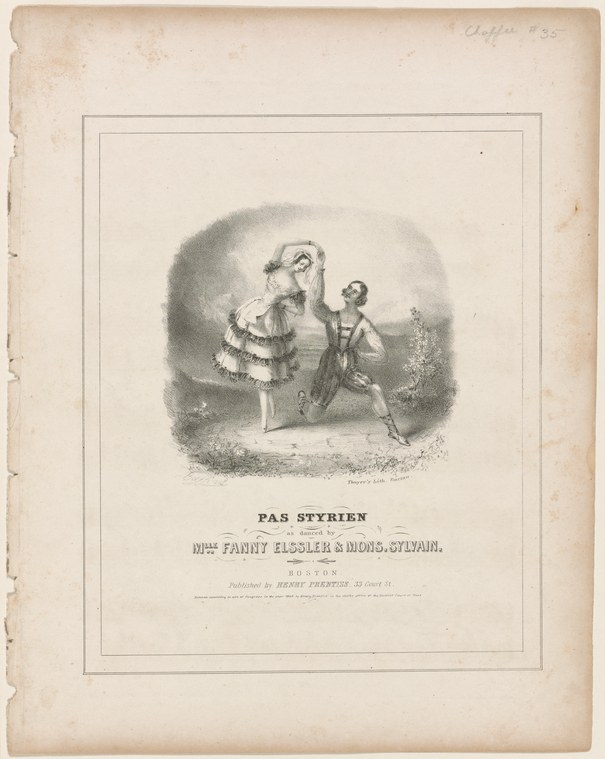
Pas styrien as danced by Mlle. Fanny Elssler & Mons. Sylvain
Unknown artist
- Collection:
- Prints depicting dance
- Source:
- New York Public Library
- Rights:
- Public domain — free to use, share and adapt.
- Recorded as:
- Public Domain
Fanny Elssler was one of the two dominant ballerinas of the Romantic era (rivaled only by Marie Taglioni), and she was celebrated above all for her character dances—Spanish, Neapolitan, Polish, and Styrian pieces—which showcased virtuosity and personality in ways that classical ballet did not. This print documents her in one of these signature roles, preserving both the style of dance performance and the aesthetic choices of early 19th-century theatrical lithography. For dance historians, it is evidence of how regional dances were staged, costumed, and celebrated in the Romantic ballet.
What you are looking at
A woman in a white tulle skirt with dark striping or flouncing stands in the center-left of the composition, her body turned three-quarter to the viewer, one arm raised and bent. Across from her stands a much smaller male figure in darker clothing, also in a turned pose. The pair occupy a shallow stage space rendered in soft shadow, with a vignette of gray wash fading to white at the edges. The woman's skirt is voluminous and caught mid-movement, suggesting active turning or traveling steps. The male figure appears to be responding to or supporting the woman's movement. The overall mood is intimate and theatrical, with the soft lithographic technique creating an atmospheric, almost dreamlike quality typical of early 19th-century dance prints.
The dancing
The woman's posture suggests an open, traveling frame: her torso is upright and slightly tilted, her raised arm extended and softly curved rather than rigidly held. Her weight appears to be on one leg with the other foot in motion, driving the rotation of her skirt. The man, though much smaller in the composition (possibly indicating distance or perspective convention rather than actual height), mirrors her turned orientation and appears to be either following or supporting her movement. The scale relationship and the woman's dominance of the frame emphasizes her as the featured dancer. Both figures maintain an upright, balletic carriage without the extreme turnout or positions of classical ballet.
The dance depicted
The title names this as a Styrian dance (pas styrien)—a regional Austrian or Alpine dance—as danced by the celebrated French-Italian ballerina Fanny Elssler and her partner Monsieur Sylvain. The Styrian pas was a character or national dance, often featured as a divertissement in Romantic-era ballets. The image captures the traveling, spinning quality typical of folk-derived dances of this period: the woman's skirt caught in swirl, the intimate proximity of the partners, and the light, upright carriage all suggest a lively, turning movement rather than the sustained poses of classical ballet. This is a dance of the Romantic stage, performed by named professionals, yet rooted in regional European folk tradition.
How it was made
This is a lithograph, identified by the soft tonal gradations, the vignette technique, and the characteristic lithographic crayon marks. The technique allowed for fine gradation of tone and shadow—visible in the atmospheric background and the delicate rendering of the woman's tulle skirt—without the linear quality of engraving. Lithography was the dominant medium for theatrical prints in the 1830s–1840s, making such images widely available and affordable for collectors, theatre patrons, and dancers themselves. The quality and composition of this print suggest it was a professional theatrical publication rather than a sketch or study.
About this work
This is a dance portrait in lithography, documenting a specific choreographed moment—a Styrian pas—as performed by Fanny Elssler, one of the greatest ballet stars of the Romantic era. The print captures the woman as the dominant presence, her voluminous skirt and traveling movement central to the composition, with her male partner in a supporting role. It represents the Romantic ballet's growing interest in character dances drawn from European folk tradition, and Elssler's particular fame for performing such national dances with theatrical flair. The print preserves not just the costume and setting but a moment of performed movement: the woman caught mid-turn, her skirt and carriage telling the story of the dance.
How to look at it
Look first at the woman's skirt and how it is caught in motion—the soft lithographic tone captures the weight and volume of tulle and shows it mid-rotation, which is the dance itself. Notice the scale relationship between the two figures and how the composition frames the woman as the spectacle. Observe the woman's arm and shoulder: they are not held in the rigid classical positions of earlier ballet but in a softer, more naturalistic curve that suggests folk movement translated to the stage. The vignette—the way the figures emerge from shadow and fade at the edges—is a Romantic-era convention that emphasizes mood and theatricality over architectural setting.
The period
This print dates to the era of Romantic ballet (circa 1830–1850), when the ballerina became the dominant theatrical presence and when ballet began to absorb 'character dances' based on folk or national tradition. Fanny Elssler's career (1821–1884) spanned this period, and she was celebrated in Paris, London, and the United States for her technical brilliance and her ability to perform both classical roles and these character pieces. The Styrian pas, like the tarantella and other national dances, became a staple of ballet divertissements during this period. Lithography was in its ascendancy as the primary medium for theatrical portraiture and promotion; prints like this one were sold at theatres, collected by dance enthusiasts, and distributed to fans.
Where it lives
The print is held in the New York Public Library's collection of prints depicting dance. It is a professional theatrical print, likely published in the 1830s–1840s during Elssler's career and the height of Romantic ballet. Such prints were sold to theatre audiences, collected, and preserved as souvenirs and records of celebrated performances.
Dance in this work
Questions about this work
Who was Fanny Elssler?
Fanny Elssler (1821–1884) was an Austrian-Italian prima ballerina of the Romantic era, celebrated for her technical brilliance and her performances of character dances—national and folk-derived pieces that showcased personality and virtuosity. She was one of the two greatest stars of mid-19th-century ballet, known for roles such as the Cachucha (Spanish dance) and these Styrian and other regional dances. She performed across Europe and the United States and was a major celebrity of her time.
What is a Styrian pas or Styrian dance?
A Styrian pas is a character dance based on the dance traditions of Styria, a region in Austria. During the Romantic ballet era, such regional dances became fashionable as theatrical divertissements—short showcases of national character and virtuosity. The Styrian dance is typically lively, turning, and energetic, with a folk-like quality but performed at the professional ballet theatre with trained dancers and full staging.
What is a lithograph and why was it used for dance prints?
Lithography is a printing process that uses oil and water on stone to create an image; it allows for fine tonal gradations and atmospheric effects impossible in engraving. Lithography became the dominant medium for theatrical prints from the 1820s onward because it was faster, cheaper, and more flexible than older techniques. This made dance prints affordable and collectible, allowing prints of celebrated performers and roles to circulate widely among theatre-goers and dance enthusiasts.
More dance artwork





