49 works in this view — arrow keys or swipe to move between them.
Dance in Art
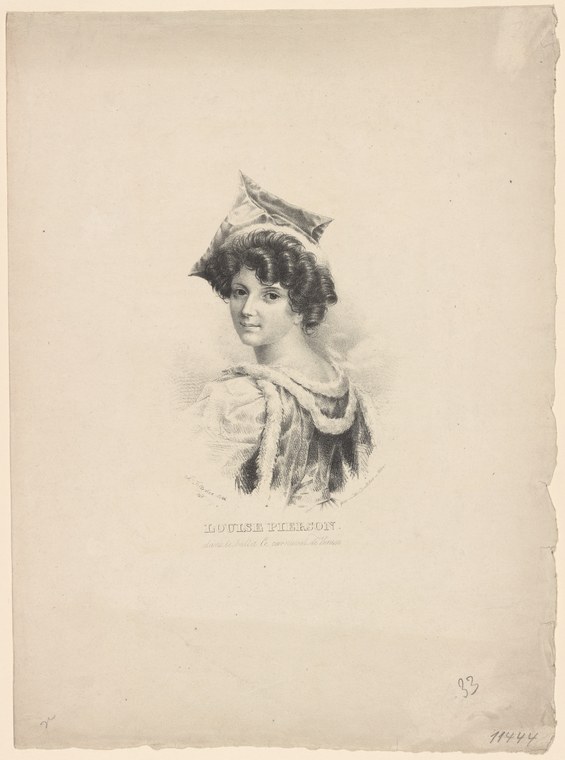
Louise Pierson, dans le ballet Le carnaval de Venise
Unknown artist
- Collection:
- Prints depicting dance
- Source:
- New York Public Library
- Rights:
- Public domain — free to use, share and adapt.
- Recorded as:
- Public Domain
This image is essential evidence of how Romantic ballet dancers were marketed and remembered: through idealized, costumed portraiture that emphasized classical restraint and ethereal beauty rather than acrobatic display. It shows that Louise Pierson, otherwise nearly unknown today, was sufficiently prominent and admired in her time to warrant expensive fine-art reproduction—a mark of professional significance that has left almost no other trace.
What you are looking at
A three-quarter-length portrait of a young woman, rendered in fine engraving or stippled technique against a plain cream background. She is shown in graceful profile-frontal pose, her head turned slightly toward the viewer. Her dark hair is swept up and adorned with an ornate headdress or tiara with what appears to be a feathered or scrolled crest. She wears a draped classical costume in a Romantic style—a light tunic or chiton with off-shoulder neckline and soft, diaphanous folds across the chest and upper body. Her right arm is raised and extended forward in an elegantly curved arabesque-like gesture, the hand delicate and expressive. The left shoulder and arm remain more restrained. The overall impression is one of refined theatrical grace, the kind of portrait that announces a professional dancer's identity and role to an educated public.
The dancing
A single female figure presented in a posed, formal manner rather than captured mid-movement. The raised right arm describes a soft arc, fingers extended and relaxed, suggesting a preparatory or transitional moment in classical dance rather than a dynamic step. Her torso is erect and composed, shoulders level. The positioning of her body and the gentle curve of her arm speak to classical ballet vocabulary—an épaulement or a preparation for movement—but the pose itself is held for portraiture rather than demonstrating active technique. There is no pointe work visible, and her feet are not shown in the composition.
The dance depicted
The title identifies this as Louise Pierson in the ballet *Le Carnaval de Venise* (The Carnival of Venice), a work that appeared in the Romantic ballet era of the mid-19th century. This is a cast portrait—a formal announcement of a dancer in a specific role—rather than a scene from performance. Pierson was a professional dancer of the period, and this portrait served to publicize her participation in a likely spectacular and light-hearted ballet featuring Venetian carnival themes. The classical costume and idealized bearing are typical of Romantic ballet's aesthetic. Without documentation of the ballet's choreography or Pierson's specific role, we cannot determine the exact dance vocabulary she performed, but the costume and period point to pantomime-dramatic scenes interspersed with classical variations.
How it was made
This is a line engraving or possibly a stipple-engraved print, evidenced by the fine parallel lines and soft tonal modeling visible in the fabric, hair, and background. The technique creates a luminous, delicate effect suited to Romantic-era theatrical portraiture. Engravings of this kind were expensive to produce and distribute, which means this image was aimed at an educated, affluent audience—theatre patrons, ballet enthusiasts, and collectors of theatrical prints. The print would have been published in Paris or another major European theatre center and sold or distributed to document the dancer and the production for posterity and publicity.
About this work
This is a formal theatrical portrait of a professional ballet dancer, Louise Pierson, in character costume from a mid-19th-century Romantic ballet. The work is a documentary artifact of both dance history and theatrical portraiture practice: it records not only a dancer's appearance and identity but also the aesthetic codes of classical ballet and the commercial machinery of public theatre. The engraving medium ensured wide circulation among theatre-going elites and established Pierson as a recognized performer worthy of fine-art documentation. Such prints were collected, displayed, and exchanged as proof of a dancer's professional standing and beauty.
How to look at it
Notice the deliberately posed stillness of the figure: this is not a moment of dance but a formal presentation. The raised arm is held in a classical line that a ballet viewer would immediately recognize as deliberate and trained—not a natural gesture. The costume is precise in its theatrical details: the classical tiara, the Greco-Roman tunic, the carefully arranged drapery. All of these elements were designed to communicate to contemporary viewers that Pierson was a serious classical dancer in the European academic tradition, not a street performer or popular entertainer. The refinement of the engraving technique itself—the delicate modeling, the absence of crude shadows—was meant to elevate the dancer to the status of a work of high art.
The artist
The artist is not recorded in the catalogue. The quality and technique of the engraving suggest a professional theatre print workshop, possibly Parisian, active in the mid-19th century. Such portraits were often produced by commercial publishers specializing in theatrical imagery, who employed skilled engravers to transform sketch or photograph into the refined line work visible here. The hand-lettering at the foot of the print (naming Pierson and the ballet) is typical of this commercial practice.
The period
This portrait dates to the height of Romantic ballet (approximately 1830–1870), when ballet was Europe's dominant theatrical dance form and dancers—especially female dancers in classical roles—were celebrities and objects of intense public fascination. The mid-century also saw the rise of the mechanical reproduction of theatrical portraiture: photographers and engravers competed to capture and circulate images of celebrated performers. *Le Carnaval de Venise* likely belongs to the wave of light, plot-driven ballets that followed the major successes of *La Sylphide* (1832) and *Giselle* (1841). Venetian and Italian carnival themes were popular in Romantic-era entertainment, offering spectacle, color, and a safely exotic setting for romantic plots and classical dance.
Where it lives
This engraving is held by the New York Public Library in its collection of theatrical prints depicting dance. It is catalogued but not extensively documented, reflecting the incomplete archival record of commercial theatrical portraiture from this period. Such prints were produced in quantity and distributed through theatre lobbies, print shops, and collectors' networks, making them common at the time but difficult to trace individually today.
Dance in this work
Questions about this work
Who was Louise Pierson?
Louise Pierson was a professional ballet dancer active in the mid-19th century, prominent enough to be commemorated in fine-art engravings. Beyond this portrait and the record of her role in *Le Carnaval de Venise*, detailed biographical information is scarce. She was one of hundreds of dancers who formed the backbone of European ballet companies but left little written record.
What is *Le Carnaval de Venise*?
This is a ballet from the Romantic era, with a Venetian carnival theme typical of mid-19th-century theatrical spectacle. The full choreography, composer, and premiere details are not documented in the current record. It was popular enough to have cast portraits circulated, suggesting it was either a significant production or featured celebrated dancers.
Why is she posed and not moving?
This is a formal portrait for public circulation, not a scene from the ballet itself. The posed classical arm position and costume are meant to communicate her identity as a trained classical dancer and to advertise her in a specific role. Theatre portraits of this kind were static presentations designed for display and collection.
What does the engraving technique tell us?
The fine-line engraving was an expensive, prestigious medium reserved for images intended for educated, affluent audiences. Its use for a theatre portrait signifies that Pierson was considered important enough to warrant this investment and that the image was meant to circulate among theatre patrons and collectors as a valuable object in itself.
More dance artwork





