49 works in this view — arrow keys or swipe to move between them.
Dance in Art
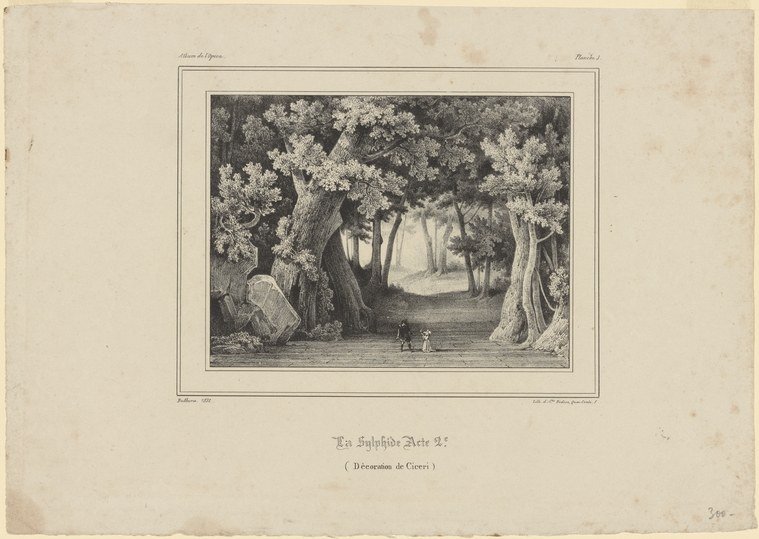
La sylphide, Acte 2e: (décoration de Ciceri)
Unknown artist
- Collection:
- Prints depicting dance
- Source:
- New York Public Library
- Rights:
- Public domain — free to use, share and adapt.
- Recorded as:
- Public Domain
Ciceri's scenic designs were as celebrated as the dancers themselves and fundamentally shaped how Romantic ballet was experienced and remembered. This engraving is evidence of the technical and artistic sophistication of early 19th-century stage design, and of the centrality of atmosphere and landscape to Romantic ballet's meaning. For historians of theatrical dance, it documents one of the most influential ballet productions of the era and the visual language that made Romanticism legible to audiences.
What you are looking at
A moonlit forest glade opens before us, the trees forming a cathedral vault of foliage with pale light flooding through the center distance. The forest floor is dark and shadowed, with massive tree trunks framing both sides of the composition. In the middle distance, two small human figures stand in the luminous space—one appears to be in motion or gesture toward the other. The engraving's tonal range creates an almost supernatural atmosphere: the feathery foliage is rendered in fine cross-hatching that catches light, while the foreground remains deeply shadowed, drawing the eye inward and upward toward the ethereal glade. The mood is one of enchantment, isolation, and mystery—the setting itself becomes a character in the drama.
The dancing
Two figures occupy the lit central space, both small in scale relative to the surrounding forest. The figure on the left appears to gesture or reach toward the other with extended arm, suggesting active engagement or pleading. Both figures wear what appears to be the light, flowing dress of the period. The postures are vertical and upright rather than in any closed or symmetrical hold; the distance between them and their relative scale emphasize the vastness of the supernatural space they occupy. Their isolation within the vast forest interior is the key compositional fact.
The dance depicted
This is almost certainly a scene from the Romantic ballet *La Sylphide* (Act II), whose supernatural setting and narrative of a mortal man pursued by an ethereal female spirit align precisely with the inscription and image. The ballet, which premiered in 1832, centers on the protagonist James's obsessive infatuation with a sylph in a misty forest. The sparse figuration and the emphasis on the sylph's isolation in an inhuman landscape—rather than on physical contact or partnering—captures a key theme of Romantic ballet: the sylph as unattainable, otherworldly, and ultimately fatal to the mortal man who loves her. The engraving does not depict vigorous movement or technical display, but rather psychological drama and spatial enchantment.
How it was made
This is an engraving, identifiable by the fine parallel lines and cross-hatching used to build tone and create the luminous foliage and dark foreground. The technique allowed for wide distribution of theatrical designs and records of celebrated productions. The credit line indicates the work is a record of the scenery designed by Pierre-Luc-Charles Ciceri, one of the leading scenic designers of the Romantic era. Engravings of stage designs served both as documentation of celebrated productions and as souvenirs for audiences and the theater-going public.
About this work
This engraving documents the Act II forest setting of *La Sylphide* as designed by Ciceri for what was almost certainly the original production or a celebrated revival in the early Romantic period. It is not a record of a dance moment in the strict sense, but rather the stage environment and atmospheric setting that was essential to Romantic ballet's aesthetics—a world of sylphs, spirits, and supernatural danger. The tiny figures are almost incidental to the design itself, which is the true subject. The work belongs in a dance gallery because the design and spatial conception directly shaped how dancers moved through and inhabited the stage, and because the printed design was circulated to audiences as part of the cultural memory of a canonical ballet.
How to look at it
Attend to the spatial construction: note how the composition draws the eye inward and upward through the forest toward the light, creating a sense of depth and otherworldliness. The figures are rendered small and distant, almost overwhelmed by the supernatural landscape. This is a deliberate choice—the effect emphasizes the isolation and inhuman scale of the sylph's world, and the mortal protagonist's bewilderment within it. The engraving's tonal sophistication, with its finely controlled grayscale and the luminous rendering of foliage, demonstrates that this is not a simple documentary record but a considered artistic interpretation of the visual experience of the stage.
The artist
Pierre-Luc-Charles Ciceri (1782–1868) was the leading scenic designer of the Opéra in Paris during the Romantic era. He pioneered the use of gas lighting, three-dimensional construction, and atmospheric perspective to create immersive theatrical environments. His designs for *La Sylphide*, *Giselle*, *La Révolte au Sérail*, and other celebrated ballets and operas established visual conventions for Romantic spectacle that influenced European theater for decades. He was known for his technical innovation and for his ability to create naturalistic landscapes and supernatural realms.
The period
The 1830s saw the emergence of Romantic ballet as a dominant European art form, with ethereal female dancers in pointe shoes, pale muslin costumes, and supernatural narratives replacing the athletic, symmetrical conventions of Neoclassical ballet. *La Sylphide* (1832) was the canonical work of this moment and established the sylph—a weightless, otherworldly female figure—as central to Romantic imagination. Stage design evolved in tandem: gas lighting allowed for more sophisticated atmospheric effects, and designers like Ciceri developed the deep perspective and chiaroscuro techniques visible in this engraving. The dissemination of such designs in print form made them culturally prominent and helped audiences understand the visual language of Romanticism.
Where it lives
The work is held in the New York Public Library's collection of prints depicting dance. It is a printed engraving, likely produced in Paris in the 1830s or shortly after, as a record and promotional image of a celebrated production design.
Dance in this work
Questions about this work
Is this a record of an actual performance or a design sketch?
This is an engraving made from a stage design by Ciceri, almost certainly after the 1832 premiere or a notable subsequent production. It documents the scenic environment as built and lit on stage, not a sketch. Engravings like this were produced for distribution to audiences and patrons, functioning as both artistic records and commercial products.
What was *La Sylphide* and why was it important?
*La Sylphide* (1832) was one of the canonical ballets of the Romantic era, premiering at the Paris Opéra with choreography by Filippo Taglioni and the legendary dancer Marie Taglioni. It established the figure of the sylph—a weightless, ethereal female spirit—as central to Romantic ballet aesthetics and narrative. The ballet's focus on supernatural beings, impossible love, and tragic endings became a template for Romantic ballet worldwide.
How did stage design contribute to the meaning of Romantic ballet?
Romantic ballet depended on atmospheric design to convey the otherworldly nature of its narratives. The forest setting, lit by gas lamps to create chiaroscuro effects, was not merely decorative but essential to the emotional and conceptual meaning of the ballet. The design told audiences they were entering a realm where normal physical and social laws did not apply, making the impossible—a mortal man in love with a spirit—temporarily believable.
More dance artwork





