49 works in this view — arrow keys or swipe to move between them.
Dance in Art
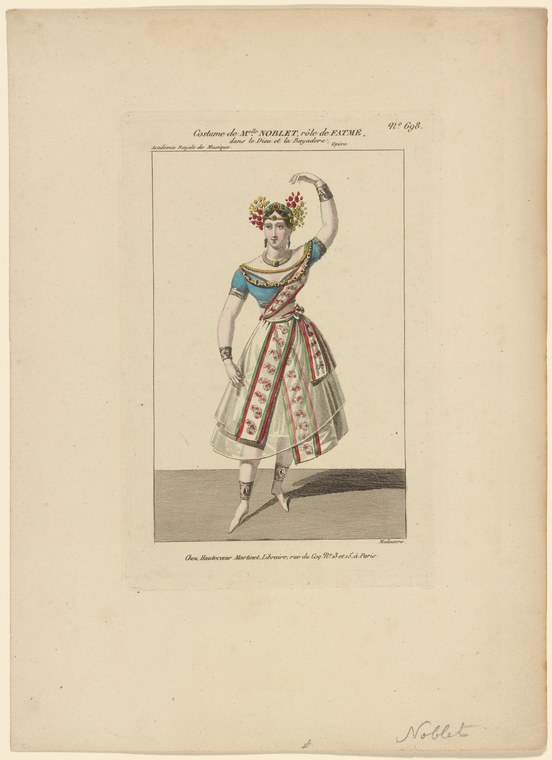
Costume de Melle. Noblet, rôle de Fatmé, dans Le dieu et la bayadère.: Opéra. Académie Royale de Musique
Unknown artist
- Collection:
- Prints depicting dance
- Source:
- New York Public Library
- Rights:
- Public domain — free to use, share and adapt.
- Recorded as:
- Public Domain
This print preserves the visual identity of a celebrated dancer in a specific role at a specific theater, making it primary evidence for understanding how 1830s–1840s Parisian audiences encountered exotic ballet and the bodies of female stars. The work also demonstrates that bayadère roles were central to the Paris Opéra's engagement with orientalism and spectacle during the Romantic period, and that these fantasies were actively marketed to the public through costume prints.
What you are looking at
A single female dancer stands in three-quarter view against a neutral background, posed in a moment of classical elegance. She wears a short white muslin skirt decorated with broad colored stripes (red and green), a short-sleeved blue silk corsage with gold trim, and a wreath of mixed flowers in her hair. Her right arm is raised gracefully overhead, the left hangs at her side with a curved line. Her weight appears settled on her left leg, right foot pointed. The figure is rendered in hand-colored engraving, with careful attention to the fabric's weight and fall, the delicate shading of her skin, and the precise details of her costume. The theatrical dress and isolated pose signal this is a portrait of a performer in a specific role rather than a narrative scene.
The dancing
The single dancer stands in an upright, dignified frame characteristic of classical technique. Her raised right arm follows an arched line from shoulder through elbow to fingertips, while her torso remains centered and composed. The weight is clearly on the left leg, the right foot pointed in a gesture position. The overall carriage—shoulders back, neck elongated, head held level beneath the flower crown—shows training in the formal stance of romantic-era ballet, though the raised arm position is less the vocabulary of strict ballet line and more the pose of a performer at rest or in a moment of display.
The dance depicted
This is a costume study for a named role: Fatmé in *Le Dieu et la Bayadère* (The God and the Bayadère), performed at the Académie Royale de Musique. The work represents a bayadère—an Indian temple dancer in the vocabulary of French Orientalist opera-ballet—though the costume synthesizes European and exotic elements rather than representing authentic Indian dress. The bare legs, the short skirt with striped decoration, the flower crown, and the muslin suggest the Paris Opéra's interpretation of orientalism in the 1830s–1840s. The engraving documents what Mlle. Noblet wore in the role, making it a record of choreographic and scenic practice rather than a representation of the dance itself.
How it was made
This is a hand-colored engraving, likely produced for a series of costume prints distributed to audiences or patrons. The technique—fine line engraving combined with watercolor or gouache hand-coloring—was the standard method for circulating images of celebrated performers and roles in the early nineteenth century. The precision of line, the careful modeling of form, and the legibility of costume detail suggest a professional theatrical printshop, almost certainly Parisian. Such prints were ephemeral popular objects: they documented the current stars and fashions, and they were affordable enough to be collected by theatergoers who wanted to remember a performance.
About this work
This is a costume study of a named performer, Mlle. Noblet, in a specific role: Fatmé in the opera-ballet *Le Dieu et la Bayadère* at the Paris Opéra. It belongs to a tradition of theatrical portraiture in engraving that documented the stars and spectacle of the Romantic era. The work sits at the intersection of dance history, theatrical design, and popular prints: it is neither a choreographic diagram nor a narrative scene, but rather a formal record of how a particular dancer dressed and stood in a role that excited audiences. For a historian of dance or costume, it is documentary evidence; for an art historian, it exemplifies the period's taste for orientalist fantasy and the commercial circulation of performer images.
How to look at it
Notice the precision with which the costume is rendered: every pleat, stripe, and ornament is legible and carefully colored. The pose is not a moment of action but a formal stand—a presentation. This was standard for costume studies: the aim was to show the outfit clearly, not to capture movement. Observe too the whiteness of the muslin and the delicate shading of the flesh: the print's technique (fine engraving with transparent hand-coloring) made it possible to render both silk and skin as distinct materials. The flower crown is rendered with botanical specificity, as if to document exactly what was worn. This is an image made to be studied closely and kept as a record.
The period
The Paris Opéra in the 1830s–1840s was at the height of Romantic ballet. *La Sylphide* (1832) and *Giselle* (1841) define the period, but orientalist ballets and operas were equally popular and lucrative. *Le Dieu et la Bayadère* belongs to a category of works—including *Le Dieu et l'Almée* and others—that used Indian and Egyptian settings to justify elaborate costumes, crowd scenes, and the display of female bodies in short skirts. The bayadère figure became a stock character: exotic, erotic, and ultimately tragic. Mlle. Noblet was a star of this repertoire. The hand-colored engraving was the period's dominant medium for distributing images of performers; theater-goers would collect them as mementos, and printshops competed to issue them quickly and accurately after a premiere or celebrated revival.
Where it lives
The work is held in the New York Public Library's collection of prints depicting dance. It originates from the library's engagement with theatrical and dance imagery of the nineteenth century and is part of a tradition of documentary and promotional prints from the Paris Opéra.
Dance in this work
Questions about this work
What is a bayadère?
In French Romantic opera and ballet, a bayadère is a temple dancer from India, a character type that allowed European artists to create exotic spectacles. The role typically involved minimal plot and maximum costume display, and bayadères often died tragically at the work's end. Mlle. Noblet played the role in *Le Dieu et la Bayadère*, one of many such works performed at the Paris Opéra in this period.
Who was Mlle. Noblet?
The print identifies her by name but gives no dates or biography. She was a celebrated dancer at the Académie Royale de Musique (the Paris Opéra) in the 1830s–1840s, famous enough to be the subject of a costume portrait. Beyond what this print shows, her individual history would require research in theater archives and period reviews.
What does 'Académie Royale de Musique' mean?
This is the formal name of the Paris Opéra during the Restoration and July Monarchy (post-1815). It was the state opera house and the locus of high theatrical spectacle and dance in France. Dancers who performed there were among the most celebrated in Europe.
How was this printed?
It is an engraving—a design cut into a metal plate, inked, and printed on paper—with hand-applied watercolor to add the blues, greens, reds, and flesh tones. This method was labor-intensive but allowed for high-quality detail and quick reproduction after the plate was prepared, making it ideal for theatrical publicity.
More dance artwork





