49 works in this view — arrow keys or swipe to move between them.
Dance in Art
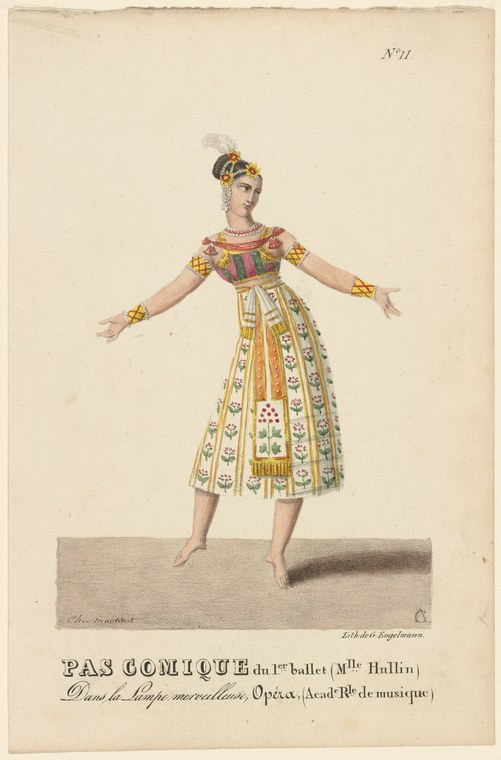
Pas comique du le ballet (Mlle. Hullin) dans la Lampe merveileuse, (Acade Rle de Musique)
Unknown artist
- Collection:
- Prints depicting dance
- Source:
- New York Public Library
- Rights:
- Public domain — free to use, share and adapt.
- Recorded as:
- Public Domain
This print preserves evidence of how character dances and exotic roles were costumed, promoted, and understood in the Romantic ballet era—a record that would otherwise exist only in written descriptions and playbills. The hand-colored theatrical print was the primary medium by which dancers' images and roles circulated to the broader public, making such works essential sources for understanding the visual culture of theater and the construction of theatrical identity.
What you are looking at
A young woman stands barefoot on a shallow platform against a plain beige background, her body turned three-quarter to the viewer with arms extended outward in an open, welcoming gesture. She wears an elaborate costume: a short-sleeved tunic bodice in red and blue with gold ornamental trim across the shoulders, and a long skirt composed of vertical panels in cream and pale blue, each panel densely patterned with small floral or geometric designs in red and blue. A jeweled choker sits at her neck, and her head is crowned with an elaborate headdress featuring feathers or plumes and gold ornaments. Her pose suggests a moment of presentation or the opening of a theatrical number—the raised arms and open stance are expressive rather than technically demanding, and the careful frontality of the composition suggests this is a portrait of a performer in character rather than a document of movement.
The dancing
A single female figure occupies the composition, presented in an open contrapposto stance with both arms raised to shoulder height and extended outward, the palms turned downward in a gesture of presentation or invitation. Her weight appears evenly distributed; the pose is stationary and dignified rather than captured mid-motion. The bare feet and simple platform emphasize the figure as an object of display. There is no partner, no group formation, and no evidence of technical footwork or balletic positioning.
The dance depicted
The inscription identifies this as a 'pas comique' (comic dance) from the ballet *La Lampe merveilleuse* (The Wonderful Lamp), performed by Mlle. Hullin at the Académie Royale de Musique in Paris. A pas comique was a character dance inserted into larger narrative ballets, typically lighter and more humorous in tone than the formal danse d'école. The exotic costume—the patterned skirt, feathered headdress, and ornamental tunic—suggests this number presented a non-European character, likely from the Orient or fantasy realm. The pose here does not document specific steps but rather presents the performer in her stage costume and character, as was common in theatrical prints of this era.
How it was made
This is a hand-colored engraving or aquatint, characteristic of French theatrical prints of the late 18th and early 19th centuries. The figure is rendered in fine line work with careful attention to the pattern and ornament of the costume; the coloring in watercolor or gouache is applied to the printed base. This technique allowed for rapid production and wide distribution of images of celebrated performers to audiences who could not attend the theater, making the print a form of publicity and souvenir. The signature at lower left (partly legible as 'Charpentraux' or similar) identifies the artist as the engraver or publisher.
About this work
This is a theatrical portrait print of Mlle. Hullin performing a character dance—a pas comique—in the ballet *La Lampe merveilleuse* at the Paris Opéra. The image belongs to a large and thriving tradition of French theatrical prints that documented the costume, character, and celebrity of leading dancers for a paying public. Such prints served as both artistic records and commercial merchandise, circulated widely and collected eagerly. The work demonstrates how character dances and exotic roles were promoted and consumed in the early 19th-century French theater, and how the dancer's image became a commodity separate from, but derived from, the ephemeral performance itself.
How to look at it
The print freezes the performer in a moment of stationary presentation rather than active dance. Notice the careful balance and symmetry of the pose—the arms extended equally, the body centered—which emphasizes display and dignity. The elaborate and densely patterned costume occupies as much visual interest as the body; the eye is drawn to the feathered headdress, the jeweled choker, and the ornate skirt panels. This is a portrait of a role and a costume as much as of a dancer, typical of how character dances were marketed to theater audiences. The modest platform and plain background keep focus on the figure itself, without narrative context or scene.
The artist
The engraver's name is partially legible at the lower left of the print. French theatrical engraving was a specialized and competitive trade in the early 19th century, with workshops in Paris producing thousands of character prints, costume studies, and performance portraits for the Opéra and Opéra-Comique. These prints were typically sold individually at the theater or through print shops, and their quality and detail varied widely depending on the importance of the performer and the ambitions of the publisher.
The period
This print dates from the height of the Romantic ballet era in France, when character dances (pas de caractère) and pantomimic comedy were central to the popularity of the ballet d'action. The fashion for exotic and Oriental themes in European theater was at its peak; costumes and characters from the Near East, North Africa, and the East Indies appeared regularly on the Parisian stage. The ballet *La Lampe merveilleuse* is not widely documented in modern histories, suggesting it was likely a minor or short-lived work, but the existence of this print shows it was successful enough to warrant the production and sale of performer portraits.
Where it lives
This print is held in the New York Public Library's collection of prints depicting dance. The collection is a major archive of theatrical prints, costume studies, and dance imagery, particularly strong in French and Italian material from the 18th and 19th centuries.
Dance in this work
Questions about this work
What is a pas comique?
A pas comique was a character dance performed as a solo or small ensemble piece inserted into a longer ballet, typically in the 18th and 19th centuries. It was lighter and more theatrical in tone than the formal ballet vocabulary, often comedic or mimetic, and frequently featured exotic or regional costumes. Such dances were enormously popular with audiences and were often the most-remembered parts of a ballet.
Who was Mlle. Hullin?
Mlle. Hullin is documented as a performer at the Académie Royale de Musique (the Paris Opéra) in the early 19th century, but detailed biographical information is scarce. The existence of this print indicates she was a celebrated enough dancer to warrant theatrical publicity merchandise, but she does not appear prominently in modern ballet histories.
How were these prints made and sold?
Such prints were hand-colored engravings or aquatints, produced by specialist workshops in Paris. They were sold individually at the theater, through print shops, and by subscription. A successful theatrical print could sell hundreds or even thousands of copies over months or years, making them a significant source of income for both artists and publishers.
What does the costume tell us about the role?
The exotic costume—with its patterned skirt, feathered headdress, ornamental tunic, and jeweled ornaments—signals that this character was meant to be non-European, likely Oriental or fantasy in nature. Such costumes were common in Romantic-era ballets and helped audiences immediately understand the dancer's role and the imagined geography of the story.
More dance artwork





