49 works in this view — arrow keys or swipe to move between them.
Dance in Art
Un ballet à l'Opéra (Pas des songes)
Unknown artist
- Collection:
- Prints depicting dance
- Source:
- New York Public Library
- Rights:
- Public domain — free to use, share and adapt.
- Recorded as:
- Public Domain
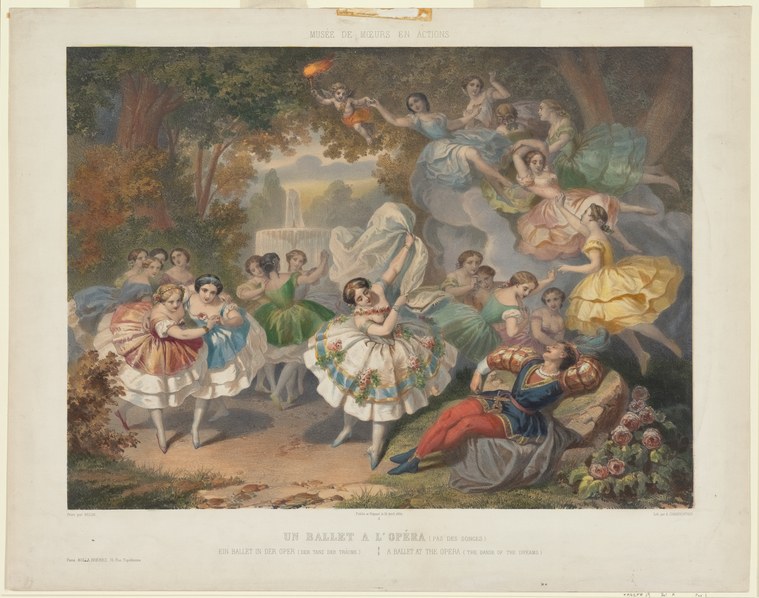
The 'Pas des songes' became one of the most iconic and imitated scenes in Romantic ballet, establishing visual and choreographic codes for dream and spirit sequences that persisted into the twentieth century. This print preserves not a photograph of an actual performance, but the idealized, widely circulated image that shaped how the public imagined the ethereal corps de ballet—an image at least as influential as the choreography itself. For dance historians, it reveals the period's investment in using vertical space, floating bodies, and supernatural framing to convey the otherworldly as the highest aspiration of ballet technique.
What you are looking at
A theatrical scene set in a moonlit woodland glade depicts a corps de ballet in an ethereal dream sequence. At center, a single dancer in a white tutu with floral garland stands alone on the ground, her body held in an upright, formal pose. Above and around her, a cloud of ethereal figures in pale silks and gauzes floats in the upper portion of the composition—some suspended or leaping through the air, their bodies arranged at impossible angles and elevations. The setting is densely framed by gnarled trees on both sides; moonlight breaks through the canopy to illuminate the scene. A reclining male figure in dark military dress sits at right, watching the spectacle. The overall effect is one of supernatural vision: the terrestrial and aerial realms occupy the same stage, with the solitary grounded dancer connecting them. The color palette is cool and luminous—pale greens, blues, flesh tones, and whites—against warm honey-toned tree trunks.
The dancing
The central dancer stands in a classical upright frame with arms held at mid-height, her body weight centered and formal rather than dynamically engaged. The aerial figures above employ an extended, floating port de bras, their limbs stretched languidly outward as though weightless; several are arranged en arabesque or attitude positions that defy gravity. The reclining male figure provides a grounded, observational anchor. The composition clusters perhaps twenty or more bodies across the frame, creating a densely populated dream-tableau rather than a social dance formation. There is no closed-hold partnering; instead, figures occupy distinct zones of the composition, united by shared lightness and uplift.
The dance depicted
This is theatrical Romantic ballet, almost certainly from the mid-nineteenth century, depicting the 'Pas des songes' (Dream Sequence) motif central to works like *La Ronde des Esprits* or the famous dream scenes from *La Somnambule* and related Romantic repertoire. The subtitle confirms this reading. The image captures the moment when the boundary between the material and supernatural dissolves: the lone grounded dancer (likely a sleepwalking heroine or spiritually transported protagonist) is surrounded by the ethereal vision—corps de ballet arranged as weightless phantoms, spirits, or dream figures. This was a signature visual device of mid-nineteenth-century ballet, enabling choreographers to explore themes of enchantment, death, and the subconscious through the illusion of flight and incorporeal presence.
How it was made
This is a hand-colored engraving or aquatint, rendered in the illustrative tradition of theatrical prints. The delicate color application and linear clarity suggest it was made from an engraved or lithographed base plate, then individually colored—a common method for producing dance ephemera and theatrical souvenir prints of the period. The technique's precision allows for legible rendering of costume detail and the formal poses, while the added color creates atmospheric depth and the luminous quality essential to conveying the ethereal mood. Such prints were produced for public sale and circulation, appealing to ballet enthusiasts and audiences seeking memento of celebrated performances.
About this work
This is a theatrical print documenting a dream-ballet scene typical of mid-nineteenth-century French Romantic opera and ballet. It depicts the supernatural encounter between a solitary human dancer and a corps of weightless, spirit-like figures suspended in an enchanted woodland setting. The inscription 'Un ballet à l'Opéra (Pas des songes)' identifies it as a scene from operatic ballet repertoire—likely from a work staged at the Paris Opéra. The work exemplifies how visual artists of the period rendered the Romantic obsession with the invisible, the transcendent, and the feminine as ethereal and otherworldly. It belongs in a dance gallery because it documents both a specific theatrical convention and the visual language through which nineteenth-century audiences understood and experienced ballet as a medium for the supernatural.
How to look at it
Attend to the composition's vertical hierarchy: the single grounded figure anchors the viewer to the stage, while the aerial bodies above create an illusion of supernatural levitation and infinite depth. The artist has used light (the moonbreak through trees) and the formal classical poses of the floating figures to signal that we are witnessing a dream-vision rather than a social or dramatic moment. Notice how the reclining male observer at right mediates between us and the scene—he is watching as we are watching, framing the spectacle as vision. The formal, arrested poses of the floating figures distinguish this from any naturalistic dance: they are positioned as tableaux, not caught mid-movement, which was the Romantic convention for rendering the supernatural.
The artist
The artist is not recorded in the catalogue, and the engraver's name is not legible in the print as visible here. The work belongs to the mid-nineteenth-century tradition of Parisian theatrical illustration, when print workshops specialized in hand-colored engravings and lithographs of celebrated opera and ballet scenes. Such prints were mass-produced for sale in theater lobbies and print shops, creating a mass market for dance imagery and helping to codify the visual and kinetic vocabulary of Romantic ballet for a broad public.
The period
This print dates to the height of the Romantic ballet era (circa 1830–1860), when the Paris Opéra dominated European dance. The 'Pas des songes' emerged as a stock scene in operas with supernatural or somnambulistic themes—works like *Robert le diable* (1831), *La Somnambule* (1832), and later *La Ronde des Esprits*. Visual artists and print makers responded eagerly, as the dream scene offered ideal subject matter: it permitted the fantasy of weightlessness, the spectacle of the corps de ballet in coordinated ethereality, and the romantic ideology of the dancer as otherworldly feminine presence. The print's aesthetic reflects the period's broader fascination with the liminal—between sleep and waking, material and spiritual, human and phantom.
Where it lives
This print is held in the New York Public Library's collection of prints depicting dance, a significant assemblage of theatrical ephemera and documentation. The work's identification as part of this named collection indicates it was acquired for its documentary value as a record of nineteenth-century stage dance.
Dance in this work
Questions about this work
What is 'Pas des songes'?
'Pas des songes' (Dream Sequence or Dream Steps) refers to a recurring scene in mid-nineteenth-century opera-ballet in which a character enters an enchanted or supernatural realm populated by ethereal dancing spirits. It became a signature visual motif, combining classical ballet technique with romantic ideology about the dancer as weightless, otherworldly, and incorporeal. The scene typically featured the corps de ballet arranged at multiple levels or suspended to create an illusion of flight.
How was this scene actually staged and danced?
Dancers performing the ethereal roles were likely arranged on platforms or elevated stages at the rear, with lighting and costume designed to obscure their support and suggest levitation. The poses would have been held or sustained rather than continuously moving, creating a tableau vivant effect. Dancers may have been suspended from above using ropes or wires, a technique documented in nineteenth-century ballet theater but not explicitly visible in prints like this.
What does the male figure watching represent?
The reclining male observer likely represents the dreamer or the earthbound protagonist witnessing the supernatural vision—a common narrative device in Romantic opera and ballet. His position and stillness contrast with the ethereal activity above, anchoring the scene to human consciousness and emotion. He may be a character like the Count in *La Somnambule* or the Prince in operatic plots involving supernatural encounters.
Why are so many figures floating if this is a ballet?
The floating arrangement serves both narrative and aesthetic purposes: it signals that the viewer is witnessing a dream or supernatural realm rather than earthly reality, and it creates a spectacular visual composition that showcases the corps de ballet as a unified, almost abstract decorative element. The Romantic era valued the corps as a collective ethereal presence rather than as individually characterized dancers, and the dream scene was the ideal context for this aesthetic.
More dance artwork





