49 works in this view — arrow keys or swipe to move between them.
Dance in Art
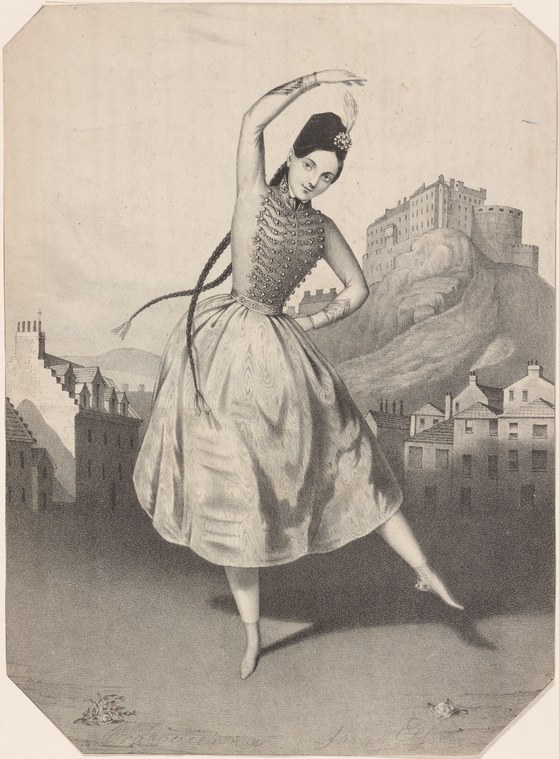
[La cracovienne] Fanny Elssler
Unknown artist
- Collection:
- Prints depicting dance
- Source:
- New York Public Library
- Rights:
- Public domain — free to use, share and adapt.
- Recorded as:
- Public Domain
Elssler's Cracovienne was one of the most celebrated and widely documented dances of the Romantic era, and her performance of it helped establish the vocabulary by which European ballet absorbed and theatricalized folk traditions. The print is evidence of how theatrical dance was marketed and remembered, and of how a single dancer's interpretation of a role could shape its identity for decades.
What you are looking at
A young woman in Romantic-era dress stands in an energetic pose against a stylized architectural backdrop. She wears a fitted bodice decorated with horizontal striping or embroidery, and a voluminous skirt of pale fabric that swirls around her legs. Her dark hair is pulled back, and her head tilts gracefully to one side as her right arm extends upward in an arcing line. Her left arm curves across her body. Behind her rises a fortified castle or fortress on a hillside, rendered in fine stippled lines, with smaller buildings clustered at its base—a Romantic-era setting evoking a Polish or Eastern European locale. The entire composition is executed in black ink or engraving, with careful attention to the fall and movement of the fabric and the dancer's elongated, balletic frame.
The dancing
The dancer is shown in a single, arrested moment of motion: her weight appears to be on her left leg, which is nearly straight, while her right leg extends back in a gentle arabesque or supporting position. Her torso tilts forward from the hips, creating a diagonal line of energy from her extended right arm through her head. Both arms are raised and flowing, the upper arm creating a long, continuous line—a hallmark of Romantic-era ballet vocabulary. The isolation and prominence of the single figure, together with the balletic port de bras and line of the body, suggests a performed solo or a choreographic moment meant to be admired for its grace and extension.
The dance depicted
The title identifies this as the Cracovienne (or Krakowiak), a Polish national dance that became a celebrated theatrical piece in the nineteenth century. Fanny Elssler, the Austro-Italian ballerina, was famous for her performances of national character dances, including the Cachucha and the Cracovienne, which allowed her to display technique within a folklorically inflected, dramatically coherent narrative. The Cracovienne typically features rapid footwork and a vivacious, somewhat earthy character, but this image captures not the vigorous, grounded quality of the folk original but rather its Romanticized, ethereal theatrical version—the dancer elevated, attenuated, and set against a distant architectural fantasy. The engraving records not the dance as it might be performed at a fair, but as Elssler transformed it on the opera stage.
How it was made
This is a line engraving or possibly a lithograph, executed with great refinement and fine hatching to suggest form, volume, and the texture of fabric and distant stone. The medium allowed for wide circulation as a print—affordable reproductions of celebrated dancers and moments from celebrated performances were a major form of theatrical publicity and fan culture in the 1830s and 1840s. The delicate linework and careful stippling create an image of considerable elegance, befitting the work's function as a souvenir or advertisement of a star performer and a fashionable entertainment.
About this work
This is a theatrical print documenting Fanny Elssler's performance of the Cracovienne, a Polish national dance adapted for the Romantic ballet stage. Elssler was one of the two or three most celebrated dancers of the 1830s and 1840s, known for her technical brilliance, her dramatic presence, and her mastery of character dances drawn from folk traditions across Europe. The Cracovienne was one of her signature vehicles—a role that allowed her to combine national identity, vivacious personality, and balletic refinement. The print preserves a moment from one performance, showing the dancer in an attitude of balletic grace, set against a Romantic-era fantasy of a Polish castle. It is both a document of how nineteenth-century theatre dancers performed folk material and a window into the economics and visual culture of operatic stardom.
How to look at it
Attend to the moment the artist chose to freeze: the dancer is captured not at the fastest or most striking point of the movement, but in a moment of lyrical stillness—the arms held high and flowing, the body extended and elegant, the gaze soft. This is the Romantic ballet aesthetic: not virtuosity for its own sake, but virtuosity in service of a kind of poetic reverie. The elaborate castle background is equally important—it locates the dancer in a Romantic fantasy of place, a distant, picturesque, 'authentic' Poland that exists primarily in the imagination of the Western European audience. The very refinement of the engraving technique, the delicacy of the line, and the attention to the fall of fabric all reinforce the impression of grace and refinement.
The artist
The artist is not recorded. The print was published and distributed by the New York Public Library's print collection, which holds theatrical prints and dance documentation from across the nineteenth century. The work is part of a large body of contemporary engravings and lithographs documenting performances by Elssler and her contemporaries, made for sale to a theatre-going public eager for mementos of celebrated performances.
The period
The 1830s and 1840s were the height of the Romantic movement in European theatre and visual culture. Romantic ballet emphasized ethereality, poetic narrative, and the supernatural; dancers performed on pointe; tutus became shorter and stiffer to show the legs and feet; and a cult of the prima ballerina developed in parallel with the rise of opera. At the same time, Romantic artists and audiences were fascinated by national character and folk tradition—especially the folk cultures of Eastern Europe and the Mediterranean, which seemed to embody authenticity and passion. Elssler's Cachucha (Spanish) and Cracovienne (Polish) were major vehicles for this aesthetic, allowing her to perform both balletic refinement and a kind of theatrical exoticism. The Cracovienne was created for her in the late 1830s and became one of her most frequently performed solos.
Where it lives
This print is held in the New York Public Library's collection of prints depicting dance. It is part of the NYPL's broader collection of theatrical and dance documentation from the nineteenth century.
Dance in this work
Questions about this work
Who was Fanny Elssler?
Fanny Elssler (1810–1884) was an Austro-Italian ballerina and one of the two or three most celebrated dancers of the Romantic era, rivaling Marie Taglioni. She was known for her technical brilliance, her dramatic presence, and her specialty in character dances—folklorically inflected roles that allowed her to perform national dances from across Europe, including the Spanish Cachucha and the Polish Cracovienne. She toured Europe and the Americas and was celebrated in both ballet and dramatic roles.
What is the Cracovienne?
The Cracovienne (or Krakowiak) is a Polish national dance, lively and rhythmic, traditionally performed at celebrations. Elssler's stage version, created in the late 1830s, transformed the folk dance into a solo showcase for a prima ballerina, combining balletic technique and Romantic-era aesthetics with a Polish setting and character. It became one of her most celebrated roles.
What does this image tell us about Romantic ballet?
This image exemplifies several key aspects of 1830s–1840s ballet: the emphasis on the ethereal and poetic; the use of pointe work and elongated lines; the rise of the prima ballerina as a star; and the Romantic fascination with national character and exoticized folk traditions. The print also shows how dance was marketed and consumed—as a souvenir, a memento of a celebrated performance, and a form of fan culture.
More dance artwork





