49 works in this view — arrow keys or swipe to move between them.
Dance in Art
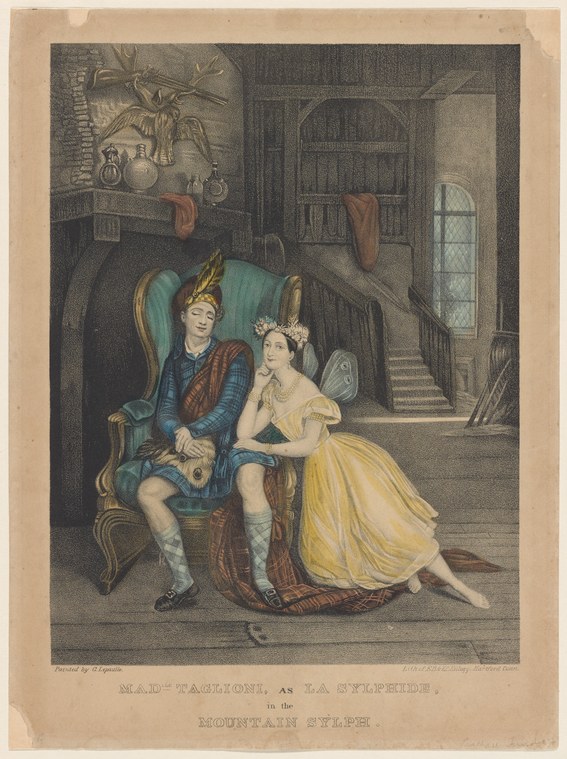
Madlle Taglioni, as La sylphide, in the Mountain sylph
Unknown artist
- Collection:
- Prints depicting dance
- Source:
- New York Public Library
- Rights:
- Public domain — free to use, share and adapt.
- Recorded as:
- Public Domain
Taglioni is the hinge on which ballet history turns: she made the Romantic ideal of the weightless, melancholic female dancer technically credible and emotionally persuasive, and in doing so gave the nineteenth-century stage a new vocabulary of movement. This image, circulated in the 1830s, shaped how ballet was understood and desired across Europe and America. For dancers and historians, it is evidence of how costume, partnering, and narrative were fused in the work that still defines what ballet *is*.
What you are looking at
A young woman in a pale yellow diaphanous skirt and flesh-colored tights reclines or sits in a languid pose against a male figure dressed in rich blue and dark red silks, positioned in an ornate chair with turquoise upholstery. The setting is a grand interior with classical architecture—arched doorways, a distant staircase, and tall windows admitting soft light from the right. On the mantelpiece above them, hunting trophies (antlers, vessels, and weapons) create an atmosphere of aristocratic leisure. The woman's body is weightless and ethereal, her head tilted back, her arm extended toward the man in an attitude of romantic abandon. The engraving's fine parallel hatching renders the fabrics with careful distinction: the man's garments are heavy and textured, the woman's skirt floats as if caught in motion or reverie. The moment is one of intimate courtship, staged with theatrical artifice.
The dancing
The male figure is seated, upright and stable, his legs extended in the fashion of the period. The female dancer is supported against his body in a recumbent or nearly recumbent position, her torso arched, her weight entirely given over to him—a posture that demands both strength from the male and absolute trust and extension from the female. Her right arm reaches upward and outward in an elegant line; her left hand rests near his shoulder. The line of her body from shoulder through hip and leg is continuous and unnaturally elongated, suggesting both the conventions of romantic ballet and the physical capabilities of a trained performer. The two figures occupy a single unified composition, their bodies interdependent.
The dance depicted
This is a scene from Marie Taglioni's most famous role, the titular Sylphide in *La Sylphide* (first performed 1832), the foundational work of Romantic ballet. The 'mountain sylph' subtitle in the print confirms the reference to Act II, set in a forest grotto in the Highlands. Taglioni was the defining dancer of early Romantic ballet, and this image captures the aesthetic that made her revolutionary: weightlessness, melancholy, the suggestion that the dancer's body transcends physical law. The male figure is James, the mortal protagonist. The image documents not just a dance but an idea—the Romantic fantasy of the ethereal female form, which Taglioni's technical refinement and expressive gift made plausible on stage. The supporting posture (what would later be called a *supported adagio*) shows the male dancer as the woman's anchor to earth.
How it was made
This is a hand-colored engraving, identifiable by the fine parallel lines (hatching and cross-hatching) that model form and shadow, and by the characteristic plate marks visible at the edges. The coloring is applied by hand after printing—note the precise but slightly loose application of the yellow skirt and blue silks, the flesh tones, the subtle gradations in the background. This technique allowed for wide circulation of theatrical imagery during the 1830s, when lithography was also emerging; engravings remained prestigious and were used for souvenirs, publicity, and the documentation of celebrated performances. The labor-intensive hand-coloring meant these prints were relatively expensive and targeted at a cultivated audience—theatre-goers who could afford to own images of the stars they had seen or wished to see.
About this work
This hand-colored engraving documents Marie Taglioni in *La Sylphide*, the work that defined Romantic ballet and established the aesthetic of the ethereal female dancer that dominated the nineteenth century. Taglioni's technical facility and interpretive gift made the impossible seem real: the sylph, a supernatural creature, moves and is supported as if gravity barely constrains her. The print is at once a theatre souvenir, a portrait of a celebrated artist, and a visual argument for what ballet could be—a medium in which the female body, perfectly trained and perfectly expressive, could embody romantic longing and transcendence. The work survives as evidence of how a single performer shaped the visual and kinetic language of her art.
How to look at it
Look first at the relationship between the two bodies: the man is the anchor, the woman the creature of air. The engraver has rendered her skirt as weightless and her extended arm as impossibly long, which is a deliberate distortion—a technical choice that says *this is not a realistic representation but an idealized one*. The setting, though grand, is subordinate to the figures; the architecture is sketched in light lines and fades into shadow, focusing attention on the intimate pair. Notice how the woman's head tilts away from the man even as her body rests against him—it is a posture of dreaming, of absence, of yearning toward something beyond the frame. This was the Romantic ideal: the woman as spirit, not as body; as longing incarnate.
The period
The 1830s were the height of the Romantic movement in art and literature, and ballet was not exempt from its aesthetic preoccupations—the supernatural, the melancholic, the unattainable. *La Sylphide* (1832, choreographed by Filippo Taglioni for his daughter) arrived at a moment when ballet was being reconceived as a vehicle for female expression and when new techniques of the body (the rise onto pointe, refinement of port de bras, the vocabulary of *adagio*) were making it possible to stage the Romantic imagination. Marie Taglioni's performances were intensely celebrated; prints like this one were distributed widely and helped make her an international celebrity. The Romantic sylph became the dominant female archetype in ballet for decades, shaping everything from costume design to the ideal body type valued in dancers.
Where it lives
This print is held in the New York Public Library's collection of prints depicting dance. It is one of thousands of theatrical prints produced in the nineteenth century to capitalize on and commemorate the fame of celebrated dancers and roles.
Dance in this work
Questions about this work
What is La Sylphide and why is it important?
*La Sylphide* (1832) is the foundational work of Romantic ballet and one of the two or three most influential ballets ever created. It established the archetype of the sylph—a supernatural, ethereal female creature—and gave ballet a new vocabulary of weightlessness and melancholy. Marie Taglioni's performance made it a sensation across Europe and America, and the ballet's aesthetic dominated ballet for the rest of the nineteenth century and beyond. Two different ballets with this title survive in the repertory today: the Bournonville version (1836) and later reconstructions.
Who was Marie Taglioni?
Marie Taglioni (1804–1884) was an Italian-born Swedish dancer who became the most celebrated ballerina of her era. Trained by her father Filippo, a choreographer, she premiered *La Sylphide* in Paris in 1832 at age 28 and became an international celebrity. She was known for her technical refinement, her expressive gift, and above all for embodying the Romantic ideal of the weightless, ethereal female form. Her career helped establish ballet as a vehicle for female artistry and shaped the aesthetics of ballet for generations.
What does 'supported adagio' mean?
A supported adagio is a section of ballet in which a female dancer performs slow, sustained movements while physically supported by a male dancer (or occasionally multiple male dancers). The male dancer provides stability, lifts, and assists while the female dancer extends, balances, and displays her line. This partnership became central to classical and Romantic ballet, and the quality of the support and the vulnerability it requires between the dancers is crucial to the aesthetic impact. In this print, the entire composition is essentially one sustained supported moment.
Why are her legs bare if this is from the 1830s?
Her legs are not bare; she is wearing flesh-colored tights, which were standard costume for ballerinas by the 1830s. This innovation allowed the line of the leg to be seen continuously from hip to ankle, which was essential to the Romantic ballet aesthetic. Before tights were adopted, dancers wore opaque stockings and skirts that obscured the line. The invention and adoption of tights was a technical innovation that made possible a new vocabulary of movement and line.
More dance artwork





