49 works in this view — arrow keys or swipe to move between them.
Dance in Art
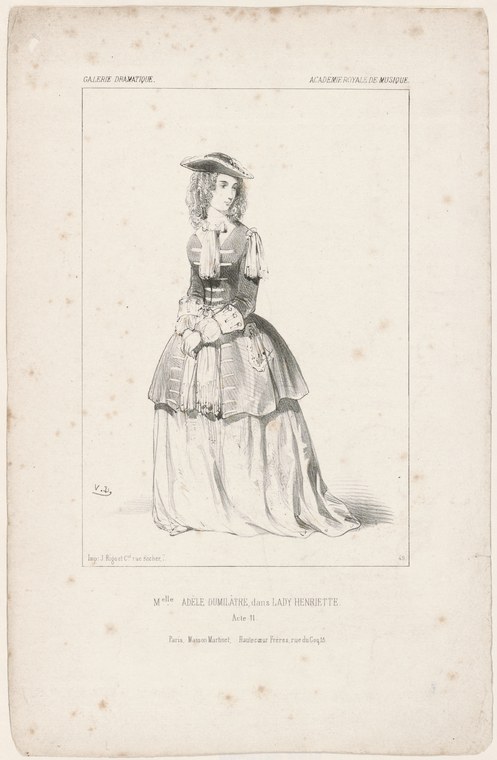
Melle Adèle Dumilâtre, dans Lady Henriette. Acte II.: Académie Royale de Musique
Unknown artist
- Collection:
- Prints depicting dance
- Source:
- New York Public Library
- Rights:
- Public domain — free to use, share and adapt.
- Recorded as:
- Public Domain
This print is primary evidence for how romantic-ballet costume was constructed and presented to audiences in the mid-19th century. Dumilâtre's fame and the prestige of a new Auber commission make this an important record of a specific, documented performance, allowing historians to anchor costume and staging to a known choreographic and musical work.
What you are looking at
A three-quarter-length portrait of a young woman in mid-19th-century theatrical costume, shown standing in a composed pose against a plain background. She wears a pale silk or satin dress with a fitted bodice, short puffed sleeves, and a full skirt that falls to her ankles; over this sits a darker, patterned overdress or tunic, creating a layered effect characteristic of romantic-era stage costumes. Her hair is styled in long ringlets and crowned with a small feathered hat or ornament. Her arms hang naturally at her sides, with her hands holding what appears to be a small prop or costume accessory. The pose is frontal and upright, with her weight evenly distributed—a formal presentation rather than a moment captured mid-movement. The engraving technique and careful hatching create soft modeling of the fabrics and gentle shadows that suggest stage lighting.
The dancing
A single standing figure in an upright, formal posture with no active dance movement visible. Her weight is centered and her arms hang passively; the stance is presentational rather than dynamic. There is no evidence of turned-out legs, elevated position, or balletic carriage in the visible line of the body. The pose reads as a portrait stance—the kind used to display costume and character rather than to show the dancer in motion.
The dance depicted
The image documents the costume worn in Act II of *Lady Henriette* (or *Lady Harriet*), a comic opera-ballet by Daniel Auber (1847), as performed by the celebrated dancer Adèle Dumilâtre. This role required virtuoso dancing in the romantic-ballet idiom—the piece was written for the Académie Royale de Musique (Opéra de Paris). However, this engraving presents the dancer as a still figure in costume rather than in action. The romantic-era tutu and puffed sleeves are consistent with the theatrical context, but the static pose tells us nothing directly about Dumilâtre's technique or the movement the role demanded.
How it was made
This is an engraving—indicated by the fine parallel lines used for shading, the crisp outlines, and the tonal subtlety achieved through variation in line density. The technique allowed for precise reproduction and wide circulation as a print; the caption and publication mark suggest this was a commercial theatrical portrait print, likely sold to the public after the work premiered or during its run. Engraving was the dominant medium for theatrical documentation and celebrity portraiture in this period, making such prints accessible beyond those who attended the Opéra itself.
About this work
This is a theatrical portrait print documenting the costume of a major romantic-era ballet role created for one of the 19th century's most celebrated dancers. Adèle Dumilâtre was a prima ballerina of international renown, and *Lady Henriette* was a prestigious commission for the Opéra de Paris. The engraving serves as a record of costume design and theatrical presentation in the 1840s rather than as a study of dance technique or movement; it belongs to the tradition of theatrical prints that functioned as both souvenirs and advertisement. Such prints reveal what romantic-era ballet looked like to the public eye—the emphasis on picturesque costume, delicate femininity, and theatrical spectacle rather than on the virtuosity of footwork or the drama of movement itself.
How to look at it
Attend to the costume details: the specific construction of the overskirt, the height and cut of the bodice, the sleeve design, and the placement of ornaments. These elements define romantic-ballet presentation and would have been immediately recognizable to contemporary theater-goers. Notice also the artist's use of line and shading to suggest the weight and fall of silk and satin—the delicate hatching conveys a sense of luxurious fabric and careful stagecraft. The formal frontality and centered pose are typical of theatrical portraiture, designed to display the role and the performer's elegance rather than to capture a fleeting moment of dance.
The artist
The artist is not recorded in the catalogue. The style and publication details are consistent with mid-19th-century Parisian theatrical print-makers, of whom there were several active in the 1840s–50s. The engraver's initials or name may appear in the lower margin, but are not legible in this image. Such prints were often unsigned or attributed only to the publisher (here possibly Martinet).
The period
Adèle Dumilâtre's career (1821–1863) spanned the height of the romantic-ballet era in Paris. *Lady Henriette* premiered in 1847, a moment when the Opéra was the center of European ballet innovation and when dancers like Dumilâtre, Fanny Elssler, and Carlotta Grisi defined the aesthetic of the era. Romantic ballet emphasized ethereal, languid femininity, elaborate tutus, exotic or picturesque settings, and the illusion of weightlessness—all conveyed here through costume and the studied elegance of the pose. Theatrical prints of this kind were a major medium of celebrity culture and performance documentation in an age before photography could reproduce stage images.
Where it lives
This engraving comes from the New York Public Library's collection of prints depicting dance, which holds theatrical and choreographic documentation spanning centuries. Such prints were commercial products, intended for sale to the public and to collectors of theatrical memorabilia.
Dance in this work
Questions about this work
Was Adèle Dumilâtre a major ballet star?
Yes. Dumilâtre (1821–1863) was a prima ballerina at the Opéra de Paris and one of the most celebrated dancers of the romantic era. She created roles in major works and was known for her technical brilliance and dramatic presence. Her long career spanned the height of romantic ballet, and she was sought after internationally.
What is *Lady Henriette*?
*Lady Henriette* (or *Lady Harriet*) is a comic opéra-ballet with music by Daniel Auber, premiered at the Académie Royale de Musique in 1847. It was a prestigious commission and a vehicle for a leading dancer. The plot is based on *Martha*, a popular opera, and the ballet sections were opportunities for virtuoso display.
Why is she standing still instead of dancing?
This is a costume portrait, not a dance study. Its purpose was to document how the role looked on stage and to serve as a theatrical souvenir. Dancers were often portrayed in formal, composed poses that would display the costume and convey elegance, rather than in active movement.
How do we know this is Act II?
The caption at the bottom of the print states 'Mlle. Adèle Dumilâtre, dans Lady Henriette, Acte II' (Mlle. Adèle Dumilâtre in Lady Henriette, Act II), identifying both the performer and the specific act in which this costume appeared.
More dance artwork





