49 works in this view — arrow keys or swipe to move between them.
Dance in Art
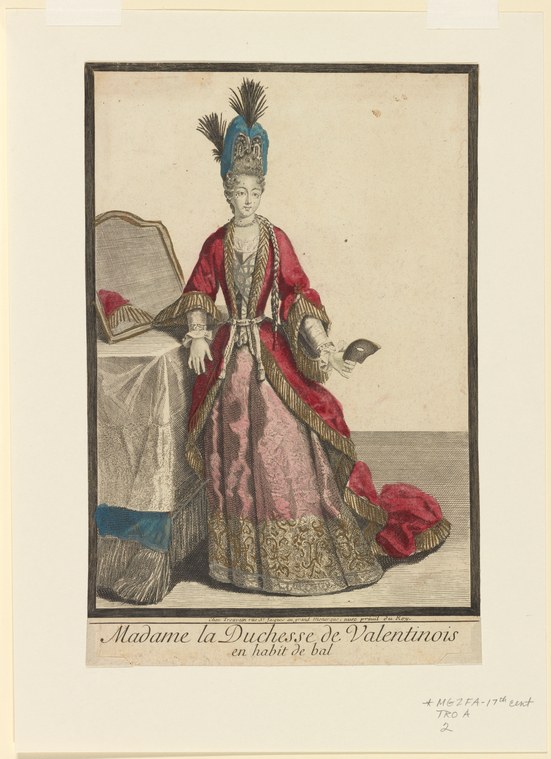
Madame la Duchesse de Valentinois en habit de bal
Unknown artist
- Collection:
- Prints depicting dance
- Source:
- New York Public Library
- Rights:
- Public domain — free to use, share and adapt.
- Recorded as:
- Public Domain
Costume plates like this are primary sources for how dance looked in practice: they document the silhouette, weight, and visual line that dancers inhabited and moved within. The rigidity of this dress — the tight bodice, the side-swept train, the elevated center of gravity — directly shaped the posture, arm carriage, and footwork of the minuet and cotillion. For a historian or dancer studying the period, this image reveals the physical constraints and aesthetic ideals that governed how the dance was performed.
What you are looking at
A woman in formal eighteenth-century ball dress stands alone against a plain background, positioned three-quarter to the viewer's left. She wears an elaborate crimson silk gown with gold brocade at the hem, the skirt swept dramatically to one side and trained behind her. Over this sits a shorter overdress or robe in deep red with gold trim and tasseled edges. Her hair is dressed high and crowned with an ornamental headdress topped by three black ostrich plumes that sweep upward. She holds a large fan in her right hand, lowered at her side. Her left arm hangs naturally, and her posture is upright and composed. Behind her stands a chair with a caned or latticed back, rendered in pale ochre. The inscription below reads "Madame la Duchesse de Valentinois en habit de bal" — Madame the Duchess of Valentinois in ball dress. The print is hand-colored, with careful attention to the lustrous reds and golds of the fabrics and the pale flesh tones.
The dancing
The single figure is static and formal, presented frontally rather than captured mid-movement. Her posture is erect and dignified, the weight evenly distributed. The fan held at her side was a crucial social accessory in courtly dance, signaling readiness for the cotillion or minuet. The costume itself — the rigid structure, the formal train, the elaborate coiffure — indicates this is a portrait of aristocratic identity rather than a moment of dynamic movement. There is no partner and no suggestion of active dance steps.
The dance depicted
This is not a depiction of dance in action but a costume plate: a portrait of a noblewoman in the formal dress required for court ball attendance in the late eighteenth century. The Duchess of Valentinois was a figure of the French aristocracy, and this print documents the visual language of her status through fashion. Ball dress of this period was inseparable from the minuet and cotillion — the prescribed courtly dances — and the costume itself was essential to their performance. However, the image shows only the still moment of presentation, not the dance itself. The woman is posed as though at the moment of arrival or greeting rather than in the middle of a choreographed step.
How it was made
This is a hand-colored engraving or etching from the late eighteenth century, established from the fine line work, the uniform background, and the style of coloring. The technique allowed for precise rendering of textile detail and the crisp definition of the costume's structure — essential for a fashion plate intended as a record of aristocratic dress conventions. Such prints were produced in series and circulated among the nobility and wealthy merchant classes as references for correct formal attire. The hand-coloring indicates this was a luxury object, more expensive than the plain printed version, aimed at a client who could afford the finished work.
About this work
This is a costume plate documenting the formal ball dress of a French noblewoman in the era of the cotillion and minuet. It belongs in a dance collection not because it depicts movement but because it records the material culture and visual identity inseparable from courtly dance practice. The costume — the rigid structure, the train, the elevated coiffure — was functional to the minuet's formal aesthetic and the cotillion's geometric patterns. The image freezes the moment before or after the dance, in the etiquette of presentation that framed aristocratic social dancing. Understanding what women wore to dance, and why, is part of understanding how eighteenth-century court dance worked.
How to look at it
Notice how the dress is constructed to create a specific visual silhouette: the side-swept train creates a diagonal line, and the rigid bodice forces an upright, dignified posture. The fan in her hand is not ornamental but functional — it was used in the minuet and cotillion to punctuate gestures and manage the folds of the dress. The headdress with its three plumes towers above her head; this height and the forward lean of the plumes would affect her balance and the way she held her neck and shoulders during a dance. The costume is not a backdrop to the dance but integral to its execution.
The period
This print dates to the late eighteenth century, a period when the minuet was reaching the end of its reign as the primary courtly dance and the cotillion was ascendant. Costume plates flourished in this era as a medium for disseminating aristocratic fashion to a growing audience of the aspiring wealthy. The formal ball dress shown here — with its exaggerated side panniers, rigid bodice, and elaborate headdress — reflects the 1770s–1780s silhouette. Such plates were often bound into fashion journals or sold individually to clients who used them as reference for dressmakers. The print's focus on the costume rather than the dance itself reflects the period's investment in visible status markers and the role of dress in mediating social hierarchy.
Where it lives
This hand-colored engraving is held by the New York Public Library in its collection of prints depicting dance. It is catalogued as a fashion plate or costume plate, a genre that documented aristocratic dress conventions in the late eighteenth century.
Dance in this work
Questions about this work
Is this woman actually dancing?
No. This is a costume plate — a portrait of formal ball dress — not a representation of dance in action. The woman is posed statically to display the gown. However, this dress was worn to dance, and its structure directly shaped how the minuet and cotillion were performed.
Who was the Duchess of Valentinois?
The title belonged to several women in the French aristocracy across different periods. Without a specific date on the print, it is difficult to identify which Duchess this represents. The print documents her through the costume rather than the individual.
Why is the train swept to one side?
This was the fashionable silhouette of the 1770s–1780s, achieved through panniers (side hoops) that lifted the fabric away from the center. The train trailing behind creates a graceful line in portraiture and was managed deliberately during the minuet and cotillion.
What is the fan for?
In the minuet and cotillion, the fan was essential: it helped manage the folds of the dress, emphasized arm gestures, and was used to signal and flirt. It is held here at her side, ready for use.
More dance artwork





