49 works in this view — arrow keys or swipe to move between them.
Dance in Art
Persian dancers
Unknown artist
- Collection:
- Prints depicting dance
- Source:
- New York Public Library
- Rights:
- Public domain — free to use, share and adapt.
- Recorded as:
- Public Domain
This engraving is a primary visual document of 19th-century Central Asian or Persian dance practice at a moment when these traditions were entering European awareness and print culture. The specificity of costume and the accuracy of the dancer's posture—the raised arm, the hip position, the extended frame—suggest direct observation and artistic training in rendering the human form, making it a rare contemporary record of dance that has few surviving visual traces. For historians of global dance and of how non-Western performance entered European consciousness, this image is a window into both the dance itself and the aesthetic and ethnographic frameworks through which it was being understood and reproduced.
What you are looking at
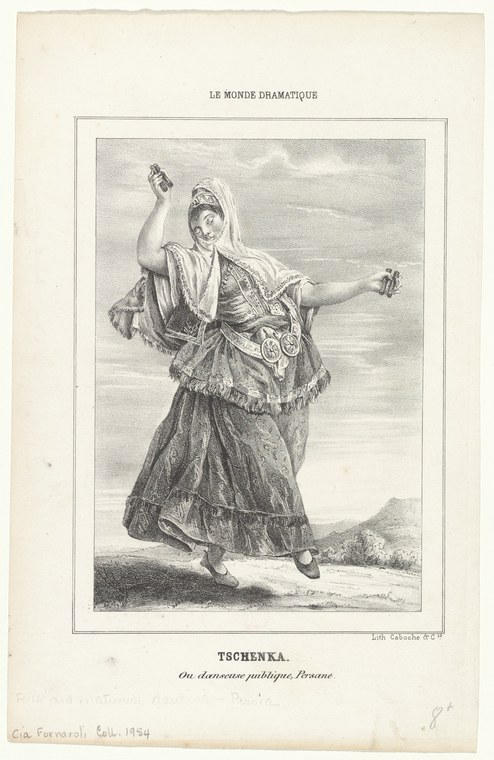
A woman in elaborate costume stands alone against a distant mountainous landscape, captured in a moment of dynamic movement. She wears a long, heavily patterned garment with dense embroidery or brocade across the bodice and skirt, topped with a short fitted jacket or vest. A white headscarf or veil drapes from her head, falling loosely across her shoulders. Her posture is expansive and energetic: her right arm is raised high with the hand positioned near her head in a gesture suggesting snapping fingers or castanets, while her left arm extends outward with a graceful curve. Her body twists slightly, weight shifted onto one leg, creating a sense of suspended motion—the kind of pause within an active phrase that engraving artists favored. The composition isolates her figure against a plain sky, making her costume and gesture the focus. The engraving's fine hatching creates subtle modeling of light and fabric texture, emphasizing the richness of the garment's surface.
The dancing
A single female dancer occupies the frame. Her body is articulated in a clearly trained pose: the spine curves gently, the pelvis tilts, and the weight appears shifted onto the back leg, creating the characteristic S-curve of a body mid-phrase. The raised right arm, with hand near the head and fingers splayed or snapping, is a gesture common to Middle Eastern and Central Asian dance traditions. The extended left arm creates an open frame. The level of detail in the figure's posture—the angle of the hip, the curve of the waist, the deliberate hand position—suggests the artist had observed this dance style, not invented it.
The dance depicted
This is almost certainly a representation of Persian or Central Asian dance, most likely from the tradition known as Lazgi (a courtly dance of the Tajik and Uzbek regions) or related styles of the Caucasus and western Central Asia. The costume—the embroidered robe, fitted vest, head covering, and the ankle-length cut—is consistent with 19th-century documentation of these traditions. The raised arm with snapping or castanets-like hand position is characteristic of Lazgi and related forms, where the upper body and arms carry much of the rhythmic and expressive content while the feet work in quick, grounded patterns. The title "Tschenka" (likely a transliteration of a local name) suggests a specific local or regional variant. The woman's soloist stance and the theatrical framing indicate this was likely a performance tradition viewed by European audiences, possibly at a court, exhibition, or traveling company.
How it was made
This is a finely executed steel or copper engraving, identifiable by the parallel hatching lines that model form and shadow, the crisp black line work, and the tonal range achieved through density of line rather than wash or wash-and-line. The technique allows for high detail in textile pattern and facial features, and the print medium meant this image circulated widely—it could be bound into journals, travel accounts, or theatrical publications, or sold as a standalone print. The precision and finish suggest this was created for a relatively educated audience with access to such printed materials, possibly accompanying a written account of Persian or Central Asian customs and performance traditions.
About this work
This engraving documents a Persian or Central Asian female dancer, identified by the title as a regional variant called Tschenka. The work is a formal portrait of performance, capturing the dancer in a characteristic pose of raised arm and extended frame that would be recognizable to audiences familiar with these traditions. The costume, rendered with great attention to embroidered detail, and the dancer's composed but energetic posture place the work within 19th-century European ethnographic interest in the dances of the Islamic world and Central Asia—a moment when such traditions were being documented, categorized, and circulated through printed images. The engraving's precision and theatrical framing signal that this is not a casual sketch but a deliberate record of a recognized performance style.
How to look at it
Attend to the dancer's posture and the deliberateness of each gesture: the raised arm is not raised casually but positioned with precision near the head, suggesting it is part of a codified movement vocabulary. The extended left arm, the slight twist of the torso, and the weight shift all indicate the artist understood this as a trained dance form with its own grammar, not merely an exotic pose. Notice also the costume—the engraver has taken care to render the embroidery, the layering of garments, and the fall of the veil, using line density to suggest richness of fabric. These details anchor the image in a specific tradition rather than leaving it as a generic "Oriental dance." The isolated figure against a simple landscape, a common convention for theatrical or ethnographic portraiture, frames this as a performer and a documented subject.
The period
This engraving dates to the 19th century, a period of intense European ethnographic interest in the Ottoman Empire, Persia, and Central Asia, driven by imperial expansion, travel writing, and the growth of illustrated periodicals. Dance and costume from these regions were popular subjects in European art and literature, often tied to Orientalist aesthetics that prized richness of detail and exoticism. At the same time, this was also a period when performance traditions from these regions were being documented more systematically—through travel accounts, museum collections, and theatrical adaptations. The style and technique of the engraving place it within the conventions of mid-to-late 19th-century reproductive print, when such images would appear in art journals, travel narratives, or ethnographic compilations aimed at a European readership curious about distant lands.
Where it lives
This engraving is held in the New York Public Library's collection of prints depicting dance. The inscription at the lower left appears to reference a publication or source (possibly a date or collection mark, though precise reading is unclear from the image alone).
Dance in this work
Questions about this work
What is Lazgi dance and how does this image show it?
Lazgi is a courtly solo or group dance from Tajik and Uzbek traditions, characterized by a proud, upright posture, articulate arm and hand movements (including finger snapping and hand positions reminiscent of castanets), and quick intricate footwork performed in place or with small traveling steps. This engraving captures the upper-body vocabulary: the raised arm, the extended frame, and the implied hand gesture are all typical of Lazgi. The long, heavily embroidered robe and vest costume match documented 19th-century dress for this tradition.
Who would have danced this and for whom?
Lazgi and related Central Asian dances were performed primarily by women in court contexts, at celebrations, and in professional entertainment settings. By the 19th century, they were also performed for Western audiences and documented in travel accounts and exhibitions. The theatrical framing and high finish of this engraving suggest it was created for a European audience interested in ethnographic documentation of distant cultures.
What does the title 'Tschenka' mean?
Tschenka appears to be a transliteration of a local or regional name for this dance or style variant, but without additional context from the original publication, the precise meaning and etymology cannot be established with certainty. It may refer to a specific regional variant of Lazgi or a related dance form from the Caucasus or Central Asia.
How was this image made and circulated?
This is a steel or copper engraving, a printmaking technique that allowed for fine detail and wide circulation. Prints like this would have been published in illustrated journals, bound into travel narratives or ethnographic works, or sold as individual plates to collectors and institutions. The technique and level of finish indicate it was created for an educated, affluent audience interested in the visual documentation of distant lands.
More dance artwork





