49 works in this view — arrow keys or swipe to move between them.
Dance in Art
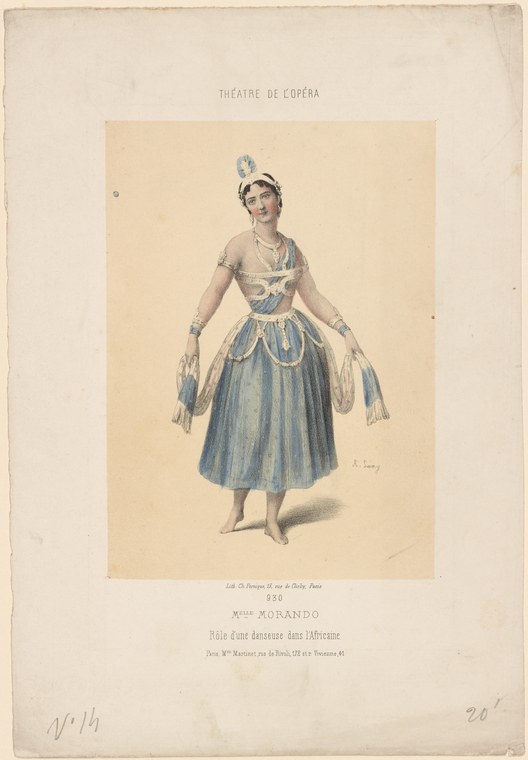
Melle Morando rôle d'une danseuse dans l'Africaine
Unknown artist
- Collection:
- Prints depicting dance
- Source:
- New York Public Library
- Rights:
- Public domain — free to use, share and adapt.
- Recorded as:
- Public Domain
This print is a precise visual record of how a celebrated dancer presented herself in a celebrated role, capturing the ideal body, posture, and costume aesthetics of Second Empire French ballet. It documents the persistence of orientalism in 19th-century theatrical dance and the central role of star performers in selling both opera and ballet to the theater-going public.
What you are looking at
A single female dancer stands in a frontal pose against a plain cream background, dressed in an elaborate mid-19th-century theatrical costume. She wears a fitted white bodice with gold trim and a low neckline, long white gloves extending past the elbow, and a voluminous skirt of pale blue silk reaching to mid-calf. A gold sash or belt cinches her waist with decorative tassels. On her head sits an ornate feathered headdress with what appears to be a jeweled ornament. Her posture is upright and composed, weight evenly distributed, with her arms held at mid-level in a relaxed position. The image is a hand-colored engraving or lithograph printed in pale tones, presented as a formal portrait of a named performer in a specific theatrical role.
The dancing
The dancer stands in an open, frontal stance with neutral weight distribution and an extended arm position that suggests neither active movement nor the closing hold of partner dance. Her arms are slightly raised and held away from her body in a pose of presentation rather than action. The upright carriage and squared shoulders are characteristic of academic ballet of the era. There is a single figure; the composition is a portrait of the individual performer.
The dance depicted
This is a theatrical ballet costume portrait, likely documenting a specific performance role. The inscription names the performer as 'Melle Morando' in the role of 'une danseuse dans l'Africaine'—a dancer in *L'Africaine* (*The African Woman*). This refers to the Meyerbeer opera, which received its premiere in 1865 and was staged with elaborate ballet divertissements in the French tradition. The costume—the ornate headdress, the exotic-coded blue and white palette, the theatrical silhouette—is typical of European ballet's orientalist fantasies of the 1860s–70s. Morando was a named principal dancer, and this print served as a record of her performance in a celebrated role.
How it was made
This is a hand-colored lithograph or engraved print, a common format for theatrical portraiture in the mid-to-late 19th century. The fine linear work and the precision of the costume details suggest engraving or lithographic transfer. The hand-coloring is delicate and selective, emphasizing the pale silk tones and gold embellishment. Such prints were mass-produced and distributed through theatrical print sellers and collected as mementos of celebrated performers and roles, making them accessible to a wide audience of opera- and ballet-goers.
About this work
This is a theatrical portrait engraving documenting a specific ballet performance by a named dancer in a celebrated operatic spectacle. It records both the star performer and the visual codes of mid-Victorian Romantic ballet—the pale tutu, the ornate headdress, the fantasy 'exotic' costume. The image belongs to a vast tradition of theatrical print culture in which dancers were celebrated as individual stars and their roles as iconic spectacles. For dance historians, it is valuable evidence of the look, silhouette, and the star system of French ballet in the 1860s–70s, a period when ballet was primarily consumed through opera and pantomime spectacles rather than as independent works.
How to look at it
Attend to the stillness of the pose: this is not a moment of motion but a formal presentation of the costume and the performer's body as a complete image. The headdress and the ornate trim are as important to the composition as the dancer herself; this is costume-as-spectacle. Notice the pale, refined palette and the precision of the hand-coloring—the markers of a high-quality, expensive print aimed at an affluent audience. The frontality and the neutral expression are conventions of theatrical portraiture designed to showcase the individual star.
The artist
The artist is not recorded in the catalogue, but the signature appears to read 'A. Lemy' (or similar). The work is printed by Martinet, a major Parisian theatrical print publisher of the era, suggesting it was a professional commission within a commercial print-publishing enterprise rather than a unique work of fine art.
The period
This print dates to the era of Romantic ballet's decline and the rise of the grand operatic spectacle, particularly under the direction of the Paris Opéra in the 1860s–70s. Ballet was integrated into opera as a divertissement rather than existing as independent evening-length works. The costume and pose reflect the Romantic tutu aesthetic that had dominated the 1840s–50s, now fading in favor of heavier, more ornate theatrical spectacles. The print format itself reflects the commercialization of theatrical celebrity and the print industry's role in creating and circulating images of admired performers.
Where it lives
The print is held in the New York Public Library's print collection devoted to dance imagery. It was published by Martinet in Paris and is identified as part of a series of theatrical performer portraits, likely sold singly or in collections at the theater or through print sellers.
Dance in this work
Questions about this work
Who was Melle Morando?
Morando was a named principal dancer of the mid-19th-century Paris Opéra, celebrated enough to be immortalized in theatrical prints. Little biographical information survives, but her appearance in *L'Africaine* marks her as a star of the operatic ballet scene. She is now known primarily through images such as this one.
What is *L'Africaine*?
*L'Africaine* is a grand opera by Giacomo Meyerbeer, premiered in 1865 at the Paris Opéra. It was a massive spectacle featuring elaborate ballets and designed to showcase the technical and decorative resources of the Opéra's corps and principal dancers. The opera was extremely successful and generated considerable theatrical merchandise, including this print.
Why the exotic costume?
The blue and white palette, feathered headdress, and ornate styling reflect 19th-century European orientalism—a fantasy vision of non-European cultures that served the theatrical imagination. Ballet and opera used such costumes as a shorthand to signal 'otherness' and excitement, often without ethnographic accuracy or respect.
How was this print made and distributed?
This is a lithographic or engraved print hand-colored by workshop artisans, a labor-intensive but commercially viable process. Prints like this were sold through theater lobbies, print shops, and subscription services, allowing middle-class audiences to own images of celebrated performers.
More dance artwork





