49 works in this view — arrow keys or swipe to move between them.
Dance in Art
French fashion plates
Unknown artist
- Collection:
- Prints depicting dance
- Source:
- New York Public Library
- Rights:
- Public domain — free to use, share and adapt.
- Recorded as:
- Public Domain
Fashion plates are archives of how bodies were expected to move and appear. This image captures the moment when Romantic ballet's aesthetic—the lifted torso, the extended line, the sense of effort concealed as ease—penetrated everyday fashionable life. For historians of dance and deportment, it shows how elite women internalized balletic movement not as trained dancers but as women of fashion.
What you are looking at
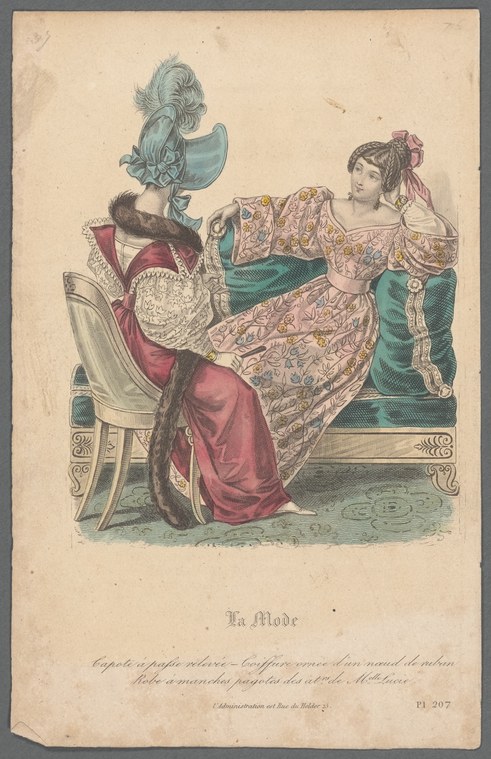
A seated woman in a fashionable gown of the 1820s–1830s engages with a standing woman in a theatrical pose. The seated figure wears a richly patterned dress in rose and cream with a low neckline and billowing sleeves, her dark hair adorned with a feathered headdress; she reclines at ease in a neoclassical chair. The standing figure, dressed in an emerald-green corseted gown with ornamental gold trim, strikes an elegant, almost balletic contrapposto: one leg extended, the body lifted, the arm positions suggesting studied grace. The standing woman's head tilts gracefully, her gaze directed away. The setting is spare—a simple columned base to the chair, minimal background—focusing all attention on the interplay between repose and choreographed elegance. The colored engraving captures the refined artifice of salon fashion during the Romantic era, where dress itself was a form of performance.
The dancing
The standing figure's posture is notably composed and lifted: weight appears balanced on one leg with the other extended, the torso held upright with the shoulder back, the arm curved gracefully. This is not a natural resting pose but a studied, elongated line—the silhouette a dancer or actor might adopt. The seated woman, by contrast, reclines in relaxed luxury, creating a compositional dialogue between repose and readiness. The spatial relationship suggests an informal social or theatrical moment rather than a formal dance partnership; there is no closed hold, no symmetry, only a shared aesthetic of bodily refinement.
The dance depicted
This is a fashion plate rather than a documentation of dance, yet it depicts a moment heavy with bodily performance. The standing woman's deportment—lifted sternum, extended leg, graceful arm—recalls the vocabulary of Romantic ballet or the theatrical conventions of ballroom elegance in the 1820s. No specific dance is enacted; instead, the image captures the ideal feminine body in motion as imagined by fashion discourse of the period. The extended line and lifted posture would have signaled grace, breeding, and modernity to a contemporary viewer schooled in ballroom etiquette and theatrical taste.
How it was made
This is a hand-colored engraving, typical of luxury fashion-plate production in early 19th-century Paris. The fine linear work establishes form with precision while the watercolor or aquatint wash adds richness and distinction. Fashion plates of this period circulated among the wealthy and fashion-conscious as aspirational models—not documentary but prescriptive, teaching posture, dress, and deportment. The technique allowed for rapid reproduction and wide distribution, making these images powerful agents in the dissemination of Romantic ideals of feminine elegance and movement.
About this work
This is a French fashion plate from the Romantic era, likely 1820s–1830s, showing two women in a moment of refined social or theatrical interaction. The standing figure's lifted posture and extended line—her body composed as if for a drawing room or stage—embody the balletic ideals that shaped elite feminine movement in this period. Though labeled a fashion plate, the work is saturated with dance vocabulary: the lifted carriage, the graceful arm, the sense of the body as an instrument of beauty and social signaling. It belongs in a dance archive not because it documents an actual dance, but because it reveals what movement and deportment meant to Romantic society—a synthesis of ballroom elegance, theatrical refinement, and the emerging aesthetic of ballet.
How to look at it
Notice the standing woman's weight distribution and spinal alignment—how her body is organized to create an elongated, lifted line rather than a natural, relaxed stance. Observe how her arm curves and her head tilts away, creating a sense of interiority and refinement. The contrast with the seated woman's sprawling ease makes the standing figure's composure more emphatic. This is a moment of performance captured as fashion: the body is on display, its lines admired, its movement choreographed by social convention.
The artist
The image is credited to no individual artist, which is typical for fashion plates of this era. They were collaborative productions, often unsigned or attributed only to the publishing house. The style and finish suggest a skilled practitioner working within the Parisian fashion-plate industry, likely under the direction of a fashion editor or house designer. These plates were distributed through periodicals, almanacs, and fashion journals to elite audiences across Europe.
The period
The 1820s–1830s were the height of European Romanticism, when the aesthetic ideal of the ethereal, lifted female body—epitomized by dancers like Marie Taglioni—exerted enormous influence on fashion, posture, and social behavior. Simultaneously, the ballroom waltz and other social dances were transforming the bodily closeness and movement allowed in polite company. This fashion plate sits at the intersection: it shows how Romantic ballet's visual language of elevation and grace was adopted by fashionable society as a marker of refinement and modernity. The image reflects the period's obsession with the feminine body as an object of aesthetic contemplation and controlled, graceful display.
Where it lives
The work is held by the New York Public Library as part of its prints collection, specifically within its assemblage of prints depicting dance. The catalogue entry is sparse, reflecting the sometimes minimal attribution given to fashion plates of the era.
Dance in this work
Questions about this work
Is this actually a dance or just a fashion image?
It is a fashion plate, not a document of an actual dance performance. However, it uses the vocabulary of dance—lifted posture, extended line, graceful arm placement—to convey ideals of feminine beauty and movement. For historians of dance, that vocabulary itself is the important thing: it shows how Romantic ballet's aesthetic pervaded everyday fashion and social behavior.
What dance style does this reflect?
No single dance style is depicted. Instead, the standing figure's posture embodies the general aesthetic ideals of Romantic ballet and ballroom deportment of the 1820s–1830s: elevation, ease, grace, and a lifted, lengthened line. These ideals influenced how women of fashion were expected to move in both social and theatrical settings.
How were fashion plates made and used?
Fashion plates were hand-colored engravings produced in Paris and other fashion capitals, typically published in fashion journals and sold as models for dressmakers and fashionable women. They were aspirational and prescriptive: they taught not just what to wear but how to stand, how to move, and what bodily ideals to emulate.
More dance artwork





