49 works in this view — arrow keys or swipe to move between them.
Dance in Art
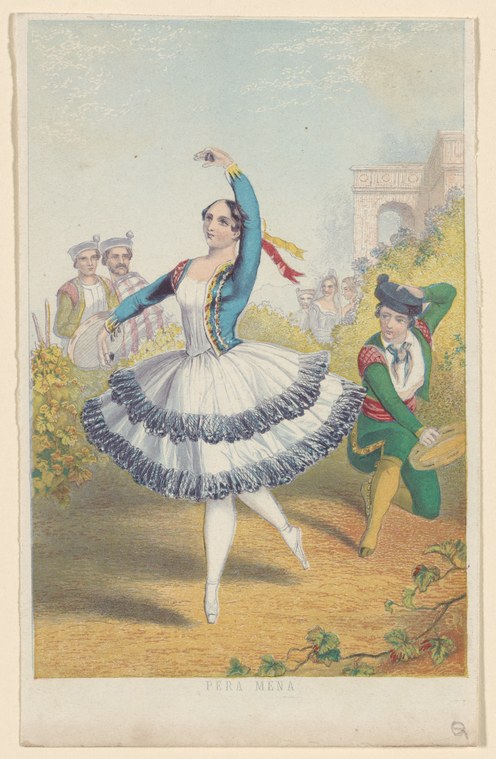
Pera Mena
Unknown artist
- Collection:
- Prints depicting dance
- Source:
- New York Public Library
- Rights:
- Public domain — free to use, share and adapt.
- Recorded as:
- Public Domain
This print preserves the visual record of Romantic ballet technique and costume at a moment when the ballerina's pointe work and ethereal elevation defined the medium. The care lavished on the dancer's anatomy, the tutu's construction, and the theatrical setting reveals what audiences valued and what dancers aspired to achieve. For historians of dance and of theatrical visual culture, it is a window into the aesthetic ideals, gender dynamics, and performance conventions of 19th-century ballet.
What you are looking at
A female dancer in a classical tutu stands at the center of this hand-colored engraving, captured mid-leap with one leg extended high and arms raised in an elegant port de bras. She wears a white tutu with a decorative dark blue border, a short-sleeved blue jacket, and pointe shoes, positioned in a sun-lit garden or courtyard setting. The background shows classical architecture—a fortified structure with crenellations—and verdant vegetation. To her left stand two male figures in period dress (one in yellow-gold, one in burgundy), apparently musicians or attendants; to her right another male figure in green observes the performance. The composition is staged and theatrical, with the dancer occupying the visual foreground and commanding the scene through her verticality and grace.
The dancing
The lead dancer is weightless and extended, lifted high on one leg with the supporting foot pointed and turned out. Her free leg is drawn up and extended at an acute angle, her torso held erect, and both arms raised in a classical frame—the raised arm bent at the elbow in a graceful curve. The pose suggests a moment of suspension at the apex of a jump or développé. The three male figures are static observers and musicians; their dress and posture suggest they are attendants rather than participants. The dancer's isolation in the center and the male figures' peripheral placement follow the gender conventions of Romantic-era ballet, where the ballerina is the focus and male dancers serve a supporting role.
The dance depicted
This is classical Romantic ballet, almost certainly depicting a celebrated ballerina in a famous solo or divertissement, likely from the mid-19th century. The pointe work, tutu style, jacket, and garden setting are all hallmarks of Romantic ballet technique and costume. The inscription 'PERA MENA' may be a title or character name, though it is not immediately recognizable to standard ballet repertoire from surviving records. The image celebrates the ballerina as a virtuosic performer capable of elevation and extension—the defining aesthetic of the Romantic period. The theatrical setting and the presence of musicians or attendants suggests a scene from a full ballet production rather than a concert piece.
How it was made
This is a hand-colored engraving, executed with fine line-work typical of mid-19th-century theatrical prints. The artist used aquatint or similar tonal technique for the background and applied watercolor or hand-coloring to the figure and setting, resulting in soft gradations of color and light. The technique was well-suited to theatrical documentation and promotion: engravings could be produced in multiple copies and hand-colored individually, making them affordable souvenirs and promotional materials for performances. The delicate rendering of the dancer's musculature, the precise delineation of the tutu's construction, and the careful shading of the architectural setting all reflect the high standards of theatrical ephemera production in this period.
About this work
This hand-colored engraving documents a classical Romantic ballet performance, featuring a female soloist in full virtuosic arabesque or développé, attended by musicians and observers in a garden setting. The work is a theatrical print of the type circulated as souvenirs and promotional material during the heyday of Romantic ballet, likely from the 1840s–1860s. It exemplifies the visual culture of ballet in this period: the ballerina elevated and isolated as the aesthetic and dramatic center, her body displayed as an instrument of grace and technical accomplishment, while male dancers and musicians occupy supporting roles. The engraving is both documentation and fantasy—a record of a real performance moment stylized and idealized for public consumption.
How to look at it
Watch the dancer's suspension: the artist has frozen her at the apex of a jump or sustained développé, the moment of maximum grace and weightlessness. The extended free leg, the pointed foot of the supporting leg, and the elongated port de bras all conspire to create a silhouette of perfect vertical alignment and extension—the Romantic ideal. Notice how the artist has rendered the tutu not as a static skirt but as fabric animated by motion, its edges crisp and its folds catching light. The garden setting and the presence of male observers place this moment in a narrative context—a performance for an audience—rather than an abstract study of technique.
The period
This work dates to the Romantic era in ballet, roughly 1830–1870, when Romantic aesthetics—a cult of the ethereal, the supernatural, the emotionally intense—transformed ballet from a court spectacle into a popular theatrical form. Dancers like Marie Taglioni, Fanny Elssler, and Carlotta Grisi became celebrities, and the ballerina became the visual embodiment of Romantic ideals: weightless, virtuosic, otherworldly. The tutu shortened during this period, allowing for greater visibility of pointe work and elevation. Theatrical prints and engravings became a major medium for documenting and promoting performances, circulating images of celebrated dancers to a mass audience. The title 'Pera Mena' has not been securely identified, but the costume and pose are entirely consistent with a mid-19th-century Romantic ballet solo.
Where it lives
This work is held in the New York Public Library's prints collection, part of a larger archive of theatrical dance imagery from the 19th century. It is a theatrical print, a category of ephemeral material designed for circulation as a souvenir or promotional item, and likely was sold to audience members or collectors of the period.
Dance in this work
Questions about this work
What is the title 'Pera Mena' and who danced this role?
The title is not securely identified in surviving ballet records. 'Pera Mena' may be a character name, a piece title, or a performer's name transliterated from another language. Without additional documentation, the specific performance and dancer remain uncertain, though the costume and technique are consistent with mid-19th-century Romantic ballet soloists.
How do I know this is ballet and not another form of dance?
The pointe shoes, the turned-out positions, the tutu, the garden setting, and the pose are all definitive markers of Romantic ballet. The height and angle of the extension, the verticality of the spine, and the arm positions reflect classical ballet technique and aesthetic principles.
Why are the men dressed differently and positioned at the edge?
In Romantic ballet, male dancers took subordinate roles as attendants, musicians, and partners, while the ballerina was the star and focus. This print reflects that convention: the men are observers or support figures, not dancers themselves. The woman's isolation and elevation make her the undisputed center of attention.
Is this a record of an actual performance or an artist's invention?
It is likely a stylized record of an actual performance, or a composite inspired by famous performers and roles of the period. Theatrical prints of this era often elevated and idealized the moment they documented, removing flaws and emphasizing grace. It is both documentary and promotional.
More dance artwork





