49 works in this view — arrow keys or swipe to move between them.
Dance in Art
French fashion plates
Unknown artist
- Collection:
- Prints depicting dance
- Source:
- New York Public Library
- Rights:
- Public domain — free to use, share and adapt.
- Recorded as:
- Public Domain
This plate documents the foundational visual vocabulary of Romantic ballet at the moment of its invention. For dance historians and costumers, it provides direct evidence of how the sylph costume was actually constructed and worn on the Paris stage in the 1830s—information that survives in few other sources. The image shows that the Romantic silhouette was not a tutu but a long, gathered skirt; the sylph's otherworldliness was conveyed through lightness of fabric, ornamental patterning, and an off-shoulder, décolleté exposure of the body—a deliberate transgression of the modest dress codes of the period.
What you are looking at
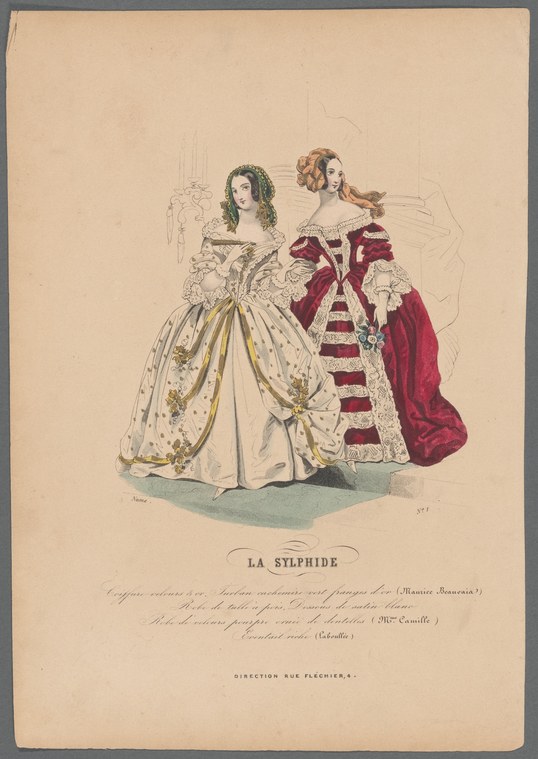
Two fashionably dressed women stand together in a formal interior setting, posed for presentation rather than captured in motion. The woman on the left wears a pale silk gown with a fitted bodice, off-shoulder neckline, and an elaborate skirt decorated with gold embroidery or appliqué arranged in a scattered pattern; her dark curled hair is crowned with what appears to be a jeweled ornament. The woman on the right wears a deep crimson velvet gown with white fur trim and wide sleeves lined in white fur, creating a striking contrast of color and texture; her auburn hair is styled in elaborate curls arranged at the back of her head. Both women stand in a three-quarter pose, their bodies angled toward each other but not touching, in the formal stance of a social presentation. The background is sketched minimally—barely suggested architectural or drapery elements—allowing the costumes to dominate the composition. The foreground shows a flat shadow beneath their feet, emphasizing the figures against a neutral ground. The inscription "LA SYLPHIDE" appears in italic capitals at the foot of the image, with additional text in smaller French script below.
The dancing
Both figures are stationary and upright, posed in the refined stance of formal dress display rather than the dynamic deportment of active dancers. Their bodies face slightly inward toward each other, their arms hang naturally or rest lightly at their sides—there is no embrace, no partnering hold, no weight shift or counterbalance. The posture is that of a figure in a salon or theater foyer, presenting costume rather than executing movement. Neither woman shows the pointed foot, lifted chest, or gathered frame of a trained dancer in motion.
The dance depicted
The inscription identifies this as *La Sylphide*, the foundational Romantic ballet first performed in Paris in 1832. The image appears to depict two characters from the ballet in their stage costumes: the sylph in her ethereal pale gown, and a supporting character (likely Effie, the mortal bride) in her formal dress. However, this is a fashion plate—a costume illustration intended to document stage dress for readers and viewers—rather than a representation of dance action. The figures are posed as they might appear in a curtain call or costume display, not mid-performance.
How it was made
This is a hand-colored engraving or lithograph, produced by the direction of Rue Fleurus in Paris (visible in the imprint). The technique combines fine linear engraving with selective hand-coloring in watercolor or tinted pigment—the dresses are rendered in full color while much of the background remains in ink outline only. This hybrid method was standard for fashion and theatrical costume plates of the 1830s–1850s, allowing for wide circulation at moderate cost while preserving the fine detail necessary to convey fabric, trim, and construction to seamstresses, designers, and theater enthusiasts. The colored prints were pasted into albums or periodicals and formed a crucial part of the visual culture of fashion and ballet.
About this work
This is a fashion plate documenting the stage costume design for *La Sylphide*, the canonical Romantic ballet. Rather than depicting a moment of choreography, it presents two characters in their performance dress in a formal, static pose suitable for reproduction and study. The image belongs in a dance gallery because *La Sylphide* (1832) marked the birth of Romantic ballet—the moment when the supernatural, the ethereal, and the female body became central to the ballet aesthetic. The costume design itself—the sylph's pale, diaphanous gown and the mortal woman's earthly finery—embodies the core narrative and visual logic of the Romantic era.
How to look at it
Observe the two silhouettes as a study in contrasts: the pale, weightless, off-shoulder gown of the sylph set against the earthly splendor of the mortal woman's crimson and fur. Note the attention to ornament—the scattered gold embroidery on the sylph's skirt suggests an ethereal, irregular beauty, while the deliberate geometric bands of trim on the red dress assert human order and status. The pose is deliberately still and formal—characteristic of fashion plate convention—but the costume design itself carries all the narrative and symbolic content: the sylph's exposed shoulder and delicate pale fabric versus the mortal's covered, richly colored, and structurally assertive dress tell the entire story of the ballet.
The artist
The artist is not recorded in the catalogue. However, the imprint indicates this plate was published under the direction of Rue Fleurus in Paris, a known address for theatrical and fashion lithographers. The inscription in French and the high quality of the draftsmanship suggest this was produced by a professional atelier serving the Parisian theater and fashion press. Such houses employed multiple artists and colorists and typically did not credit individual contributors.
The period
The Romantic era (c. 1830–1850) saw ballet emerge as a dominantly female-centered art form, driven by the cult of the ethereal and supernatural dancer. *La Sylphide*, choreographed by Filippo Taglioni for his daughter Marie in 1832, crystallized a new aesthetic: the female body as vehicle for dreams, spirits, and unattainable desire. Fashion plates like this circulated in the same periodicals as literary criticism and dance reviews, making ballet costume a matter of public fashion as well as theatrical spectacle. The image dates to the height of Romantic ballet's influence on both stage and street fashion.
Where it lives
This plate is held as part of the NYPL's collection of prints depicting dance. It is one of numerous French fashion and theatrical costume plates produced for circulation in the 1830s–1840s, likely originally published in a journal or sold as a loose print for framing or album insertion.
Dance in this work
Questions about this work
Is this a picture of dancers actually dancing?
No. This is a fashion plate—a costume illustration designed to document stage dress. The figures are posed statically for presentation, not captured in movement. Fashion plates served both theatrical and commercial audiences: they showed audiences what ballerinas wore, and allowed dressmakers to replicate or adapt the designs. They are documents of costume and design, not choreography.
What ballet is this from?
*La Sylphide*, the foundational Romantic ballet premiered in Paris in 1832, choreographed by Filippo Taglioni. The plate shows two characters: the sylph (the supernatural creature of the title) and Effie (the mortal bride). The sylph's pale, ethereal costume and the mortal woman's earthly finery represent the central dramatic conflict of the work.
Why is the sylph's dress so different from a modern ballet tutu?
The Romantic tutu was a long, gathered skirt reaching to mid-calf or ankle, not the short, stiff tutu of later Classical ballet. The length and flow of the fabric created an ethereal, floating effect that matched the Romantic aesthetic of weightlessness and supernatural beauty. The absence of structure also allowed for the flowing arm movements central to Romantic choreography. The tutu was shortened and stiffened in the late 19th century as ballet technique evolved toward faster footwork and higher extensions.
Who made this print?
The artist is not recorded, but the imprint shows it was published under direction of Rue Fleurus in Paris, a known address for theatrical and fashion lithographers. Such prints were often collaborative—drawn by one artist, colored by others—and the individual contributors were rarely credited.
More dance artwork





