49 works in this view — arrow keys or swipe to move between them.
Dance in Art
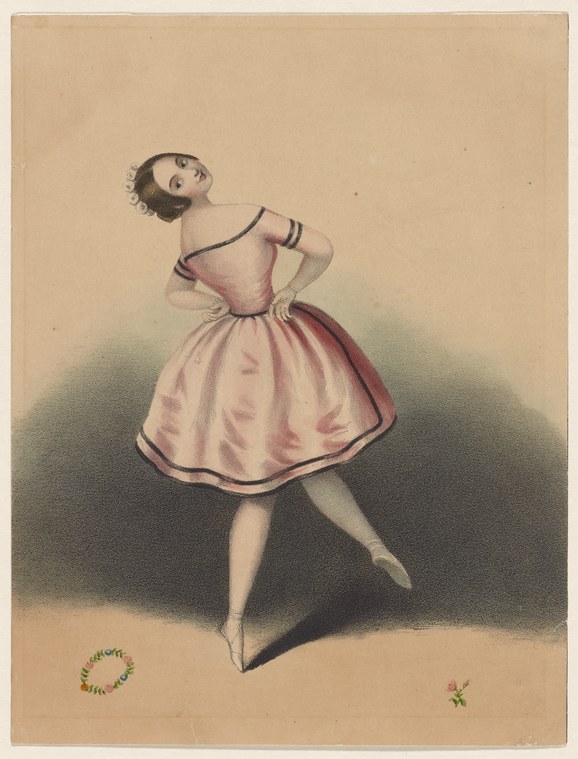
Clara Webster: Beauty of Ghent
Unknown artist
- Collection:
- Prints depicting dance
- Source:
- New York Public Library
- Rights:
- Public domain — free to use, share and adapt.
- Recorded as:
- Public Domain
This print captures the look, the pose, and the commercial presentation of a Romantic ballet dancer of the 1830s–1840s—a moment when ballet became a fashionable entertainment and female dancers became objects of cult devotion. The image shows us how the Romantic ideal was packaged and sold to the public, and what dancers of the period were expected to look like on stage. For historians, it is evidence of both the aesthetic and the economics of dance in this crucial period.
What you are looking at
A young female dancer in a pale pink dress stands alone against a neutral ground, her body caught mid-movement in a pose of pronounced elegance. She wears a short, full skirt with darker pink or wine-colored trim at hem and waistband, paired with a fitted bodice featuring off-shoulder styling and dark ribbon bands at the upper arms. Her dark hair is styled up in a period coiffure. The dancer's weight is shifted onto her right leg, which is extended behind her in an extended line; her left leg supports her upright frame. Her posture is highly arched and refined—the chest lifted, the head tilted back and to one side in a gesture of grace or abandon. The background is rendered in soft, atmospheric tones that suggest depth through graduated shading, creating an ethereal, stage-like space. Two small ornamental elements appear in the lower corners: what appears to be a wreath or circular motif on the left, and a small flowering plant on the right, suggesting a decorated theatrical or ballroom setting.
The dancing
The dancer is alone in the frame, her body articulated with the precise control expected of a trained performer. Her extended leg line is straight and long, suggesting strength and flexibility; her supporting leg is straight but with a subtle sense of sprung energy in the knee. The arm positions are elegant but not codified in any strict academic vocabulary—one arm appears to be raised or positioned expressively rather than in a closed ballroom frame. The overall posture shows a marked backward arch of the torso, which was a hallmark of Romantic-era ballet presentation. The head position is thrown back in an attitude of theatrical expression or reverie.
The dance depicted
This is almost certainly a Romantic ballet dancer of the 1830s–1850s, and the image likely depicts a specific named dancer and role, though the catalogue gives us only the title 'Clara Webster: Beauty of Ghent.' The pose and dress are consistent with the solo presentations and *pas* that defined the Romantic repertory: a moment of suspended grace, the dancer isolated in a spotlight-like compositional space. The arched back, the extended leg, the lifted chest, and the dreamy head position are all vocabulary of Romantic ballet. The short tulle skirt—though simpler than a full *tutu à l'opéra*—is consistent with stage wear of the period. Without identifying marks or a signature visible, we cannot know whether this is a documented image of Webster herself or a commercial print made to capitalize on her fame.
How it was made
This is a hand-colored engraving or lithograph, most likely produced in the 1830s or 1840s for commercial distribution. The technique allowed for fine linear detail in the dancer's form and delicate shading in the face and drapery, while the hand-coloring was applied over a printed base—note the soft, slightly irregular application of the pink and flesh tones. This method was standard for theatrical portraiture of the era: affordable enough to sell to a broad audience of theatre-goers, yet refined enough to serve as a souvenir or token of fandom. The small size and the presence of decorative elements (the wreath and flower) suggest this was a commercial print, possibly sold as a loose sheet outside the theatre or as part of a series of performers.
About this work
This is a theatrical portrait of a Romantic-era ballet dancer, likely made in the 1830s–1850s, celebrating the performer Clara Webster in a role or signature pose. The image captures the aesthetic values of Romantic ballet: the elevation and extension of the body, the sense of weightlessness and ethereal grace, and the solitary, spotlight-like presentation of the female dancer. The hand-colored engraving or lithograph format was the standard way audiences encountered images of their favorite dancers during this period—affordable prints that circulated widely outside the theatre and served as mementos of live performance. For a historian of Romantic ballet, this image documents not only performance aesthetics but also the apparatus of celebrity and fan culture that surrounded the leading dancers of the era.
How to look at it
Notice the extreme arch of the dancer's back and the way the head is thrown back—this was a signature Romantic pose, meant to suggest dreaminess, abandon, or the dancer's entry into a supernatural or emotional realm. The elongation of the leg line and the precision of the foot position show that this is a trained, professional dancer, not an amateur. The pale, almost translucent coloring of the skin and the ethereal quality of the composition reflect how Romantic artists wanted the ballerina to appear: as if she were not quite of this world. Pay attention to the way the artist has composed the figure in isolation against a soft background—this staging convention made the dancer stand out as an object of worship or admiration, a visual strategy that mirrors the role of the star performer on stage.
The artist
The artist is not recorded in the catalogue. The engraving or lithographic technique suggests a commercial print shop, likely in London (given the English names and the 'Beauty of Ghent' epithet, which may reference a famous role or pose). Such prints were often made after quick sketches or performance notes by artists who may or may not have seen the dancer live; the aim was to capitalize quickly on a performer's popularity.
The period
Romantic ballet was at its height in the 1830s–1850s, the era of Marie Taglioni, Carlotta Grisi, Fanny Essler, and other female stars who became celebrities as much as dancers. The commercial publication of theatrical prints flourished during this period: lithography and hand-coloring made it possible to produce affordable, colorful portraits of performers for mass circulation. Ballet had moved from the court and the aristocratic salon to the public theatre, and the rise of the box office and the star system created a demand for images of famous dancers. These prints were sold to fans, displayed in homes, and collected like the theatrical trading cards of later eras. The Romantic movement in the arts emphasized emotion, grace, the supernatural, and the feminine ideal, all of which are evident in the aesthetics of this image.
Where it lives
This print is held in the New York Public Library in a collection of prints depicting dance. It is a commercial theatrical souvenir, likely sold or given away in connection with performances in London or another major theatrical center. The hand-coloring and the wear visible in the image suggest it is an original hand-colored print from the period, not a later reproduction.
Dance in this work
Questions about this work
Was Clara Webster a real dancer, and did she really perform this role?
The catalogue gives us only the title and the name, so we cannot be certain. It is plausible that Webster was a known performer of the 1830s–1850s, and that this print was made to commemorate a famous role or appearance. However, without additional documentation, we cannot verify her biography or confirm the accuracy of the role title. Such prints were sometimes made speculatively or with loose connection to actual performances.
What does 'Beauty of Ghent' refer to?
This may be the title of a ballet or a specific scene within a ballet, or it may be a poetic epithet applied to the dancer herself. Ghent was a major theatre center in the Low Countries, and the title might reference a role Webster danced or premiered there. Without additional sources, the reference cannot be resolved.
What is that wreath in the lower left corner?
It is likely a decorative motif, possibly a laurel wreath or a symbol of triumph or honor, common in theatrical portraits. It may also serve a practical function: to fill space or to frame the composition in a way that was aesthetically pleasing to viewers of the period.
How do we know this is Romantic ballet and not some other kind of dance?
The short tulle skirt, the pointe work implied by the foot position, the extremely arched back, the ethereal staging, and the pale, elongated ideal of the female body are all hallmarks of Romantic ballet aesthetics. The period costume and the theatrical presentation confirm this identification.
More dance artwork





