49 works in this view — arrow keys or swipe to move between them.
Dance in Art
Mlle. Camargo
Unknown artist
- Collection:
- Prints depicting dance
- Source:
- New York Public Library
- Rights:
- Public domain — free to use, share and adapt.
- Recorded as:
- Public Domain
Camargo's innovations—shortened skirts, heeled slippers, rapid footwork, and visible technical display—marked the birth of modern ballet. This print is evidence of those innovations in practice and was likely circulated as propaganda for a new style of dance. For historians and dancers, it shows the precise moment when theatrical dance began to value technical difficulty and speed over courtly restraint.
What you are looking at
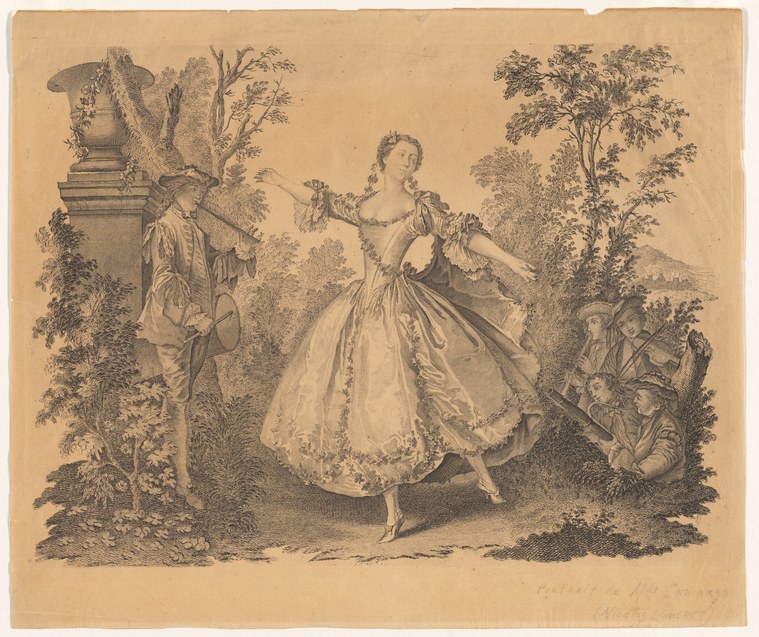
A woman in an elaborate mid-18th-century dress dominates the center of this engraved composition, caught mid-movement in what appears to be a garden or park setting. She wears a full-skirted gown with a fitted bodice and puffed sleeves, her skirts billowing outward as if lifted by rapid motion; her posture is upright and graceful, with one leg extended. The figure is framed by classical garden elements—an ornamental urn on a pedestal to the left, gnarled trees, and lush foliage—which suggest a performance or entertainment in a formal aristocratic setting. To the right, two smaller figures (servants or attendants) observe from the middle distance. The entire composition is rendered in fine black engraving on a buff paper, with delicate cross-hatching creating volume and shadow. The woman's face is turned slightly away, and her arms are positioned to balance her movement, suggesting active, energetic motion rather than a static pose.
The dancing
The primary dancer stands in a nearly upright posture with a pronounced hip tilt, her weight appearing to shift as one leg extends forward and outward. Her arms are raised but not locked in a rigid ballroom hold; they curve gracefully at the sides, suggesting the balletic arm positions of the period. The raised skirt, caught mid-lift, reveals an ankle and a heeled slipper. Two attendant figures in the background are much smaller and appear stationary, establishing the central woman as the sole performer.
The dance depicted
This is almost certainly a theatrical or court dance of the mid-18th century, most likely a solo performance by a professional dancer. The title names Mademoiselle Camargo, one of the most celebrated French dancers of the 1730s–1740s, known for her technical virtuosity and her innovation of the heeled slipper suited to rapid footwork. The print captures a moment of traveling action or a turn executed with raised skirts—a showpiece technique that Camargo popularized. The upright posture, raised skirts, and emphasis on the feet (even in this engraving) align with the emerging technique of early ballet d'action rather than the courtly, grounded style of minuet or gavotte.
How it was made
This is a fine engraving, most likely executed in the mid-18th century, using the burin technique to create precise lines and delicate cross-hatching for tonal effects. The quality of detail—especially in the rendering of fabric texture, the ornamental urn, and the foliage—indicates skilled professional work, probably created from a drawing or painting supplied by a choreographer, dancer, or court artist. The print format and quality suggest circulation among the educated elite of Paris and France, with the work likely published as a keepsake or record of a celebrated performer.
About this work
This engraving documents a moment in the career of Marie-Anne de Cupis de Camargo, who revolutionized female dance technique and costume in the 1730s. The work captures not simply a pose but an action—the traveling and turning technique that made Camargo famous and controversial. It is a rare visual record of what early 18th-century theatrical dance actually looked like in the body, recorded by an artist who understood both the elegance and the physical precision required.
How to look at it
Attend first to the woman's feet and the lifted hem of her skirt: the artist has taken pains to show both, suggesting their importance to the performance. Notice the upright carriage of her torso and the curve of her arms—this is balletic posture, distinct from the courtly bearing of earlier social dances. The moment frozen here is not a static pose but an instant of rapid traveling motion, probably a pirouette or a series of quick steps across the stage. The garden setting and the observers frame her as a public performer, not a court dancer in social interaction.
The artist
The artist is not recorded in the catalogue. However, the quality and style of the engraving, and the prestige of the subject, suggest a professional engraver working in Paris in the 1730s–1740s, possibly one who specialized in theatrical or court subjects. Such engravings were often commissioned by dancers, troupes, or patrons to document and promote celebrated performances.
The period
This print was made at a pivotal moment in dance history. The 1730s saw the beginnings of ballet's transformation from courtly social dance into a virtuosic theatrical art form. Camargo's rise coincided with the development of pointe technique, the shortening of the female skirt (from floor-length to mid-calf), and an emphasis on footwork and speed. Visually, the engraving belongs to the tradition of theatrical portraiture popular in France, where prints of celebrated performers—dancers, singers, actors—were mass-produced and collected.
Where it lives
This engraving is held in the New York Public Library's collection of prints depicting dance. It is part of a tradition of 18th-century theatrical ephemera that documented the careers of celebrated performers and circulated among educated audiences as both keepsakes and records of stage innovation.
Dance in this work
Questions about this work
Who was Mademoiselle Camargo?
Marie-Anne de Cupis de Camargo (1710–1770) was a French dancer who became one of the most celebrated performers of the early 18th century. She pioneered the use of heeled slippers, shortened her skirts to show off her rapid footwork, and brought technical virtuosity to female dance. She danced at the Opéra de Paris and across Europe, and was revolutionary in treating dance as a vehicle for athletic display rather than courtly refinement.
What dance is she performing?
The print does not name a specific dance, but the posture, footwork, and technique suggest an early form of theatrical ballet—not a court dance or social form. The lifted skirts and extended leg suggest rapid travel or turning steps that would later become standard ballet vocabulary. It is a solo performance piece, likely created to showcase Camargo's technical abilities.
Why is the skirt so short?
Camargo revolutionized female dance costume by shortening the skirt from floor-length to mid-calf, allowing her rapid footwork to be seen and admired. This was controversial—critics saw it as immodest—but it became the standard for theatrical dance. The raised, billowing skirt in this print is a key visual signature of Camargo's innovation and technical skill.
Is this an eyewitness record?
It is a theatrical print made for circulation, not a documentary photograph. However, it was likely made from a drawing or painting by someone who saw Camargo perform, and it records real costume, posture, and technique. Engravings of this type were considered reliable enough to circulate among patrons and to be treasured as records of celebrated performers.
More dance artwork





