49 works in this view — arrow keys or swipe to move between them.
Dance in Art
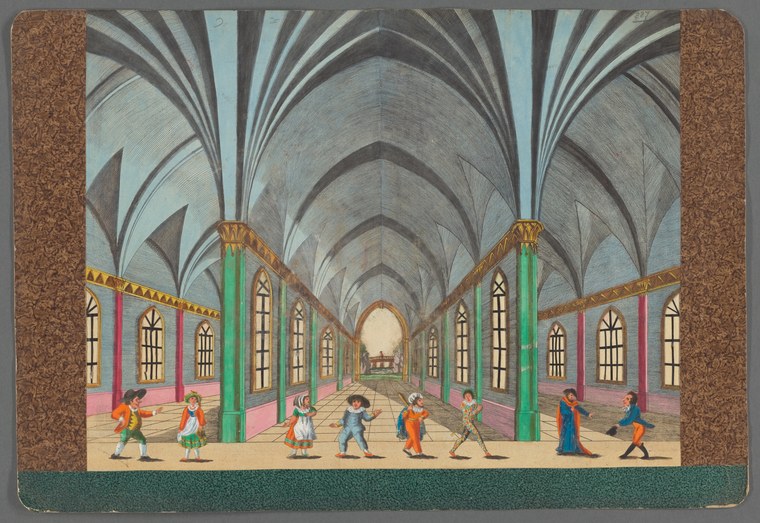
Interior with vaulted ceiling; in the foreground, a line of actors? including Harlequin
Unknown artist
- Collection:
- Prints depicting dance
- Source:
- New York Public Library
- Rights:
- Public domain — free to use, share and adapt.
- Recorded as:
- Public Domain
This image is rare visual evidence of how theater was physically staged and how bodies were arranged in Renaissance or early Baroque court entertainment. For historians of dance, it documents the visual and spatial conventions of theatrical display—the use of costume, architectural framing, and processional arrangement—that preceded formalized ballet and coexisted with it. The likely presence of a commedia dell'arte figure (Harlequin or a related stock character) connects popular theater to aristocratic spectacle.
What you are looking at
A theatrical interior depicting a grand Gothic or Renaissance church or cathedral, rendered in a delicate hand-colored print. The space recedes toward a distant lit doorway or window, with soaring ribbed vaults and pointed arches in cool grey-blue tones. The architectural ornament is decorative rather than naturalistic—stylized and somewhat flattened. In the foreground, a line of eight figures stands across the floor in a shallow stage-like arrangement, their bodies turned in various directions. They wear early modern dress: the figures on the left sport vivid yellow, orange, and red costumes with contrasting stockings; those toward the center and right wear blue, green, and violet. One figure wears a notably long blue robe. The floor is rendered in pale tan. The walls flanking the space are a warm rust-brown or terracotta. The overall palette—cool architectural tones against warm walls and bright costume colors—creates a theatrical stage set rather than a naturalistic interior.
The dancing
The eight figures form a loose horizontal line, somewhat unevenly spaced. Bodies are upright and frontal, with little dynamic weight shift or leaning. Arms hang naturally or gesture simply outward; none adopt a closed dance hold with a partner. The postures suggest standing or slow walking rather than active dancing—some figures face the viewer, others face laterally or away. One figure on the right appears to gesture or beckon. The figure in the long blue robe stands more prominently, almost centrally. The grouping reads as processional or processional-theatrical—an arrangement of distinct characters rather than couples or a unified ensemble in synchronized movement.
The dance depicted
The scene likely depicts a theatrical procession or mummery from sixteenth- or seventeenth-century court entertainment or commedia dell'arte. The catalogue suggests 'actors? including Harlequin,' though the bright, varied costumes and the theatrical architectural setting align more readily with commedia dell'arte players or court masquers than with Harlequin specifically (who typically wore a parti-colored tunic and mask). The figures' static poses, distinct costuming, and processional arrangement resemble the entrée or opening movement of a court ballet or theatrical entertainment—a moment of display and character introduction rather than dance proper. The work cannot be assigned to a recognizable named dance form but records a theatrical tradition in which costumed figures moved through architectural spaces in stylized, deliberate arrangements.
How it was made
This is a hand-colored woodcut or engraving, likely printed from the sixteenth or seventeenth century and then tinted by hand with transparent watercolor or gouache. The precision of the architectural perspective and the fineness of the line work suggest engraving; the relatively simple color palette and the localized fills of color suggest hand-coloring afterward rather than color printing. The technique allowed for wide circulation—multiple impressions could be printed and individually colored—which means this likely served as a souvenir of a theatrical event or as a pattern book for other artists to copy. The format is small and portable, consistent with it being a page in a book or an independent broadsheet.
About this work
This print records a moment from early modern court or popular theater—a formal, processional arrangement of costumed characters in a stylized architectural setting. It belongs in a gallery of dance art because it documents how bodies were arranged, dressed, and moved within theatrical spectacle during the Renaissance or early Baroque period. Though the figures are not actively executing a recognizable dance step, they are moving in an intentional choreographic arrangement: a procession through space with distinct costuming, distinct personalities, and clear theatrical hierarchy. The work is valuable precisely because it shows the threshold between costume pageantry and dancing proper—the moment before or during movement in a choreographed scene.
How to look at it
Observe the careful balance between the architectural setting and the human figures: the ornate Gothic space is almost as much a character as the costumed actors. Notice how the artist uses color to distinguish individual figures and direct the viewer's eye—the warm tones of the brown walls frame the bright costumes. Look at the figures' feet and the way they touch or stand on the floor; they are not in any recognizable dance posture, yet their line across the space has been deliberately composed. The distant lit opening at the end of the colonnade draws the eye through the scene, suggesting both the direction of movement and the theatrical illusion of depth.
The period
This print dates to a period when court ballet in France and Italy was formalizing as a distinct art form (mid-sixteenth to early seventeenth century). Simultaneously, commedia dell'arte was at its height in Italy and spreading through Europe, blending popular theatrical traditions with elements of court culture. Both traditions valued spectacle, costume, procession, and the careful arrangement of figures in space. The architectural interiors depicted in prints of this kind reflect the real spaces in which such entertainments took place—church-like halls with painted or decorated walls, where processions and tableaux vivants were staged. The print's style and format align with emblem books, pageant prints, and theater designs circulating in Northern Europe during this period.
Where it lives
The work is held in the Prints collection at the New York Public Library. It is catalogued only as 'Interior with vaulted ceiling; in the foreground, a line of actors? including Harlequin,' with no artist, date, or medium recorded. Its current holding suggests it is a loose European print, likely sixteenth or seventeenth century.
Dance in this work
Questions about this work
Is this a painting or a print?
This is a print—most likely an engraving or woodcut—that has been hand-colored after printing. The precision of the architectural lines and the fineness of the shading are characteristic of engraved plates. The watercolor or gouache overlays were added by hand to each impression, which was a common and economical way to bring color and life to prints before color printing became widespread.
What are these people doing? Are they dancing?
They are arranged in a formal theatrical procession or grouping, not actively dancing. Their postures are static or slow-walking. However, this arrangement is choreographed in the broad sense: the artist has deliberately placed eight distinct figures in a line, each with a separate costume and personality, within a grand architectural space. For Renaissance and early Baroque theater, this kind of procession and display was a central form of spectacle.
Who is Harlequin and why is he here?
Harlequin is a stock character from commedia dell'arte, a form of improvisational theater that flourished in Italy and spread through Europe from the sixteenth century onward. He was a witty, acrobatic servant figure, usually dressed in a patched or parti-colored tunic and a mask. The catalogue identifies one of these costumed figures as likely Harlequin, which suggests the scene depicts a moment from commedia dell'arte performance or from a court entertainment that incorporated commedia characters.
What was theater like in the sixteenth and seventeenth centuries?
Theater in this period was a visual and spatial spectacle as much as a text-based performance. Court ballets combined music, dance, costume, and elaborate sets. Commedia dell'arte troupes performed in improvised scenarios with stock characters, acrobatic movement, and witty banter. Both traditions valued elaborate costume, careful arrangement in space, and the movement of figures through ornate architectural settings. This print documents that visual tradition.
More dance artwork





