49 works in this view — arrow keys or swipe to move between them.
Dance in Art
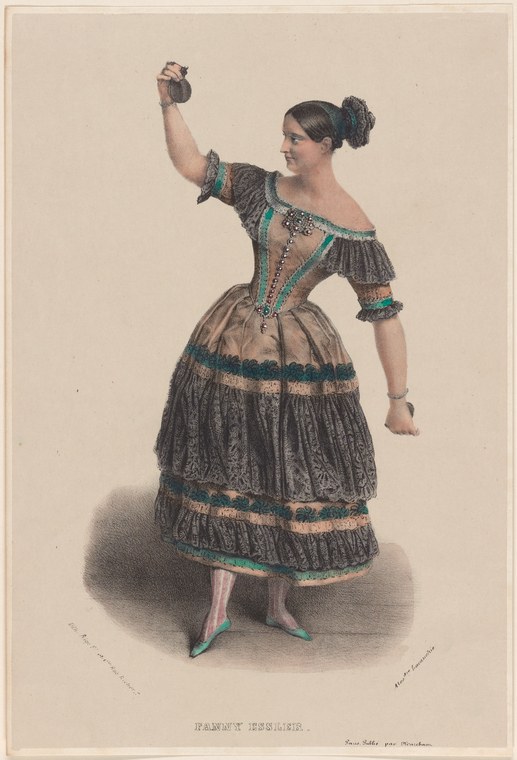
Fanny Essler [sic]
Unknown artist
- Collection:
- Prints depicting dance
- Source:
- New York Public Library
- Rights:
- Public domain — free to use, share and adapt.
- Recorded as:
- Public Domain
This image is essential evidence for understanding how Romantic ballet was marketed and consumed by the nineteenth-century public, and how dancers' bodies were idealised and presented for mass circulation. For dancers and choreographers, it offers precise documentation of costume construction, the proportions and stance of the period, and the theatrical conventions that governed how dancers were posed for public imagery.
What you are looking at
A woman in theatrical costume stands in a three-quarter pose against a neutral background, her body angled to the right while her gaze and raised arm direct attention upward and away. She wears a dark silk dress with horizontal bands of emerald-green trim across the bodice and skirt, the skirt itself composed of multiple gathered tiers that create volume and movement even in stillness. The dress is cut off-shoulder in the Romantic era style, with short puffed sleeves gathered at the wrist with matching green ribbon. She wears pale stockings and green pointed slippers. Her dark hair is arranged in a fashionable low chignon. Her left arm is raised to shoulder height with the hand holding what appears to be a small ornamental object (possibly a tambourine or mirror), while her right arm hangs at her side. The pose suggests a moment of graceful suspension—neither fully still nor captured mid-movement—characteristic of theatrical portraiture of the 1830s–1840s.
The dancing
The single figure occupies the composition with confident verticality, the raised arm creating an open, expansive frame. Her weight appears to rest easily on her right leg, with the left leg slightly advanced and bent, suggesting the lifted, ethereal quality prized in Romantic ballet. The pose is one of display rather than active motion—a moment held for the viewer rather than a fleeting instant of performance. The hand raised toward the head is delicate and extended, the fingers refined and elongated in a manner consistent with the balletic ideal of elongation and ethereal lightness.
The dance depicted
This is a portrait of a Romantic-era ballet dancer, almost certainly a principal female performer given the solo presentation and professional execution. The style of dress, pose, and presentation align with the Romantic ballet canon of the 1830s–1840s, when dancers in roles such as sylphs or spirits adopted lighter fabrics, shorter skirts, and ethereal poses that emphasised weightlessness and otherworldliness. The raised arm and tilted head suggest a moment of reverie or enchantment typical of Romantic narrative ballet. No specific movement is captured—this is a posed portrait showing the dancer in character rather than documenting actual choreography.
How it was made
This is a hand-coloured engraving or lithograph, executed with fine line work and delicate tinting to suggest fabric texture and form. The technique allows precise rendering of costume detail—the emerald trim, the gathered tiers of the skirt, the ribbon at the wrist—while the subtle shading across the figure creates volume and three-dimensionality. The neutral background and vignette effect (soft fading at the edges) are typical of theatrical portraiture from this period, designed for wide circulation among the theatre-going public. The production values and careful finish suggest a commercial print from a theatre publisher rather than a fine-art print.
About this work
This is a theatrical portrait print of a professional ballet dancer in Romantic-era costume, executed in the early-to-mid nineteenth century. The work documents both the aesthetic ideals of Romantic ballet—the ethereal pose, the elaborate silk costume with signature emerald trim, the refined gesture—and the commercial apparatus of theatrical promotion that circulated images of celebrated dancers to the public. The woman depicted has not been identified with certainty in the title, but the costume and pose are consistent with the leading ballerinas of the 1830s–1840s, a period when the Romantic ballet reached its artistic height and when lithographic and hand-coloured prints became the primary means of documenting and marketing star performers.
How to look at it
Observe the exact moment the artist chose: not a moment of active motion or clear technical display, but a pose of stillness and grace designed to show the entire costume and the dancer's refined proportions. Notice how the raised arm and tilted head create a sense of inward focus or reverie—a distinctly Romantic sensibility that values emotional and spiritual qualities over technical brilliance. The costume itself is the second subject: the horizontal bands of emerald-green trim against dark silk, the shallow decolletage, the gathered tiers of the skirt—all characteristic of 1830s–1840s theatrical fashion. The pale stockings and green slippers anchor the figure and emphasise the dancer's legs and feet, which were newly visible and celebrated in this era.
The artist
The artist is not recorded in the catalogue. The style of the print—its refined hand-colouring, the careful attention to costume detail, and the theatrical subject—suggests a commercial theatrical print publisher working in the major European or American theatre centres (London, Paris, or New York) in the mid-nineteenth century. Such prints were often created by house artists employed by publishers rather than attributed individually.
The period
This print dates from the height of the Romantic ballet era, approximately 1830–1850, when the ballet underwent a radical transformation in aesthetics, music, and subject matter. Dancers began to wear lighter fabrics, shorter skirts (eventually reaching mid-calf, the iconic length of the era), and pointe shoes, and adopted ethereal, weightless movement qualities. The repertory shifted toward supernatural or exotic narratives—sylphs, spirits, odalisques—that showcased the dancer's ability to suggest otherworldliness. Simultaneously, the rise of lithography and hand-coloured engraving made it possible to produce theatrical portraits at scale and relatively low cost, transforming dancers into celebrities whose images were collected and traded by the theatre-going public.
Where it lives
This work is held in the New York Public Library's collection of prints depicting dance. It is catalogued as a theatrical portrait from an unknown date, with the artist unrecorded. The print appears in a broader collection of theatrical and dance-related imagery accumulated by the library, likely for historical and documentary purposes.
Dance in this work
Questions about this work
Who is this dancer?
The title given in the catalogue is 'Fanny Essler [sic]', but this is likely a transcription error or misidentification. While the spelling and the costume are consistent with the famous Austrian dancer Fanny Elssler (1810–1884), one of the most celebrated Romantic-era ballerinas, the catalogue does not confirm the subject with certainty. The image documents the costume and pose of a leading Romantic ballet dancer of the 1830s–1840s, but the identity remains unverified.
What is the emerald-green trim for?
The horizontal bands of emerald-green silk are part of the costume design, not functional elements. In Romantic ballet, costumes were richly decorated with ribbons, braids, and applied trim to enhance visual interest and to reflect the character being portrayed. The emerald colour was fashionable and luxurious, and its repetition across the bodice and skirt creates visual coherence and elegance.
Why is this a theatrical portrait rather than a dance scene?
The artist chose to depict the dancer in a posed moment of display rather than a moment of actual choreographic action. This was the standard convention for theatrical portraiture of the nineteenth century, designed to showcase the dancer's costume, proportions, and refinement of bearing. Such images were intended for wide public circulation and collection, not as documentary records of specific performances.
How do we know this is Romantic ballet and not another dance form?
Multiple visual cues indicate Romantic ballet: the short, tiered skirt, the pointe shoes, the off-shoulder neckline, the ethereal pose, and the overall aesthetic of lightness and otherworldliness. These are distinctive features of the Romantic ballet aesthetic that emerged in the 1830s and dominated the repertory through the mid-nineteenth century.
More dance artwork





