49 works in this view — arrow keys or swipe to move between them.
Dance in Art
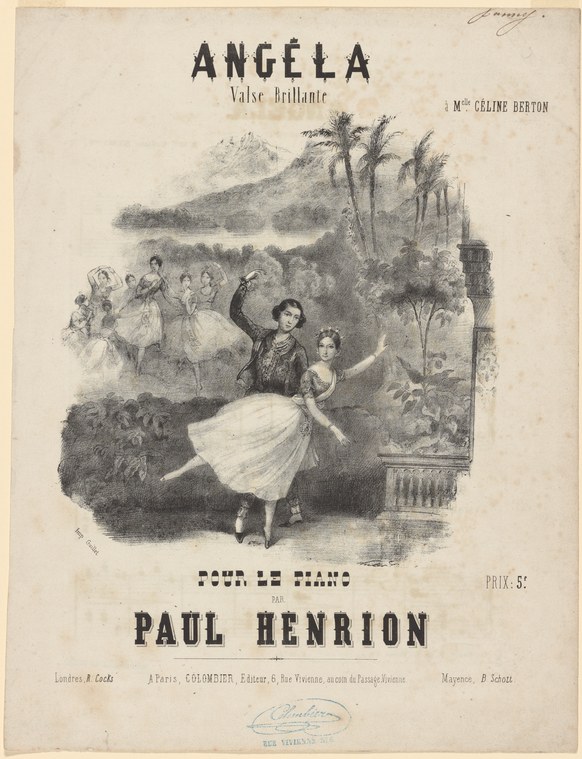
Angela: Valse brillante pour le piano par Paul Henrion
Unknown artist
- Collection:
- Prints depicting dance
- Source:
- New York Public Library
- Rights:
- Public domain — free to use, share and adapt.
- Recorded as:
- Public Domain
This work reveals how dance was consumed and commercialized in the Romantic era: not only as live performance but as a portable, reproducible image that could be owned, displayed, and collected. The lithograph's soft, dreamy aesthetic directly embodies the Romantic ballet aesthetic—the elevation, the ethereality, the emphasis on the female soloist—making it a primary document of how performers and impressarios wanted ballet to be seen and remembered.
What you are looking at
A Romantic-era theatrical scene depicts a young woman in a white tulle skirt and dark jacket posed in an elegant arabesque or attitude, her body caught mid-turn against a hazy background of palm trees and classical architecture. She wears a small hat and leans gracefully backward, one leg extended behind her. In the middle distance, a crowd of figures in lighter dress suggests a tropical or Mediterranean setting—a garden party or ball. The composition uses soft charcoal tones with white highlights on the skirt; the background dissolves into atmospheric mist, emphasizing the soloist's lifted frame. The mood is one of buoyant grace, the dancer suspended in a moment of balletic elevation.
The dancing
The central figure stands alone in a steep, extended arabesque or attitude derrière, her supporting leg turned out and her free leg lifted high behind her. Her arms are positioned with balletic elegance—the exact line cannot be determined from this angle, but her posture suggests the upward lift and turnout characteristic of early-to-mid nineteenth-century ballet technique. Her torso is arched backward, creating a pronounced curve through the spine. No partner is present; she is spotlit in isolation. The distant crowd is rendered too faintly to read as dancers, appearing instead as onlookers.
The dance depicted
This is romantic ballet, most likely from the 1830s–1850s French theatrical tradition. The title *Angela: Valse brillante* suggests this is a solo female character, possibly from a larger ballet or a divertissement. The arabesque pose and the tulle skirt are hallmarks of the Romantic ballet aesthetic, when ethereal soloists in white dresses became the standard female ideal. The setting—tropical or exotic—suggests this may depict a scene from a ballet with an orientalist or colonial theme, common in the period. The artist has chosen to freeze the dancer at a moment of maximum elevation and extension, a convention that emphasizes the otherworldly quality central to Romantic ballet imagery.
How it was made
This is a lithograph, a printmaking technique that allowed for soft charcoal effects and the hazy atmospheric qualities visible here. Lithography was the dominant medium for theatrical publicity and souvenir prints in the mid-nineteenth century, particularly for dance. The process allowed rapid reproduction at modest cost, making it ideal for sheet music covers—which this appears to be—and for marketing theatrical performances to a broad urban audience. The stone's ability to capture both fine detail (in the dancer's face and costume) and soft tonal gradations (in the landscape) made it the preferred choice for this genre of image.
About this work
This is a lithographic sheet music cover for a piano piece titled *Angela: Valse brillante*, composed by Paul Henrion and dedicated to Mme Céline Berton. The image is a commercial theatrical souvenir—evidence of the mid-nineteenth-century appetite for ballet imagery as both popular entertainment and fashionable collectible. The print documents not only a specific piece of music but also the visual language of Romantic ballet: the elevated, ethereal female soloist in white tulle, set in an exotic or dream-like landscape, captured mid-movement in a moment of impossible grace. Such images circulated widely and shaped how the urban public understood and desired ballet.
How to look at it
Attend to the specific moment the artist chose: not a balletic jump (which would be frozen at the apex) but a sustained, extended arabesque—a position that requires control and can be held. This choice emphasizes not virtuosity or spectacle but elegance and stillness. Notice how the pale tulle skirt reads almost as sculpture against the darker background, and how the figure's backward lean creates an impossible arch—not anatomically true, but theatrically expressive. The exotic landscape behind her is intentionally vague, rendered in mist; the focus is entirely on the soloist's body as the subject.
The artist
Paul Henrion (fl. 1840s–1860s) was a French composer and arranger known for light theatrical music, dances, and salon pieces for piano. *Angela: Valse brillante* is typical of his output—elegant, accessible, designed for both public performance and domestic music-making. The lithograph's artist is not recorded, but the print was published by Colombier in Paris, a major theatrical publisher of the period. The dedication to Mme Céline Berton suggests she was either the first performer or a celebrated dancer of the time.
The period
By the 1840s–1850s, Romantic ballet—pioneered in Paris by Marie Taglioni and developed at the Opéra—had established a visual and choreographic language centered on the ethereal, turn-out, and the illusion of weightlessness. Lithographic sheet music covers became a primary vehicle for disseminating and marketing this aesthetic to the growing middle-class market for music and dance imagery. The tropical or exotic settings seen in this image reflect the Orientalist fantasies that pervaded Romantic art and dance, from *La Bayadère* to *Le Corsaire*. At the same time, the waltz was ascending as the dominant social dance of the era, and even theatrical soloists were often depicted in or associated with waltz movement.
Where it lives
This lithograph is part of the New York Public Library's collection of prints depicting dance, held in the Prints Division. It is a sheet music cover, a commercial object designed for sale and distribution to the public. Such covers were often kept and collected, making them common in institutional holdings today.
Dance in this work
Questions about this work
Who was Angela?
The record does not identify a specific performer by that name. 'Angela' may have been a character in a ballet, the name of a dancer who performed this piece, or simply a title chosen for the waltz. The dedication to Mme Céline Berton is a separate attribution, possibly indicating the work's first performer or a celebrated dancer of the time.
What does the pose tell us about Romantic ballet technique?
The arabesque was a foundational position in Romantic ballet, emphasizing the turned-out leg, the lifted spine, and an extension away from the body. This image shows the characteristic backward lean and lifted frame that made Romantic ballet look ethereal and weightless. The pose also required significant strength and flexibility—it was not an easy position but was made to look effortless.
Why is this a sheet music cover?
By mid-century, theatrical imagery was a powerful marketing tool for both music and dance. Publishing a waltz with a lavish lithographic cover featuring a celebrated dancer or character created a crossover product—a souvenir of the theater that could be purchased, played on the piano at home, and displayed. It was an early form of theatrical merchandise.
What does the tropical setting mean?
Exotic or tropical locations were a common motif in Romantic ballet and visual culture, reflecting both colonial interests and fantasies about distant, sensual worlds. The setting may indicate the character of Angela came from a larger ballet with an orientalist theme, or it may simply evoke an otherworldly, dreamlike atmosphere divorced from European reality.
More dance artwork





