49 works in this view — arrow keys or swipe to move between them.
Dance in Art
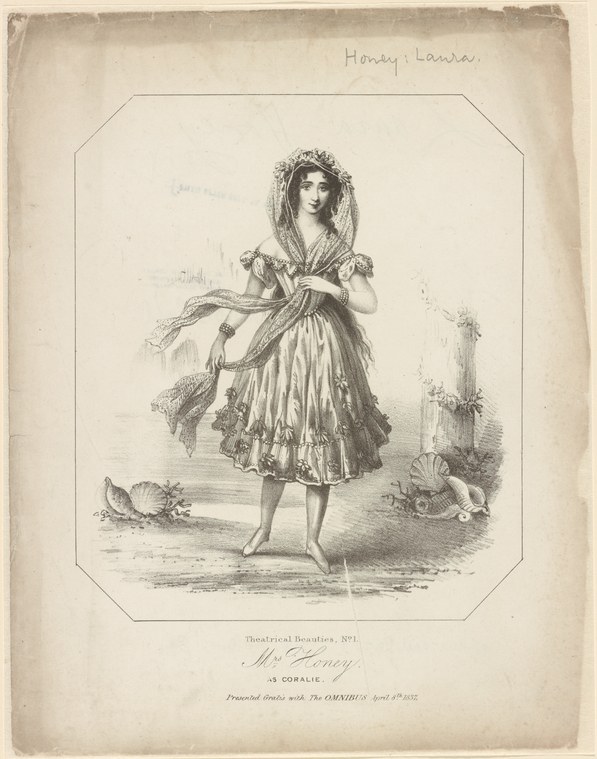
Mrs. Honey. As Coralie.: Presented gratis with the Omnibus April 8th 1837
Unknown artist
- Collection:
- Prints depicting dance
- Source:
- New York Public Library
- Rights:
- Public domain — free to use, share and adapt.
- Recorded as:
- Public Domain
This image reveals how Romantic ballet was disseminated and consumed in the 1830s: not through paintings or sculptures, but through cheap, widely distributed prints that made the bodies and costumes of celebrated dancers available to the masses. It documents a specific performer and her interpretation of a character type—the ethereal sylph—that dominated European ballet for decades. For historians of dance, celebrity culture, and print distribution, it is evidence of how the theatre shaped public imagination and how the public's appetite for images of dancers shaped the economics of theatrical stardom.
What you are looking at
A young woman stands alone in a shallow landscape, barefoot and positioned as if pausing mid-movement. She wears a Romantic-era dress: a fitted bodice with short puffed sleeves and a full skirt that falls to just below the knee, caught mid-swirl or gesture. Over her shoulders she drapes a long, patterned shawl or veil of gossamer fabric that billows asymmetrically around her—the signature prop of the Romantic ballet sylph. Her hair is crowned with flowers. The setting is sparse: a few rocks and shrubs anchor the foreground; a single tall plant or tree rises in the middle distance. The engraving technique renders the scene in fine black lines against cream paper, with careful cross-hatching to suggest volume and shadow. The composition is intimate and vertical, focusing the viewer's gaze entirely on the solitary dancer.
The dancing
The dancer's weight appears to rest lightly, with one leg straight and the other bent, creating the impression of a balletic pose caught between steps—neither fully grounded nor fully airborne. Her arms are raised and extended in a gentle, open frame characteristic of Romantic ballet, one slightly higher than the other. The pose suggests the ethereal, weightless quality central to the ballet d'action of this period. Her body is modestly turned in a three-quarter view, and the fluttering shawl amplifies the sense of movement and delicacy.
The dance depicted
This is an image of Romantic ballet, almost certainly depicting a character or a scene from a narrative ballet of the 1830s. The shawl, the flower crown, the solitary figure in a wild or liminal landscape, and the lightness of the pose all point to the sylph tradition established by La Sylphide (1832). The print's title identifies the figure as 'Coralie' and credits 'Mrs. Honey' as the performer—this is a theatrical celebrity portrait, printed to commemorate a specific performance. The dance itself is not named in the record, but the visual vocabulary is unmistakable: this is the Romantic ballet's vocabulary of the supernatural, the ethereal, and the feminine ideal. The image documents how this particular dancer embodied that ideal on stage.
How it was made
This is an engraving, created using fine steel or copper lines to build form and tone. The technique allowed for precise detail in the fabric and the dancer's face while maintaining the delicate, linear quality essential to fashion and theatrical portraiture of the era. Engravings of this kind were distributed as loose sheets, often given away 'gratis' (as the print states) alongside popular periodicals or newspapers—in this case, apparently the Omnibus. This means the image was not a precious collector's item but an affordable, widely circulated memento of a celebrated performance, allowing working-class and middle-class theatregoers to take home an image of the star.
About this work
This is a theatrical portrait engraving of Mrs. Honey performing as Coralie, distributed free with a London periodical on 8 April 1837. It captures the aesthetic and physical vocabulary of Romantic ballet at its height: the solitary female figure, the supernatural costume, the pose that suggests both groundedness and flight, the landscape that is more symbol than place. The engraving's fine linear technique was the dominant medium for circulating images of celebrity dancers in the 1830s, making it a primary document of how a particular performer was seen, remembered, and consumed by her public. The work belongs to a rich archive of prints depicting named dancers in named roles, a tradition that sustained theatregoers' engagement with ballet between performances.
How to look at it
Notice first the pose itself: it is neither a conventional standing position nor a fully developed balletic step, but a moment of suspension that the Romantic ballet valued above all—the sense that the dancer might rise into the air at any moment. The shawl is central: it is not merely a costume element but a visual argument about weightlessness and otherworldliness. Observe also the artist's choice to isolate the figure: there is no ensemble, no partner, no scene-painting in the background. The dancer's body and costume are everything. Finally, look at the technique: the fine engraved lines that render the fabric, the light cross-hatching that suggests the volume of the skirt and the delicacy of the veil, and the careful attention to the dancer's face and expression. These choices tell us what mattered to the engraver and to the public who bought these prints.
The artist
The artist is not recorded. However, the style and quality of the engraving suggest it was produced by one of London's commercial theatrical print shops, which in the 1830s employed skilled engravers to create celebrity portraits after performances. These were often drawn from sketches made at the theatre or from the memory of the engraver; accuracy of likeness was secondary to the immediate circulation of the image. The print's quality and finish suggest professional work produced quickly to capitalize on a popular performance.
The period
In 1837, Romantic ballet was at its cultural peak in London and across Europe. La Sylphide had premiered in Paris in 1832 and was rapidly becoming the defining ballet of the age, establishing a vocabulary of ethereal femininity, supernatural narrative, and technical innovation. The 1830s saw an explosion in theatrical imagery: lithographs, engravings, and woodcuts of dancers and actors circulated in enormous quantities, making the theatre visible to those who could not afford tickets. The Omnibus itself, a penny newspaper founded in 1829, was part of a new media landscape of affordable print for working and middle-class readers. This engraving sits at the intersection of all these developments—a new technology of ballet, a new technology of popular journalism, and a new kind of celebrity.
Where it lives
This engraving comes from the New York Public Library's collection of prints depicting dance. The print was distributed freely with the Omnibus, a London penny newspaper, on 8 April 1837, making it a mass-circulation theatrical souvenir rather than a unique or precious object.
Dance in this work
Questions about this work
Was this a real person and a real performance?
Yes. Mrs. Honey was a real dancer who performed in London in the 1830s. Coralie was a character or role she danced—likely in a now-forgotten ballet or pantomime of the era. The print was issued the day after (or during) her performance, capitalizing on her popularity. We do not have detailed records of every dancer and every role from this period, but the print itself is documentary evidence that she performed this role on this date.
Why does she look so ethereal?
Because that was the entire point of Romantic ballet. Dancers of the 1830s were supposed to embody the supernatural, the weightless, the otherworldly. The pose, the costume, the shawl, the flower crown, the isolated landscape—all of these elements work together to suggest that the dancer is not quite of this world. The engraver has captured and emphasized these qualities, making Mrs. Honey look like the sylph or spirit she was supposed to be playing.
What is the shawl for?
The shawl or veil became iconic in Romantic ballet, especially after La Sylphide. It served multiple purposes: it signaled the supernatural or fantastical nature of the character, it allowed the dancer to create flowing, ethereal lines with her body, and it gave her an additional prop to manipulate and gesture with. Audiences loved the visual effect of the billowing fabric, which made the dancer seem to float or fly.
How much would this have cost?
It was given away free with a penny newspaper. This made it vastly more accessible than paintings or expensive prints—any theatregoer with a few pence for the newspaper could take home an image of the star. This was revolutionary: it meant that celebrity and the memory of performance could be distributed to working-class audiences, not just the wealthy.
More dance artwork





