49 works in this view — arrow keys or swipe to move between them.
Dance in Art
Mdlle. Lucile Grahn [with accompanying article]
Unknown artist
- Collection:
- Prints depicting dance
- Source:
- New York Public Library
- Rights:
- Public domain — free to use, share and adapt.
- Recorded as:
- Public Domain
This print documents both a major historical dancer and the visual culture through which nineteenth-century audiences came to know the stars of Romantic ballet. It shows how engraving allowed dance to be circulated, remembered, and celebrated in print form—a crucial function before photography became widespread. The image also crystallizes the aesthetic ideals of Romantic ballet at its height: ethereal grace, refined technique, and an almost supernatural quality of movement.
What you are looking at
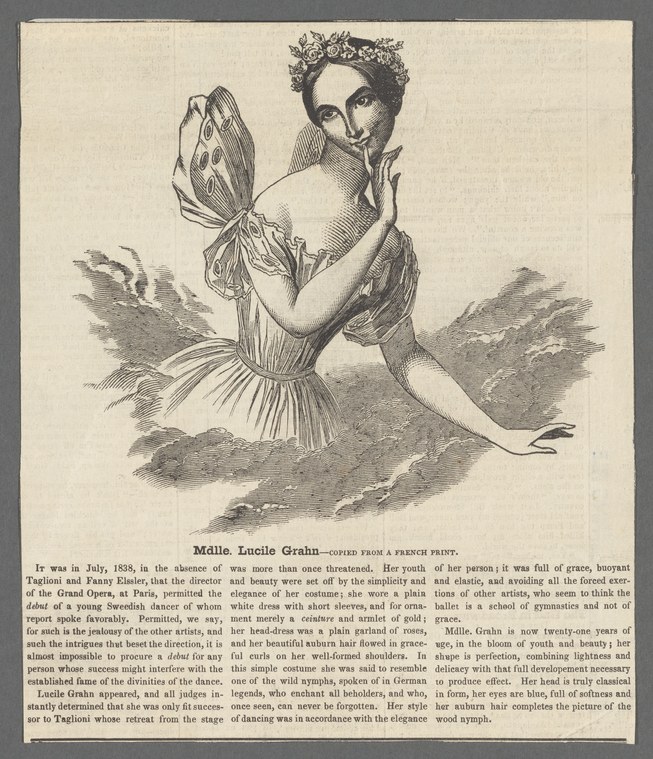
A young woman in a classical dancing pose dominates the composition, her body angled toward the viewer in a three-quarter turn. She wears a simple, high-waisted white or pale muslin dress caught mid-movement, with the skirt billowing slightly around her legs. Her dark hair is crowned with a wreath of flowers or laurel, and her delicate arms frame her face and body with studied grace. In her raised hand she holds a large butterfly—a Romantic-era symbol of lightness and transformation. The background is rendered in loose, sketchy pen strokes suggesting an undefined naturalistic setting, with suggestions of landscape behind her. The entire image is executed as an engraving or lithograph, with fine cross-hatching creating form and shadow. The effect is intimate and ethereal, capturing a single suspended moment of elegant movement.
The dancing
The dancer stands in a classical contrapposto position with her weight shifted to one leg, her body lifted and elongated. Her arms are held with studied softness—one hand raised to frame her face, the other extended to present the butterfly. Her posture suggests the refined, upright carriage of ballet training, with her torso held erect and her gaze directed inward. There is a single dancer, and the composition emphasizes her isolation and the delicacy of her form against the spare background.
The dance depicted
This is a portrait of the Romantic-era ballerina Lucile Grahn, one of the great dancers of the 1830s and 1840s. The butterfly motif and the ethereal quality of her pose evoke the vocabulary of Romantic ballet—the style that dominated European stages during Grahn's career and featured otherworldly female figures in roles like Sylphide and Giselle. The engraving captures the essence of Romantic ballet aesthetics: weightlessness, refinement, and an almost supernatural grace. Grahn was celebrated for the poetry and elegance of her dancing, qualities the artist has distilled into a single, suspended moment.
How it was made
This is an engraving or possibly a lithograph, executed in black ink on paper using fine cross-hatching to model form and create atmospheric effect. The technique allows for precise delineation of the dancer's figure and costume while maintaining a sketchy, suggestive quality in the background—a common approach in dance portraiture of the period. The image accompanied a printed text article about Grahn's career and performance history, suggesting it was produced for a periodical or illustrated publication aimed at a literate middle-class audience interested in theatrical celebrities.
About this work
This engraving is a portrait of Lucile Grahn, a Danish-Swedish ballerina of international renown, captured in a pose that embodies the Romantic aesthetic that defined her era. The artist freezes her in a moment of crystalline elegance, holding a butterfly—a symbol of the ethereal, weightless beauty that Romantic ballet prized. The accompanying text identifies her as a leading dancer of the Grand Opéra in Paris and recounts her youth, grace, and technical accomplishment. The work belongs to a tradition of dance portraiture that used the engraved image and biographical text to disseminate knowledge of celebrated performers to readers who might never see them dance on stage.
How to look at it
Attend to the stillness of the pose. Although the dancer is captured mid-movement, the engraver has chosen a moment of suspension and balance, not a moment of dynamic action. Notice how the butterfly—held aloft in her hand—is the lightest, most delicate element, matching the weightlessness of the figure itself. The fine detail lavished on her face, hair wreath, and costume contrasts with the sketchy, undefined background, directing all attention to the dancer's body and bearing. This compositional choice embodies the Romantic ideal of the ballerina as a figure separate from and above the material world.
The artist
The artist is not identified in the catalogue record. The engraving was copied from a French print, as the inscription notes, suggesting it may be a secondary reproduction made for an English-language publication or for circulation in the Anglo-American market. The style and technique are consistent with commercial dance portraiture of the 1830s–1840s, when engraved likenesses of celebrated performers were a standard form of theatrical merchandise and publicity.
The period
This work dates to the height of the Romantic era in ballet, a period (roughly 1830–1850) when the ethereal, weightless female dancer became the central figure of European theatrical dance. Lucile Grahn was one of the four great ballerinas of the 1840s—alongside Marie Taglioni, Fanny Cerrito, and Carlotta Grisi—whose dominance in roles like Sylphide, Giselle, and La Péri defined the aesthetic. This was also the era when lithography and engraving were the primary means of disseminating images of performers; such prints were sold as souvenirs, appeared in illustrated periodicals, and shaped public memory of dancers. The accompanying article confirms the work's function as a form of celebrity journalism, offering biographical and anecdotal details to readers who might never see Grahn perform.
Where it lives
The work is held in the New York Public Library's collection of prints depicting dance. It is a reproduction of a French print, as indicated by the inscription, and was likely published in an English-language periodical or as a separate print to be sold or distributed to audiences interested in theatrical celebrities.
Dance in this work
Questions about this work
Who was Lucile Grahn?
Lucile Grahn was a Danish-Swedish ballerina who achieved international fame during the 1830s and 1840s, dancing major roles at the Grand Opéra in Paris and other leading European theaters. She was celebrated for her technical skill, grace, and elegance, and was counted among the greatest dancers of the Romantic era alongside Marie Taglioni and Fanny Cerrito. She is remembered as a master of the style that defined nineteenth-century ballet.
What does the butterfly symbolize?
The butterfly is a symbol of lightness, grace, and transformation central to Romantic ballet aesthetics. It suggests the ethereal, almost supernatural quality that Romantic choreography and dance technique aimed to create. The butterfly also evokes the natural world and a kind of freedom or weightlessness that was the ideal of the age.
Why was this printed?
This engraving was produced for circulation in print media—likely as part of an illustrated periodical or as a separate print sold to the public. Dance portraiture of this kind was a major form of celebrity journalism in the nineteenth century, allowing audiences to own an image of a famous dancer and to read biographical information about her. Before photography became widespread, such prints were the primary way most people encountered images of the theatrical stars they admired.
What is the dance style?
This is Romantic ballet, the dominant style of European theatrical dance in the 1830s–1850s. Romantic ballet emphasized ethereal, weightless movement, often featuring female dancers in otherworldly roles (sylphs, spirits, supernatural beings). The technique required great refinement of the upper body and arms, as well as the pointe work and elevated jumps that had become standard by this era.
More dance artwork





