49 works in this view — arrow keys or swipe to move between them.
Dance in Art
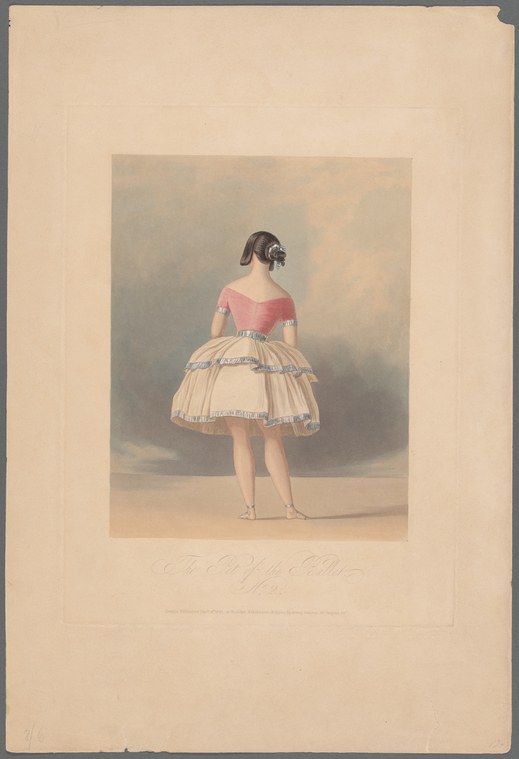
The pet of the ballet
Unknown artist
- Collection:
- Prints depicting dance
- Source:
- New York Public Library
- Rights:
- Public domain — free to use, share and adapt.
- Recorded as:
- Public Domain
This print is evidence of how Romantic ballet was understood and celebrated in its own time—not as a narrative spectacle but as the display of a virtuosic and almost superhuman bodily control. For historians of dance, it documents the anatomy of the tutu and the conventions of pointe work in the 1840s; for viewers, it shows that the technical and aesthetic values of classical ballet have changed little in 180 years.
What you are looking at
A young female dancer is shown in a standing pose against a neutral gray background, viewed from behind and slightly turned toward the viewer's right. She wears a pink silk off-the-shoulder bodice with short puffed sleeves and an extremely voluminous skirt of pale silk or tulle, structured with multiple layers and bound at intervals with blue ribbons or trim. The skirt extends to mid-calf and displays the characteristic bell shape of Romantic-era ballet tutus. She stands on the tips of her toes in pointe position, with her weight forward and her legs extended and aligned. Her dark hair is pulled back in a simple style, adorned with what appears to be a small ornament or flower. The lighting is soft and diffused, creating gentle shadows that model the form of both the dancer and the voluminous fabric. The composition emphasizes the silhouette and the technical achievement of the pose—the viewer's attention is drawn to the refinement of the line from her lifted torso through her extended leg and pointed foot.
The dancing
A single dancer in profile-rear view stands in a stable, controlled pointe position with her legs straight and her torso lifted. Her arms are not prominently featured in the composition, which focuses on the vertical alignment and the extension of the lower body. The pose suggests the classical vocabulary of ballet—specifically the sustained, weightless quality of relevé or an attitude position held at its apogee. The artist has rendered the feet with anatomical precision to show the extreme plantarflexion required by pointe work.
The dance depicted
This is a theatrical ballet dancer, almost certainly from the Romantic period (circa 1830–1850) based on the style of the tutu and the technical vocabulary of the pose. The work is titled 'The pet of the ballet,' suggesting this may be a portrait of a celebrated dancer of the era—a prima ballerina or favorite performer. The image captures the aesthetic ideal of Romantic ballet: ethereal, elevated, weightless, with an emphasis on the impossible extension and refinement of the body. The tutu and pointe work are signature elements of the classical ballet tradition as it developed in Paris and Saint Petersburg.
How it was made
This is a hand-colored lithograph, or possibly a hand-colored engraving, executed with considerable technical refinement. The delicate rendering of the tulle layers, the subtle modeling of the figure, and the restrained palette—dominated by pale pinks, blues, and grays—are consistent with mid-nineteenth-century reproductive prints. The technique allowed for mass production and wide circulation of images of celebrated performers, which were popular among ballet enthusiasts and the general public. The hand-coloring was applied to each impression, making each print unique while maintaining the underlying graphic precision.
About this work
This is a portrait print of a Romantic-era ballet dancer frozen in a pointe position, celebrated for her role as a featured performer ('the pet of the ballet'). It is a document of both the dancer's virtuosity and the aesthetic ideals of the Romantic stage—the illusion of weightlessness, the architectural beauty of the tutu, and the technical discipline of classical ballet technique. The image belongs in a gallery of dance because it is not merely a portrait but a precise notation of a physical achievement and a moment in the history of theatrical movement: the dancer's body is shown as the subject itself, the object of admiration and study.
How to look at it
Notice the precision with which the artist has rendered the pointe position—the angle of the foot, the straightness of the leg, the lift of the torso. The pose is not a moment of movement but a sustained, almost architectural achievement. Observe also the elaborate construction of the skirt: the artist has taken care to show how the layers are structured and how they frame the body. The title, 'The pet of the ballet,' encourages the viewer to see this as a portrait of a particular, celebrated individual, not a generic representation of ballet. The soft background isolates the figure and emphasizes her as the sole object of attention and admiration.
The artist
The artist is not recorded, but the style and quality of the work suggest a professional printmaker working in Paris or London during the height of Romantic ballet. Unsigned portraits of dancers were common in this period; they were often produced as commercial prints for sale to audiences and ballet enthusiasts, and authorship was frequently omitted. The skill of the execution—particularly in the rendering of fabric and the control of tone—indicates a trained hand in the lithographic tradition.
The period
The 1830s–1850s were the golden age of Romantic ballet in Europe. This period saw the triumph of the pointe technique, the development of the tutu as the standard costume for female dancers, and the emergence of a star system centered on celebrated ballerinas. The Paris Opéra and its rival theaters competed for audiences through spectacular productions of ballets like 'La Sylphide' and 'Giselle,' which demanded virtuosic dancing from their female leads. Simultaneously, a robust commercial market in lithographic prints and engravings allowed images of celebrated dancers to circulate widely among the middle classes. This print belongs to that economy of celebrity and visual reproduction.
Where it lives
The work is held in the New York Public Library's collection of prints depicting dance, catalogued as part of its broad holdings in theater and performance imagery. As an unsigned lithograph or engraving of unknown date and maker, it represents the category of commercial theatrical prints produced in the nineteenth century for circulation among urban audiences interested in ballet.
Dance in this work
Questions about this work
What period of ballet is this from?
The style of the tutu, the pointe technique, and the overall aesthetic place this work firmly in the Romantic era of ballet, roughly 1830–1860. This was the period of 'La Sylphide,' 'Giselle,' and the dominance of the Paris Opéra as the center of European ballet.
Who is the dancer depicted?
The catalogue record does not identify the performer, and the print is unsigned. However, the title 'The pet of the ballet' suggests she was a celebrated, favorite dancer of her time. Such commercial prints often did not name their subjects, assuming audiences would recognize celebrated performers by sight.
Why is the skirt so large?
The voluminous tutu became the standard costume for female ballet dancers in the Romantic era because it created visual lightness and reinforced the aesthetic of weightlessness and ethereal beauty. It also allowed the legs and feet—the instruments of the dancer's virtuosity—to be clearly visible. The layers also moved and caught light in ways that enhanced the impression of elevation and otherworldliness.
What does pointe work tell us?
The ability to balance and move on the tips of the toes was a central technical achievement of Romantic ballet and a sign of the dancer's years of rigorous training. Pointe work requires extraordinary strength and control and was (and is) celebrated as a visible marker of virtuosity and discipline. The print's emphasis on the pointed foot and extended leg celebrates precisely this achievement.
More dance artwork





