49 works in this view — arrow keys or swipe to move between them.
Dance in Art
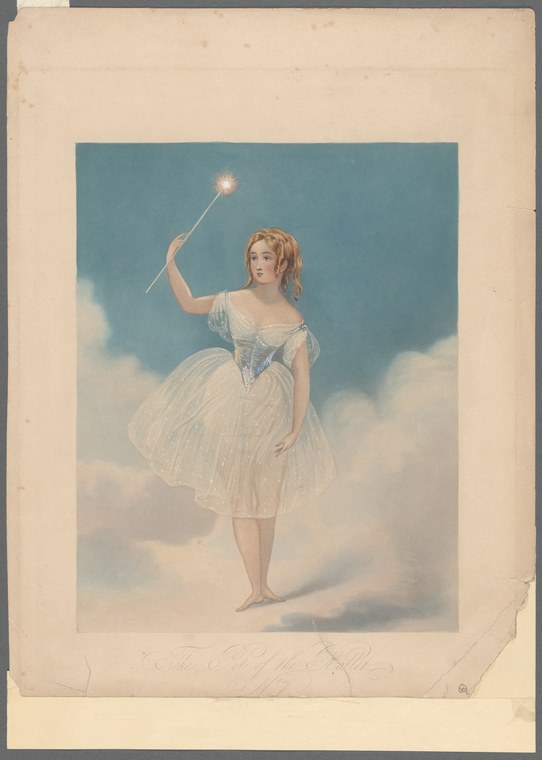
The pet of the ballet
Unknown artist
- Collection:
- Prints depicting dance
- Source:
- New York Public Library
- Rights:
- Public domain — free to use, share and adapt.
- Recorded as:
- Public Domain
This print is essential to understanding how 19th-century ballet was consumed and remembered by its non-professional audience. It reveals the genre's visual mythology—the emphasis on ethereal femininity, magic, and sentiment—and shows how ballet became a mass-market cultural fantasy through lithographic reproduction. For dancers and historians, it documents the costume, aesthetic, and narrative preoccupations of the Romantic stage.
What you are looking at
A young woman stands alone against a soft, cloudlike background painted in cool blues and whites. She wears a pale tulle ballet dress with a fitted bodice in blue-grey tones and a voluminous skirt that falls to mid-calf, typical of mid-19th-century Romantic ballet. Her fair hair is styled in the period fashion, gathered loosely at the crown. She stands in a relaxed pose with one arm raised gently, holding what appears to be a small magical object—a wand or talisman with a glowing star or light at its tip. Her gaze is directed upward toward this luminous object, creating a sense of wonder or enchantment. The composition is intimate and theatrical; the figure occupies the center of the frame against an ethereal, atmospheric setting that suggests a dreamlike realm rather than a stage or earthly location.
The dancing
The dancer stands alone in a nearly frontal pose with her weight evenly distributed and her body relaxed rather than in a formal ballet position. Her raised arm is bent gently at the elbow, the hand turned upward in a gesture of offering or receiving. The arm position is graceful but not technically demanding—it reads as a narrative gesture rather than a display of technique. Her head tilts back slightly, following the light from the wand. The overall frame is soft and lyrical, without the rigid carriage of strict classical ballet training visible in other works of the period.
The dance depicted
This is a Romantic-era ballet image, most likely from the 1830s–1850s, when such imagery became central to ballet culture and its popular dissemination. The ethereal setting, the magical wand, and the title 'The pet of the ballet' suggest a character from a fairy-tale or supernatural ballet narrative—possibly a sylph, fairy, or enchanted being. The pose and costume are consistent with the Romantic ballet's emphasis on lightness, mystery, and otherworldly femininity. The work belongs to the tradition of sentimental theatrical imagery created for a popular audience, showing not an action sequence but a moment of magical contemplation that would have appealed to the ballet's admirers.
How it was made
This is a hand-colored lithograph or colored print, likely created in the 1830s–1840s. The soft modeling of light and shadow, the luminous quality of the background, and the delicate rendering of the tulle fabric are characteristic of colored lithographic prints of the period, which allowed for rapid reproduction and wide distribution to a theater-going public. The technique—particularly the subtle gradations in the sky and the use of white highlights to suggest the glow of the wand—shows sophisticated color printing. Such prints were affordable luxuries, often sold as souvenirs or collected in theatrical series, and they shaped public memory and fantasy around celebrated dancers and roles.
About this work
This is a sentimental theatrical print capturing the essence of Romantic-era ballet—a solitary female figure in a magical moment, dressed in the period's iconic tulle and bodice, holding aloft a luminous charm. It dates to the 1830s–1850s and was created for a popular audience seeking to own an image of the ballet world's enchanted femininity. The print belongs to a large body of theatrical lithographs that documented and mythologized the stars and roles of the Romantic stage, serving as both advertisement and souvenir.
The work is significant not as a document of technique or an actual stage moment, but as evidence of how the ballet was understood by and marketed to its public. The title 'The pet of the ballet' suggests the image may record a specific celebrated dancer or a generic heroine type—either way, it represents the Romantic ballet's investment in mystery, magic, and the idealized female body as a vessel for otherworldly emotion.
How to look at it
Attend to the moment the artist has chosen: not a step or a technical display, but a pause—a moment of wonder or enchantment. Notice how the upward gaze and raised arm create a vertical axis that draws the eye upward to the light, which is the emotional center of the image. The soft, cloudlike background is not naturalistic but purely theatrical and dreamlike. The title 'The pet of the ballet' suggests this may be a specific character role; consider whether the costume or pose would have been recognizable to a contemporary viewer as a particular famous dancer or famous role.
The artist
The artist is not recorded. However, the style and execution are consistent with the commercial theatrical print shops of Paris and London in the 1830s–1840s, where lithographed images of celebrated dancers and roles were produced in series for public sale. Such prints were often unsigned or bore only a printer's mark, and they represent the collaborative work of lithographers, colorists, and publishers rather than individual authorship.
The period
This print was created during the height of Romantic ballet, following the triumph of *La Sylphide* (1832) and preceding *Giselle* (1841). The period saw an explosion of ballet imagery in popular media—lithographs, newspapers, journals—as the art form became a central attraction of urban entertainment. Ballet was understood as a realm of fantasy and feminine beauty, and prints like this one served to circulate and standardize the visual language of the stage. The printing technique itself was relatively new and revolutionary, allowing for mass production and affordable access to theatrical imagery.
Where it lives
This print is held in the NYPL's Prints collection, which documents theatrical and popular imagery. It is a colored lithograph or similar print medium, typical of the commercial theatrical merchandise of the 1830s–1850s, and was likely purchased or collected as a souvenir or keepsake by a ballet enthusiast of the period.
Dance in this work
Questions about this work
What is the wand she is holding?
The object appears to be a magical wand or talisman, glowing with a star or light. It is a narrative device typical of Romantic ballet, which often featured fairy-tale elements, enchantment, and supernatural characters. Such objects were part of the visual spectacle and storytelling vocabulary of the stage.
Was this a real dancer, or is this a generic character type?
Without a signature or caption, it is impossible to say. The print may commemorate a specific celebrated dancer in a famous role, or it may be a generic representation of a 'ballet girl' or fairy character created for sale to the general public. Either way, it represents an idealized figure rather than a portrait.
Why was she called 'the pet' of the ballet?
The title likely refers either to a celebrated favorite performer of the time, or to a character who was the audience's favorite—a beloved figure in the ballet world. The term suggests charm, popularity, and a certain proprietary affection from the public.
How do we know when this was made?
The costume, the printing technique, the style of the composition, and the overall aesthetic are consistent with 1830s–1850s theatrical lithographs. The record does not provide a date, but the image itself places it clearly in the Romantic ballet era.
More dance artwork





