49 works in this view — arrow keys or swipe to move between them.
Dance in Art
Lucile Grahn
Unknown artist
- Collection:
- Prints depicting dance
- Source:
- New York Public Library
- Rights:
- Public domain — free to use, share and adapt.
- Recorded as:
- Public Domain
Romantic ballet is foundational to all later theatrical dance traditions, and images like this one are among the most reliable visual evidence we have of how performers actually moved and how their art was conceptualized. The work captures the aesthetic ideology of Romantic ballet—the cult of the supernatural, the emphasis on female dancers as ephemeral beings, and the technical achievement of the illusion of weightlessness.
What you are looking at
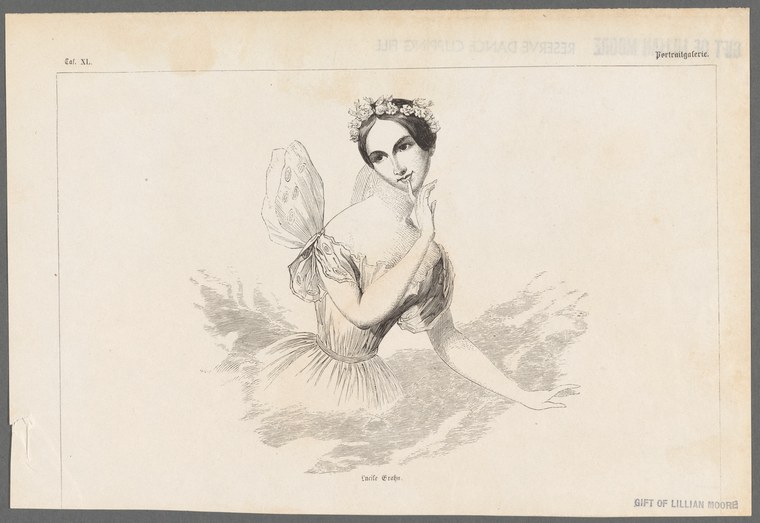
A young woman with dark hair crowned with flowers gazes over her shoulder toward the viewer, her body angled in a graceful contrapposto pose. She wears a fitted bodice in a darker shade and a voluminous skirt of diaphanous material that pools around her lower body. Most remarkably, she has large butterfly wings attached to her back—delicately rendered with fine linear detail—and smaller fairy or sylph wings emerge from her sides. The figure floats against a soft, sketched ground rendered in light wash, with no architectural setting or stage furniture; the composition is intimate and dreamlike, focusing entirely on the figure's elegant bearing and the play of her gossamer costume. The overall effect is ethereal and romantic.
The dancing
The dancer is captured in a standing pose with her weight slightly back, her torso twisted gracefully to address the viewer while her face turns with characteristic Romantic-era composure—contemplative rather than animated. Her arms are positioned softly, one hand raised near her shoulder in a gesture of repose or introspection. The pose suggests a moment of suspension or meditation rather than active movement; there is no indication of rapid footwork or dynamic partnering. The scale and proportion of the figure suggest a soloist, and the overall frame privileges elegance and refinement over technical display.
The dance depicted
This is most likely a Romantic ballet figure, specifically one of the sylphs or supernatural creatures that populated mid-nineteenth-century works like *La Sylphide* (1832) and *Giselle* (1841). The butterfly and fairy wings are the defining attribute of such roles. The ethereal, weightless quality sought in Romantic ballet—the illusion of creatures barely touching the ground—appears to be the artistic aim here. The pose and costume align with what male and female dancers of the Romantic era were trained to project: otherworldly grace rather than earthly vigor. The work may depict a specific famous dancer in a celebrated role, though without further documentation this cannot be confirmed.
How it was made
This is a lithographic print, identifiable by the characteristic fine linework, the use of wash for tonal modeling, and the reproductive technique visible in the handling of fabric texture and shadow. Lithography allowed for a softer, more tonal range than wood engraving and made possible the delicate rendering of the wings and the figure's transparent skirt. The technique was well suited to theatrical portraiture and was the dominant medium for dance prints in the nineteenth century, allowing rapid circulation of images of celebrated performers to audiences across Europe.
About this work
This lithographic print captures a moment from Romantic ballet, depicting a dancer posed as a supernatural sylph or fairy—the archetypal female character of mid-nineteenth-century ballet. The large butterfly wings and ethereal pose encapsulate the Romantic era's obsession with otherworldly, weightless movement and the fantasy worlds conjured on the ballet stage. The work belongs to a substantial body of theatrical portraiture that documented the stars of the Romantic ballet and served as both artistic record and promotional material for performances.
The image is valuable precisely because it documents not just what Romantic ballet looked like, but what artists and audiences believed it should look like: a figure suspended between the human and the supernatural, elegant and restrained even in an imagined moment of flight. The lithographic medium itself speaks to the professionalization and commercialization of ballet in this period.
How to look at it
Notice the moment the artist has chosen: not mid-leap or caught in rapid turning, but a pose of repose and introspection. This reflects a key value of Romantic ballet—the illusion of effortless grace rather than technical strain. The wings are rendered with meticulous attention to their translucent, delicate structure, emphasizing the fantasy element. Observe also the treatment of the skirt: its voluminous folds and the way it seems to dissolve into the background suggest the airiness and weightlessness the Romantic aesthetic prized. The three-quarter turn of the body and the gaze toward the viewer create an intimate contact with the audience, another hallmark of theatrical portraiture of the period.
The artist
The artist is not recorded in the catalogue. The style and technique are consistent with mid-nineteenth-century theatrical lithographers working across Europe, particularly those who produced celebrity portraits and ballet scene documentation. Such prints were typically unsigned or bore only a lithographer's mark, and were often created after drawings by more celebrated artists or from live observation. The quality of the rendering suggests a skilled hand experienced in capturing the subtleties of costume and the proportions of trained dancers.
The period
This print dates from the height of the Romantic ballet era (roughly 1830–1870), when works featuring sylphs, sprites, and other supernatural figures dominated European ballet repertories. The period saw the rise of the ballerina as the central figure of ballet (male dancers were increasingly sidelined), and the cult of the ethereal, otherworldly female dancer reached its zenith. Lithographic dance prints were a major art form and mode of celebrity during this time, serving both as souvenirs for audiences and as documentation of the fashions and movements of the stage. The subject matter—a lone female figure in a transcendent pose—is archetypal of the era.
Where it lives
This work is held in the New York Public Library's collection of prints depicting dance. It forms part of a substantial archival record of nineteenth-century theatrical imagery. The attribution to a specific dancer (Lucile Grahn) appears in the catalogue title but cannot be verified from the image alone; the print may be a portrait of the dancer in a famous role, or the title may reflect a later attribution or misidentification.
Dance in this work
Questions about this work
Was Lucile Grahn famous, and did she dance in roles with wings?
Lucile Grahn was a major Danish-Swedish ballerina of the Romantic era and performed extensively across Europe. She was known for dancing in leading roles in *La Sylphide* and other Romantic ballets. However, the attribution of this particular print to her cannot be verified without further research or documentation from the holding library.
Why do Romantic ballet dancers have wings in these pictures?
Wings were used in Romantic ballet to mark certain characters as supernatural or otherworldly—sylphs, spirits, fairies—which were the dominant subject matter of the era. They were part of the visual vocabulary used to signal to audiences that the figure on stage belonged to a fantasy realm rather than the everyday world. In some productions wings were literal costume pieces; in others they may have been suggested through artistic convention.
Is this a photograph, a painting, or a print?
This is a lithographic print—a reproductive technique that allowed artists to create images that could be printed and distributed widely. It is neither an original painting nor a photograph, but rather a skilled translation of a performance or a costume design into a medium that made it accessible and affordable to a broad public. Lithographic prints were the dominant medium for theatrical portraiture in the nineteenth century.
More dance artwork





