49 works in this view — arrow keys or swipe to move between them.
Dance in Art
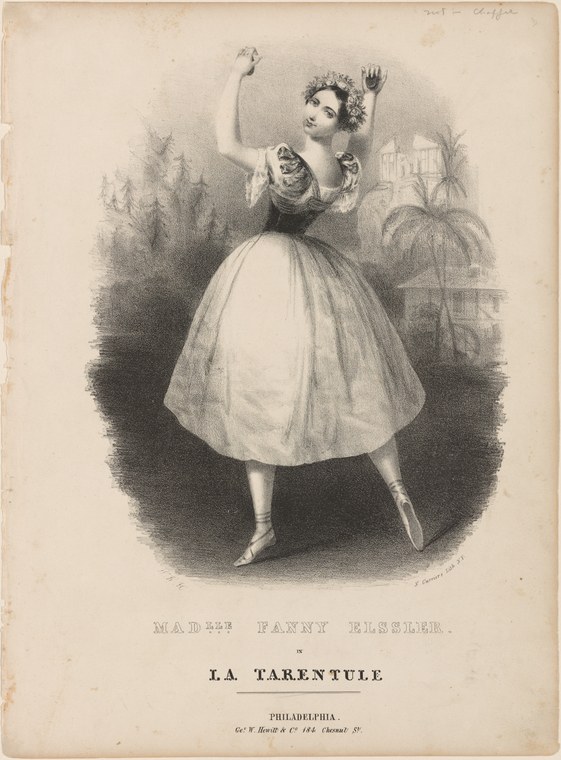
Madlle. Fanny Elssler in La tarentule
Unknown artist
- Collection:
- Prints depicting dance
- Source:
- New York Public Library
- Rights:
- Public domain — free to use, share and adapt.
- Recorded as:
- Public Domain
Elssler's *Tarentule* was a watershed moment in dance history: it proved that a female ballet dancer could command the stage through technical virtuosity *and* dramatic acting without the ghostly, ethereal quality associated with her rival Taglioni. This print preserves the visual record of that innovation and was itself part of the machinery that made Elssler an international celebrity. For any historian of Romantic ballet or 19th-century performance culture, Elssler's image is foundational.
What you are looking at
A young woman in a voluminous white tulle skirt stands in a classical ballet pose, caught mid-movement with one arm raised gracefully overhead and the other extended to the side, palm upward. She wears a fitted bodice with short puffed sleeves and stands en pointe on one leg, her other leg bent beneath her. The background is lightly rendered in grayscale: dark evergreen trees suggestive of a forest scene occupy the left side, while architectural elements—a building or pavilion—appear dimly on the right. The figure is bathed in a soft luminosity that makes the white skirt glow against the shadowed surroundings, emphasizing the ethereal quality of the pose. The composition is vertical and intimate, focusing entirely on the solitary dancer.
The dancing
The dancer's weight is placed on her supporting leg in a turnout position characteristic of ballet training. Her raised arm traces a curved line upward with an open hand; her extended arm is held to the side at approximately shoulder height with fingers extended. The body demonstrates the elongation and verticality fundamental to ballet—no sagging, a lifted spine, and a clear lift through the crown of the head. The bent leg of the working side is tucked under the body, not extended into space, suggesting a position near an attitude or assemblé preparation rather than a developpé or grand battement.
The dance depicted
This is Romantic-era ballet, almost certainly documenting the famous Italian dancer Fanny Elssler. The subtitle *La Tarentule* references Elssler's most celebrated role: a dramatic solo from the 1839 ballet *La Tarentule*, in which she performed the role of a young woman bitten by a tarantula and driven into a frenzy. The pose shows her in a moment of controlled passion rather than the wild convulsions the tarantula bite would produce; this is the theatrical discipline of the Romantic ballet era, where even extreme emotion is bound by classical technique. The forest setting and the solitary female figure in white tulle are quintessential Romantic ballet iconography.
How it was made
This is a lithographic print, recognizable from the grayscale tonal gradations achieved through crayon work on stone, the soft edges, and the characteristic way light and shadow blend without harsh lines. The technique allowed rapid reproduction and wide distribution of dance imagery to an audience hungry for images of celebrated performers. Lithography in the 1830s–1840s was the dominant medium for theatrical portraiture and was far cheaper and faster than engraving, making these prints affordable to middle-class audiences and allowing theaters to capitalize on star performers' fame. The signature visible in the lower right corner indicates the lithographer, not necessarily the original artist.
About this work
This is a lithographic portrait of the legendary Romantic-era dancer Fanny Elssler in her iconic role as the tarantula-bitten heroine of *La Tarentule*. The print documents a single moment of controlled classical ballet poise set against a Romantic landscape, capturing both the technical discipline and the emotional theatricality that defined her artistry. Elssler was one of the two supreme ballet stars of the 1830s–1840s (the other being Marie Taglioni), and her performances—especially *La Tarentule*—were celebrated across Europe and America. This image circulated widely as a souvenir of her performances and as evidence of her technical mastery and dramatic intensity.
How to look at it
Notice how the artist has chosen not the moment of wild frenzy (which would show violent, distorted movement) but rather a moment of classical poise and control—yet the upraised arm and extended leg, combined with the intense, inward-turned expression, suggest barely contained emotion. This is the essential paradox of Romantic ballet technique: the body must be perfectly disciplined even as the face and port convey passion. Look at how the white tulle seems to glow and how it occupies more visual space than the dancer's body itself; this is how Romantic ballet presented the female body as almost ethereal and lightweight, a quality Elssler's technique was famous for achieving despite her powerful musculature.
The artist
The lithographer is not recorded in the catalogue. The print was published by G. S. Harris & Co. in Philadelphia, indicating it was made for the American market during or shortly after Elssler's triumphant 1840–1842 tour of the United States. Lithographic prints of Elssler were produced in quantity by multiple publishers across Europe and America, often by different hands, to capitalize on her celebrity.
The period
This print dates to the height of the Romantic ballet era (circa 1838–1845). The 1830s saw the triumph of the ethereal, otherworldly Romantic heroine—the spirit, the sylph, the maiden in white—but Elssler's *Tarentule* (premiered in 1839) offered a different vision: a passionate, flesh-and-blood woman capable of both technical fireworks and emotional extremity. The tarantula subject also marked a shift toward ballets with dramatic narratives grounded in folk legend and exotic locales rather than purely allegorical narratives. In the art of dance portraiture, lithography was at its height as the primary medium for disseminating images of celebrated performers to fans, critics, and historians.
Where it lives
This is a lithographic print held in the New York Public Library's collection of prints depicting dance. It was published by G. S. Harris & Co. in Philadelphia, suggesting it was part of a commercial trade in dance imagery aimed at American audiences during Elssler's celebrated US tour.
Dance in this work
Questions about this work
Who was Fanny Elssler?
She was an Austrian dancer (1810–1884) who became one of the two supreme stars of Romantic ballet alongside Marie Taglioni. Where Taglioni embodied the ethereal, supernatural heroine, Elssler excelled at dramatic, passionate, and technically dazzling roles. She made a triumphant tour of the United States (1840–1842) that made her an international celebrity and helped establish ballet as a major theatrical attraction in America.
What is *La Tarentule*?
It is a one-act ballet choreographed by Jean-Auguste Aumer, premiered in Paris in 1839 with Elssler in the title role. The plot concerns a young woman in southern Italy who is bitten by a tarantula and driven into a frenzied dance as a result. Elssler's performance in this role was celebrated for combining technical brilliance (fast footwork, multiple pirouettes) with dramatic conviction, and the work became her signature vehicle throughout her career.
Why is this printed lithograph, not a painting?
Lithography was the dominant medium for theatrical portraiture in the 1830s–1840s because it was fast, relatively inexpensive, and could be reproduced in quantity. A single lithographic stone could yield hundreds of prints, making it possible for theaters and publishers to sell images of celebrated performers to fans at an affordable price. This was the age of mass-market theatrical celebrity and mass reproduction.
How do you know this is Elssler in *La Tarentule*?
The print is inscribed with the title *Madlle. Fanny Elssler in La tarentule*. This is contemporary documentation, not scholarly attribution. The image itself also contains period-appropriate Romantic ballet vocabulary (the white tulle skirt, the classical pose, the forest setting) that confirms it is a dance image of the era.
More dance artwork





