49 works in this view — arrow keys or swipe to move between them.
Dance in Art
Manège, plan de terre des voltes
Unknown artist
- Collection:
- Prints depicting dance
- Source:
- New York Public Library
- Rights:
- Public domain — free to use, share and adapt.
- Recorded as:
- Public Domain
For dancers and historians, this image is documentary evidence of how Renaissance choreography was notated and transmitted in print. The volte was performed in courts across Europe and was controversial enough to be debated in moral literature; this diagram shows how dance masters broke down its mechanics for teaching purposes. The work demonstrates that dance history was recorded and studied in real time, not invented retrospectively.
What you are looking at
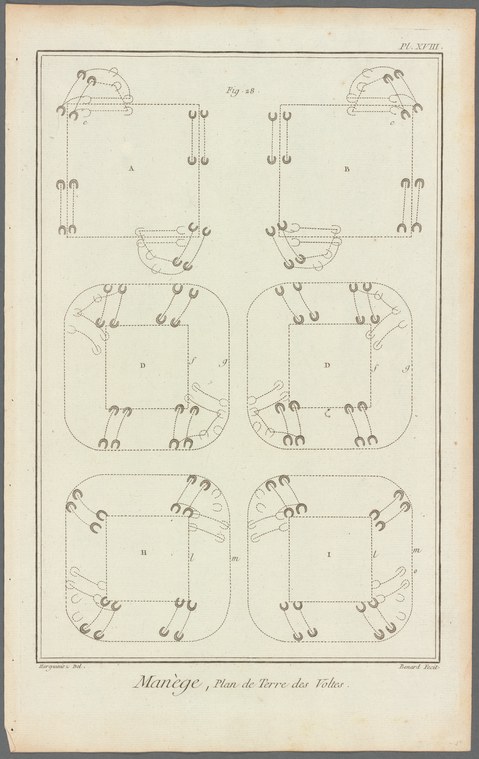
This is a technical schematic diagram showing the ground plan and movement patterns of the volte, a Renaissance court dance. The plate is divided into six panels (labeled A through F), each depicting a rectangular or rounded-square floorplan with pairs of footprints arranged in symmetrical patterns. Small curved lines at cardinal points suggest the positions of dancers or musicians. Dotted lines connect footprints to show the path of movement across the floor. The footprints themselves are rendered as small paired marks, roughly shoe-shaped, oriented to indicate the direction each dancer faces. The whole composition is orderly and geometric, rendered in a simple line-based engraving style on cream paper with a narrow border frame. The title at foot reads "Manège, plan de terre des voltes" (The management/arena, ground plan of the voltes).
The dancing
The dancers are represented only as footprints and movement lines rather than as bodies. Each panel shows paired footprints, indicating couples. The footprints are oriented in various directions—sometimes parallel, sometimes at angles—suggesting the turning and traveling characteristic of the volte. The curved lines at the edges of each panel likely indicate the musicians or the boundaries of the dance space. There is no representation of arm position, hold, or upper body; this is purely a choreographic notation showing weight placement and floor track.
The dance depicted
This is a technical illustration of the volte (volta), a dynamic turning dance of the Renaissance court, most popular in the sixteenth century. The volte was danced by couples and was notorious for its vigorous lifting and turning, which scandalized conservative observers. The ground plans shown here—with their emphasis on rotational paths and paired movement—confirm the turning nature of the dance. The multiple panels likely illustrate variations or sequences within the volte's choreography. This is a teaching or reference document rather than a representation of a live performance; it belongs to the tradition of Renaissance dance notation and choreographic description.
How it was made
This is an engraving, identifiable by the fine line-work, the regular cross-hatching (visible in the border and framing), and the characteristic appearance of the printed surface. The technique allowed for precise geometric rendering of floor patterns, which would have been difficult to convey in painting or manuscript. The small scale and portable format suggest this was intended as a page in a printed dance manual or treatise, circulating among courtiers, dance masters, and the educated elite who could read choreographic notation. The use of standardized symbols (footprints, directional lines) indicates a systematic approach to dance documentation.
About this work
This is a technical diagram of the volte, a sixteenth-century Renaissance court dance, showing the ground plans and step sequences for couples. Rather than depicting dancers in motion, it uses a schematic notation of footprints and movement paths to record how the dance was performed. It belongs to a significant tradition of Renaissance dance documentation—including works by Thoinot Arbeau, Fabrizio Caroso, and others—that attempted to preserve and transmit choreography through printed instruction. The volte was one of the most physically demanding and socially charged dances of its era, and this diagram is evidence of how dance masters analyzed and taught it.
How to look at it
Focus on the footprints in each panel: they show how couples progressed through space and how their weight shifted from step to step. The orientation and spacing of the prints reveal the characteristic rotational axis of the volte—the dancers do not travel in straight lines but rather turn as they move forward. Compare the six panels to see how the choreography was varied or repeated. The symmetry of most patterns reflects the formal geometry of court dance and the principle that choreography was often mirrored or repeated in couples.
The period
The volte was at the height of its popularity in the mid-sixteenth century, particularly in Italian and French courts. It appears in the most famous surviving Renaissance dance manuals: Thoinot Arbeau's *Orchésographie* (1588) and Fabrizio Caroso's *Il Ballarino* (1581) both describe and illustrate the volte. The dance's vigorous turning and the close hold required between partners made it controversial among clerics and moralists, who saw it as immodest. By the seventeenth century it had fallen out of favor as dance styles shifted toward the more measured baroque forms. This diagram, without a recorded date, likely belongs to the late sixteenth or early seventeenth century, when such technical notation was becoming more systematic and widespread in print.
Where it lives
This print is held in the Prints Depicting Dance collection at the New York Public Library. It is a page from what was likely a printed dance manual or treatise, though the source edition is not recorded in the catalogue.
Dance in this work
Questions about this work
Is this the same as a pavane or galliard?
No. The pavane was a processional dance, the galliard a jumping dance. The volte was distinguished by its vigorous turning and the lifting of the woman by her partner, which required physical strength and close contact. This diagram's emphasis on rotational paths is typical of the volte.
How do I read these footprints?
Each small mark represents the placement of one foot. The orientation (the angle of the mark) shows which direction the dancer was facing. Dotted lines show the path traveled across the floor. In each panel, you are looking down at the floor from above, as if the room were transparent.
Why are there no pictures of actual dancers?
This is a notation document, designed to record choreography in a compact, teachable form. It was probably used alongside written descriptions or oral instruction. Pictorial representations of the volte do survive (in artwork by artists like Lucas Cranach and Peter Bruegel), but this diagram serves a different purpose—to show the mechanics and the sequence of steps.
Was the volte danced everywhere?
The volte was most popular in Italy and France in the sixteenth century. It appears in Italian and French dance manuals and in court records. However, it was controversial and by the early seventeenth century had largely disappeared from court dance, replaced by baroque forms. This diagram may record a dance that was already becoming historical.
More dance artwork





