49 works in this view — arrow keys or swipe to move between them.
Dance in Art
A country dance
Unknown artist
- Collection:
- Prints depicting dance
- Source:
- New York Public Library
- Rights:
- Public domain — free to use, share and adapt.
- Recorded as:
- Public Domain
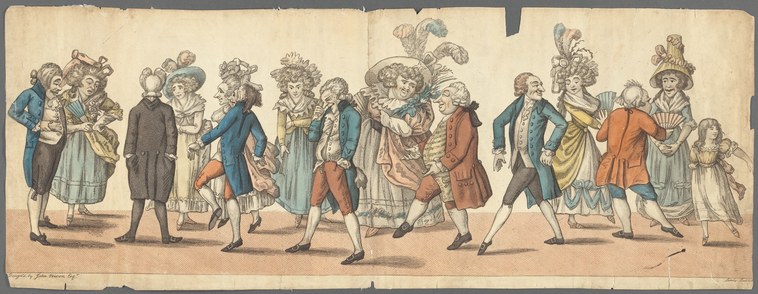
Country dancing was foundational to 18th-century social life and identity: this engraving is a contemporary record of that practice in action, capturing both the formal arrangement and the informal sociability of a dance occasion that shaped generational experience. For historians and dancers, the image documents the visual and kinetic grammar of a major historical dance form at a moment before Romantic ballet eclipsed social dancing from high cultural attention, making it a crucial witness to what 'dancing' meant to ordinary people of the period.
What you are looking at
A hand-colored engraving depicting a processional line of figures in 18th-century dress, moving across a shallow stage or ground plane. The composition spans two joined sheets and shows approximately fifteen figures arranged in a loose line, with varying heights and depths suggesting recession into space. The foreground figures are rendered larger and more detailed, while those toward the rear diminish in scale. The figures wear formal attire: women in long dresses with small bonnets or caps, men in coats with breeches and stockings, and several children interspersed throughout. The palette is muted—ochre and cream grounds with selective touches of blue, orange, and pink in the clothing. The line moves gently from left to right, with figures in varying poses: some walking, some with arms raised or extended, suggesting choreographed movement rather than processional stiffness. The figures occupy a neutral space with no landscape, interior, or architectural detail; the focus is entirely on the bodies and their ordered relation to one another.
The dancing
The dancers move in a single file or slightly scattered line rather than in closed couples, distinguishing this from Romantic-era paired dances. Most figures stand upright with natural posture; several have raised or extended arms in gestures of sociability or invitation. The spacing between figures is irregular but deliberate, suggesting they maintain awareness of one another without rigid formation. Children appear distributed through the line, indicating a mixed-age social occasion. The women's dresses hang loosely, allowing visible movement at the ankle, and the men's silhouettes show straight legs in breeches, typical of walking or processional movement rather than turning or swaying.
The dance depicted
This most likely depicts an English country dance or cotillion from the mid-to-late 18th century, the social and recreational dance forms that dominated European ballrooms and country assemblies of the period. The title 'A country dance' supports this reading. The procession format—a line or lines of mixed-gender figures moving with deliberate spacing—is characteristic of the longways sets and contredanses that required multiple couples arranged in formation. The informal, orderly progression and the presence of children suggest a public or semi-public occasion, possibly a village assembly or country house gathering. The engraving records not choreography in detail but rather the social occasion and the dressed figures engaged in it.
How it was made
This is a hand-colored engraving, executed in black line with selective application of watercolor or gouache to the printed surface. The engraver has used fine parallel lines (hatching) to model form and suggest depth, particularly visible in the folds of the women's dresses and the definition of the men's coats. The hand-coloring, applied after printing, is restrained and sometimes sketchy, leaving much of the paper visible; this technique was typical of popular prints made for distribution to a broad audience. The joining of two sheets indicates this was either a longer composition cut and rejoined, or printed in two sections for assembly—common practice for panoramic or processional subjects. The technique and hand-coloring suggest a commercial print made for sale to the gentry and merchant classes who participated in country dancing.
About this work
This is a hand-colored engraving of a country dance or cotillion in the English style of the mid-to-late 18th century. The work captures not a single moment of choreography but rather the social and visual character of a rural or provincial assembly—a mixed-age line of dressed figures moving in ordered procession. It belongs to a genre of popular prints that documented social dancing as a marker of civility and genteel recreation. The engraving format and hand-coloring indicate it was made for a broad market audience: gentry, country householders, and the aspirational middle classes who aspired to participate in such entertainments or to view them as records of fashionable practice.
The work is significant as evidence of how country dancing was understood and visualized in the period when it was consolidating as a defining social practice in Britain and northern Europe. Unlike later theatrical ballet images or formal dance instruction plates, this print presents dancing as a social occasion—a community event—rather than as a display of virtuosity or technical accomplishment. The title is generic, the figures are unidealized, and the emphasis is on the orderly line and the mixed company, suggesting the engraving was aimed at documenting a kind of behavior and social formation rather than celebrating individual performers.
How to look at it
Attend first to the spacing and arrangement of the figures: the engraver has emphasized their orderly procession and their relationship to one another in line, not their individual movement quality. Notice the variations in pose—some figures walk with arms at rest, others raise arms or gesture—which suggest the figure-dancing patterns of country dances, where dancers moved through changes of position while advancing along the set. The hand-coloring is selective and sometimes crude; it does not aim to create illusion but rather to enliven the print and identify social status through clothing (the blue coats and orange vests of the men, the varied skirt colors of the women). The scale variations and the joining of the two sheets create a panoramic effect that mimics the experience of watching a procession or line of dancers unfold in sequence.
The period
The 18th century saw the establishment of country dancing and contredanse as the dominant social dance forms across England, France, and the European gentry. These dances were codified in published instruction manuals (notably Playford's *The English Dancing Master*) and were taught to children as a mark of genteel education. The period saw the rise of public assemblies and country house gatherings as occasions for social dancing, and a flourishing popular print trade that documented fashionable life and behavior. By the 1770s–1790s (the likely date of this work), country dancing had become so central to social life that prints, books, and illustrations of it proliferated. At the same time, ballet was emerging as a distinct theatrical form with professional performers, but social dancing remained the primary dance experience for the vast majority of the population.
Where it lives
The work is held in the New York Public Library's collection of prints depicting dance. The catalogue identifies it as part of a broader holding of dance-related prints, many of which lack detailed attribution or dating. The work is classified by subject (dance) rather than by artist or technical method, which suggests it entered the collection as a topical acquisition rather than as the work of a recognized printmaker.
Dance in this work
Questions about this work
What is a country dance?
A country dance (or contredanse) is a social dance form performed in lines or sets by multiple couples, originating in England and becoming dominant across Europe in the 17th–19th centuries. Dancers move through prescribed figures and changes—advancing, retiring, turning—while the group maintains formation. Unlike ballet, country dancing was participatory social entertainment, not performance, and was danced by ordinary people of all social classes at assemblies, house gatherings, and public balls.
How do I know these people are dancing and not just walking?
The orderly spacing, the formal dress, and the title all indicate dancing. The raised arms on some figures suggest the arm positions and gestures that were part of country dance figures. Most tellingly, the composition freezes a moment of ordered procession that would be meaningless as a simple walk but makes sense as a record of the formal arrangement dancers adopted at the start of a dance set or during a processional figure.
Who danced country dances?
Country dances were danced by people across the social spectrum in the 18th century—gentry, merchants, farmers, and townspeople all participated. They were taught to children as part of polite education and performed at assemblies, private house gatherings, and public balls. The presence of children in this image suggests a family or community occasion rather than an exclusive elite gathering.
Why is this engraving hand-colored rather than printed in color?
Hand-coloring was economical for popular prints: the engraving was produced once in black line, then individual copies could be colored by hand quickly and cheaply, with variation in quality and color choice. This made the print affordable for a broad market while allowing some customization. Hand-colored prints were the standard way to distribute colored images before color printing technology became viable.
More dance artwork





