49 works in this view — arrow keys or swipe to move between them.
Dance in Art
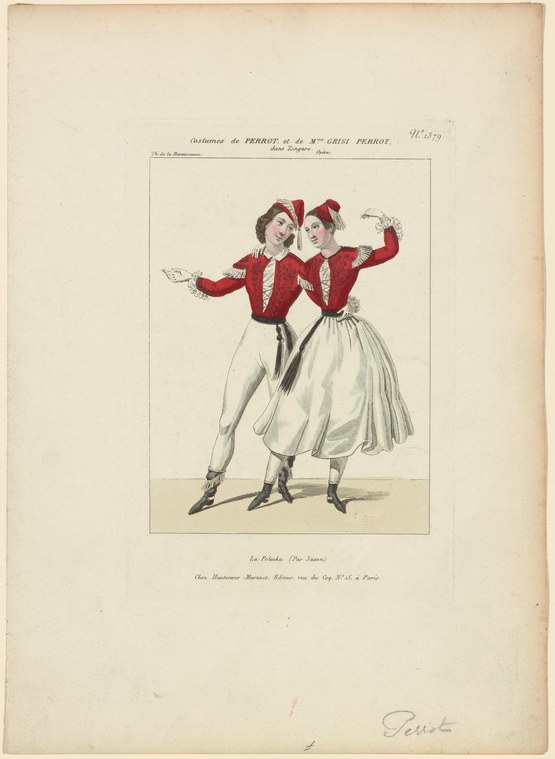
Costumes de Perrot et de Mme. Grisi Perrot dans Zingaro.: Opéra, Th. de la Renaissance
Unknown artist
- Collection:
- Prints depicting dance
- Source:
- New York Public Library
- Rights:
- Public domain — free to use, share and adapt.
- Recorded as:
- Public Domain
This image connects two major figures in romantic-era dance—Perrot was one of the most celebrated male dancers and choreographers of the period, and the Grisis were a prominent theatrical family. The work provides rare visual evidence of how professional dancers dressed for opera roles and what kind of movement vocabulary such costume implied. For historians and dancers studying the transition from romantic ballet to character dance and operatic performance, it documents a specific production and the artistic choices made for a particular role.
What you are looking at
This is a costume design illustration for two dancers in the opera *Zingaro*, performed at the Théâtre de la Renaissance. The composition shows two nearly identical figures posed in a dynamic, theatrical stance against a plain background. Both wear striking red jackets with decorative frogging or braiding down the front, paired with full white skirts that fall to mid-calf. The jackets have short sleeves and fitted waists, and each figure wears a red bow or ribbon in their hair. The dancers are shown in a symmetrical arrangement, their bodies tilted slightly inward toward each other, with one arm extended outward and the other raised. Their legs are positioned in a lively, alert posture, with black shoes visible beneath the skirts. The illustration uses hand-coloring over a line engraving, with careful attention to the texture and folds of the white fabric and the bright red of the jackets. The style is characteristic of mid-19th-century French theatrical costume documentation.
The dancing
The two figures are posed with their bodies angled toward one another in a mirror-like arrangement. Both have their weight slightly forward, legs positioned as if in mid-movement or about to step. One arm is extended outward from the body at roughly shoulder height, while the other is raised higher, creating a sense of buoyant, playful energy. The posture suggests nimbleness and theatrical grace rather than the formality of classical ballet; the figures appear ready to move rather than held in a static pose. The symmetrical doubling of the figures—identical in costume and near-identical in pose—emphasizes their character as a matched pair, likely suggesting they were danced by performers of comparable skill.
The dance depicted
This illustration documents a costume for a specific theatrical production, *Zingaro* at the Théâtre de la Renaissance (a major Parisian venue). The work identifies the wearers as Perrot and Mme Grisi Perrot, indicating this is a professional record of a named performance. The red jacket and white skirt combination, combined with the light, forward-tilted posture and the lively arm positions, suggests a role in romantic-era theatrical dance rather than formal ballet. Without access to the original score or detailed performance records, the exact nature of the choreography cannot be certain, but the costume style and period (likely 1840s–1850s based on the engraving technique and fashion) point toward the lighter, more comic or character-based roles that were emerging in the romantic theater of that era. The term *Zingaro* (Italian for "gypsy") suggests the piece may have drawn on exoticist themes popular in romantic opera and ballet.
How it was made
This is a hand-colored engraving or possibly a lithographic print, which can be inferred from the fine line work, the way the composition is framed, and the method of coloring. The technique allowed for precise documentation of costume detail—the frogging on the jacket, the drape of the skirt, and the accessories are all rendered with clarity useful for theatrical wardrobe record-keeping and for reproduction in collections or publications aimed at theaters and dancers. Hand-coloring on top of the print base gave the illustrator the ability to capture the vivid red and clean white of the stage costume, which would have been essential to the visual impact of the performance. This type of document circulated among theater professionals, in costume archives, and in printed collections of theatrical designs intended to serve as reference material.
About this work
This is a costume design illustration for the opera *Zingaro* at the Théâtre de la Renaissance, documenting the stage wear of the dancers Perrot and Mme Grisi Perrot. It is a professional theatrical record in the form of a hand-colored engraving, typical of 19th-century European practice for preserving and disseminating costume information. The work captures not only the precise details of the garment—the red jacket with decorative braiding, the full white skirt, the hair ribbon—but also the character and deportment of the dancers through pose and gesture. It belongs in a gallery of dance because it is both a historical document of professional performance and a visual interpretation of how bodies moved and presented themselves in the romantic theater of mid-19th-century France.
How to look at it
Observe the careful balance of the pose: how the two figures mirror each other yet face slightly inward, creating a sense of conversation or partnership. Notice the extension and lift in the arms, which conveys lightness and alertness rather than the sustained lines of classical ballet. Pay attention to the costume itself—the way the red jacket fits the torso and the full white skirt suggests a character who can move freely and energetically, not someone constrained by formal court dress. The symmetrical doubling of the figures is itself a composition choice, conveying that this is a set piece or ensemble role designed for visual balance and parallel action.
The period
This illustration dates from the era of Romantic ballet and opera in France, roughly the 1840s–1850s, when the Théâtre de la Renaissance was an active venue for mixed theatrical work combining ballet, opera, and pantomime. Jules Perrot (1810–1894) was at the height of his fame during this period, known for both his dancing and his choreography, often partnering with the Grisi family members. The costume style—bright, theatrical, and designed for visibility and movement—reflects the aesthetics of romantic theater, which valued vivid colors, expressive gesture, and the visibility of the dancer's body within the frame of the stage. Hand-colored engravings and lithographs were the standard means of documenting and disseminating such designs across Europe, making them both practical records and marketable objects for the theater-going public.
Where it lives
This work is held in the New York Public Library's collection of prints depicting dance. It is catalogued as a costume design document for a specific theatrical production, reflecting the 19th-century practice of preserving records of professional performance through illustrated costume plates.
Dance in this work
Questions about this work
Who were Perrot and Mme Grisi Perrot?
Jules Perrot (1810–1894) was one of the most celebrated male dancers and choreographers of the romantic era, known for his roles in major ballets and operas across Europe. The Grisi family were prominent in romantic-era performance; Mme Grisi Perrot was likely Carlotta Grisi (1819–1899), a renowned ballerina, who married or was closely associated with Perrot during this period. This illustration documents their costumes for a specific theatrical collaboration.
What is *Zingaro*?
Zingaro (Italian for "gypsy") was an opera or operatic entertainment performed at the Théâtre de la Renaissance in Paris. The exotic "gypsy" theme was popular in romantic-era theater and ballet, often reflecting 19th-century European fascination with exoticist subjects. The exact premiere date and composer are not recorded in the catalogue, but the costume style and printing technique suggest a mid-19th-century production.
Why would a costume design be illustrated and printed this way?
Hand-colored engravings and lithographs of theatrical costumes served multiple purposes: as precise records for the theater wardrobe, as reference guides for costumers, as promotional materials for the production, and as collectible objects for the public interested in theatrical fashion and performance. They circulated among professional theaters and were sometimes bound into collections or published separately.
What does the pose tell us about the choreography?
The lively, forward-tilted posture with extended arms suggests movement that is energetic and visually expressive rather than formally restrained. The light frame and alert positioning indicate roles requiring quick, nimble footwork and clear gesture—consistent with character roles or lighter entertainment pieces rather than formal classical ballet. The symmetrical doubling suggests these were parallel roles designed for coordinated or matched action.
More dance artwork





