49 works in this view — arrow keys or swipe to move between them.
Dance in Art
Gavotte Pavlova
Unknown artist
- Collection:
- Prints depicting dance
- Source:
- New York Public Library
- Rights:
- Public domain — free to use, share and adapt.
- Recorded as:
- Public Domain
Anna Pavlova was one of the most influential figures in ballet history, a performer who redefined the art form as fundamentally expressive rather than purely virtuosic. This print, regardless of whether it depicts an actual gavotte, captures the visual language of Pavlova's stardom—the verticality, the transparency, the sense of weightless emotion that made her work revolutionary. For dancers and historians, the image documents not just a pose but an entire aesthetic philosophy that reshaped modern dance.
What you are looking at
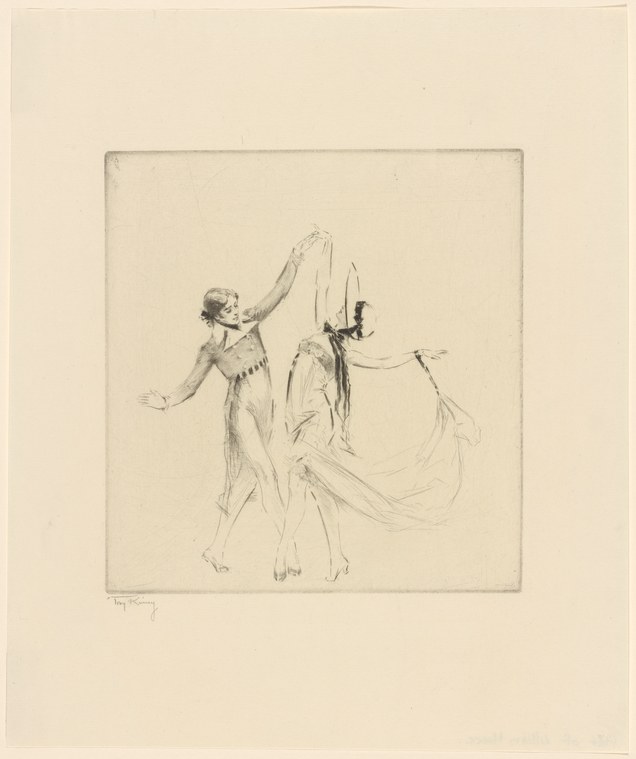
A single female dancer is shown in an elegant, linear composition against a plain background. She stands in a contrapposto pose with her weight on one leg, the other extended, wearing a classical tunic or short draped dress with what appears to be a beaded or decorated waistband. Her arms are raised and extended, one hand holding aloft a transparent fabric or veil that billows upward and to the side, creating a sweeping diagonal line across the composition. The drapery is rendered with delicate, feathery linework that suggests movement and lightness. Her posture is upright and dignified, the raised veil and extended limbs conveying a sense of graceful release or abandon—a moment of floating rather than grounded dancing. The overall effect is ethereal and lyrical, emphasizing line and flow over weight or earthed technique.
The dancing
The dancer occupies a single, isolated figure in what appears to be a classical contrapposto stance. One leg bears weight while the other is bent or extended; the upper body is elongated and open, with both arms raised to shoulder height or higher. The hands are delicate and expressively positioned—one releasing or gathering the veil, the other open and gestural. The pose suggests weightlessness and sustained extension rather than grounded movement or percussive footwork. There is an emphasis on verticality and the silhouette created by the raised drapery.
The dance depicted
The title 'Gavotte Pavlova' indicates this is a representation of a performance by Anna Pavlova, the Russian prima ballerina. However, the pose and aesthetic suggest Pavlova's celebrated roles in the Romantic repertoire rather than an actual gavotte, which is a Baroque court dance characterized by a specific hop and rhythmic pattern. The raised veil and the ethereal, sustained quality of the line point toward works like 'The Dying Swan' (1905) or similar dramatic solo pieces in which Pavlova became famous. The image captures not the codified steps of a gavotte but the Romantic ideal of weightless, expressive movement that Pavlova embodied. Without the artist's name or a dated inscription, the intention—whether to show an actual gavotte choreography or to evoke Pavlova's signature theatrical presence—remains ambiguous.
How it was made
This is an etching or engraving, rendered in black ink on cream paper, likely mounted on a backing sheet. The technique is linear and economical: the artist uses fine parallel lines and crosshatching to suggest form and shadow, particularly in the drapery and the dancer's musculature, while leaving much of the body defined by outline alone. The translucent veil is conveyed through sparse, feathery marks that suggest rather than describe. This technique allows for crisp, reproducible impressions and implies circulation as a print—probably a portfolio or collection of theatrical images. The delicate line quality and the attention to fabric and movement are characteristic of early 20th-century theatrical print culture, when such images were collected as mementos of celebrated performances.
About this work
This is a print depicting a solo female dancer in classical dress, identified by the title as a performance by the legendary Russian ballerina Anna Pavlova. The image shows a sustained, weightless pose with raised arms and billowing veil, emphasizing the Romantic aesthetic that defined Pavlova's theatrical presence and her revolutionary approach to ballet as a vehicle for dramatic expression. The work is an artifact of early 20th-century theatrical culture, when celebrated dancers were immortalized in prints that circulated widely among educated audiences and collectors of the performing arts. The simplicity and elegance of the composition reflect both the technical mastery of the printmaker and the symbolic power that Pavlova held in the imagination of her time.
How to look at it
Attend to the moment of suspension the artist has chosen: the dancer is neither rising nor falling, but held at an apex of weightlessness. Notice how the veil defines the composition as much as the body does—it is not a costume detail but a compositional element that extends the dancer's line and creates the sense of buoyancy. The linear technique of the print—the spare use of line and the emphasis on outline over mass—reinforces this weightlessness; there is almost no shadow, no earthiness, only silhouette and flow. The contrast between the dancer's firm stance and the ephemeral, sketchy rendering of the veil is the engine of the image.
The period
This print dates to the early 20th century, when Anna Pavlova (1881–1931) was at the height of her international fame. Pavlova's career coincided with the Sergei Diaghilev's Ballets Russes (founded 1909) and the broader modernization of ballet in Europe. Her signature work, 'The Dying Swan' (1905), revolutionized ballet by proving that a four-minute solo could move audiences more deeply than full-length spectacles. The Romantic ballet tradition, with its emphasis on ethereal, otherworldly female figures, remained dominant in the commercial ballet world during Pavlova's era, even as avant-garde choreographers pushed ballet toward abstraction and new movement vocabularies. Theatrical prints and photographs of celebrated dancers became popular souvenirs and promotional images, circulating in the same markets as cigarette cards and postcards.
Where it lives
Held in the New York Public Library's collection of prints depicting dance. The work is catalogued with minimal metadata, suggesting it may have been acquired as part of a larger lot or collection of theatrical prints rather than as a documented individual artwork with known provenance.
Dance in this work
Questions about this work
Was this a real gavotte that Pavlova danced?
The title 'Gavotte Pavlova' likely refers to a short solo choreographed for or performed by Pavlova, rather than a traditional Baroque gavotte. Pavlova danced many roles and variations created for her by choreographers; without documentation of the specific piece, the relationship between this title and any historical choreography cannot be confirmed. The Romantic aesthetic visible in the print—the ethereal quality, the emphasis on emotional expression—suggests this was a theatrical solo rather than a stylized court dance.
Who was Anna Pavlova?
Anna Pavlova (1881–1931) was a Russian prima ballerina who became one of the most celebrated and influential dancers of the early 20th century. She trained at the Imperial Ballet School in St. Petersburg and became prima ballerina of the Mariinsky Theatre. She is best known for her iconic role in 'The Dying Swan' (1905), a four-minute solo that transformed how audiences understood ballet. She toured internationally, establishing her own company and helping to bring Russian ballet to audiences worldwide.
Is this a photograph or a drawing?
This is a print—an etching or engraving made from an incised metal plate. The technique allowed the image to be reproduced in multiple impressions and distributed as a collectible. The fine linear style is characteristic of printmaking, which emphasized line over tonal shading and was well-suited to capturing the elegant, linear qualities of ballet.
What does the veil represent?
The veil is likely both a literal costume element and a symbolic one. In Romantic ballet, transparent fabrics and veils conveyed ethereality and otherworldliness—the sense of the dancer as a spirit or dream figure. The veil here extends the dancer's line and creates the sense of weightless movement; it is as much a compositional tool as a costume piece.
More dance artwork





