49 works in this view — arrow keys or swipe to move between them.
Dance in Art
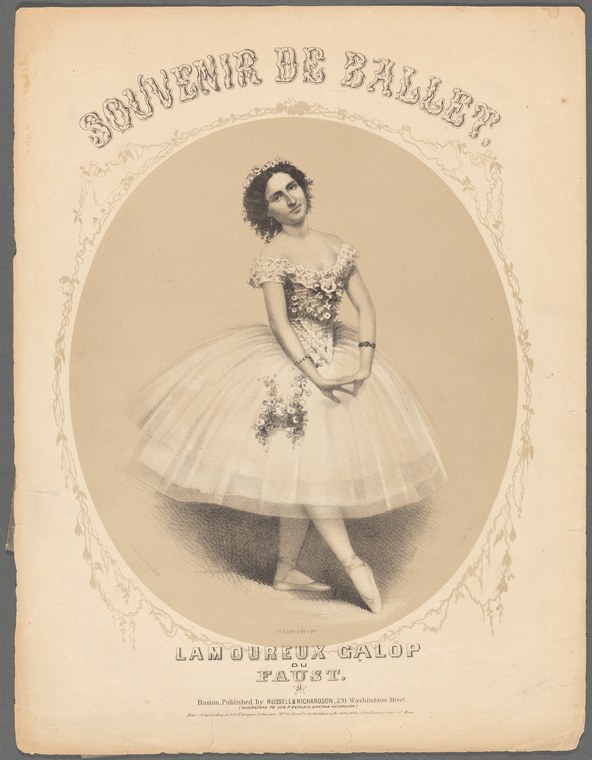
Souvenir de ballet, Lamoureux galop du Faust [sheet music cover portraying Louise Lamoureux]
Unknown artist
- Collection:
- Prints depicting dance
- Source:
- New York Public Library
- Rights:
- Public domain — free to use, share and adapt.
- Recorded as:
- Public Domain
This image preserves a record of the Romantic ballet costume and the material practice of theatrical promotion in the era when ballet rose to great popularity. It shows how dancers were presented to the public through mass-produced prints, and it documents a specific work and performer whose work is otherwise largely lost to written record.
What you are looking at
A young woman in classical ballet costume stands alone against a neutral background, enclosed within an ornate oval frame. She wears a white tulle skirt of mid-calf length, a fitted bodice embellished with flowers or jewels, and short off-shoulder sleeves—the canonical dress of mid-nineteenth-century Romantic ballet. Her dark hair is arranged in a center part with curls at the sides. She stands in a composed, modest pose with her weight on one leg, arms held softly at her sides, gazing upward and to the side with a wistful expression. The frame itself is decorated with delicate foliate scrollwork and a draped ribbon bow at the base. At the top, ornamental lettering reads "SOUVENIR DE BALLET," and below the figure, "LAMOUREUX GALOP / FAUST." The overall composition is formal, vertical, and portrait-like—a commemorative image rather than a narrative scene.
The dancing
A single figure is shown in a standing position, weight favoring the left leg in a soft stance that suggests readiness rather than active movement. Her arms rest naturally, one hand at her side, the other near her body, creating a composed silhouette. Her upper body is relaxed and upright; her face is turned slightly upward in an expression of romantic contemplation. There is no indication of partnerships, ensemble work, or dynamic movement—the pose is one of repose and presentation rather than mid-action dancing.
The dance depicted
This is a souvenir image from a Romantic ballet, as indicated by the costume, the historical context of the Faust theme, and the inscription naming it a galop from that work. The "galop" was a fast, whirling social and theatrical dance of the mid-nineteenth century, yet this image does not capture movement; instead, it presents the dancer in a static, dignified pose. The inscription identifies the subject as Lamoureux, who danced this role. The image serves as a commemorative print advertising or documenting a specific performance piece, part of a long tradition of theatrical souvenir imagery sold to audiences.
How it was made
This is a lithographic print on paper, recognizable by the soft tonal modeling, the grayscale palette, and the characteristic line quality of lithography. The technique allowed for wide distribution and affordable reproduction of theatrical images for popular consumption. The delicate shading and fine detail suggest a skilled hand; the ornamental border and formal composition indicate professional commercial production. Lithography was the dominant medium for theatrical souvenirs and popular prints in the nineteenth century, making this work accessible to audiences beyond those who attended the live performance.
About this work
This is a Romantic-era ballet souvenir—a lithographic portrait commemorating a dancer named Lamoureux in a role from a ballet staged to the Faust theme, which was popular subject matter in the 1840s–1860s. The work documents both the visual conventions of mid-nineteenth-century theatrical dress and the practice of circulating celebrity dancer images as a form of theatrical merchandise. It sits within a large body of similar prints produced for performers and productions of the period, giving insight into how ballet companies marketed their art and how audiences consumed images of their favorite dancers.
How to look at it
The viewer should attend to the costume details—the short tulle skirt, the fitted bodice, the off-shoulder neckline, the style of the hair—which are the visual grammar of Romantic ballet and which date the work precisely. Notice the pose: it is not a leap, a turn, or a partnered figure, but rather a composed, portrait-like stance that emphasizes the dancer's dignity and appeal rather than technical virtuosity. This convention—presenting the ballet dancer as a graceful, ethereal figure at rest—was central to how ballet dancers were marketed and understood in the nineteenth-century imagination.
The artist
The artist is not recorded in the catalogue. The print was published in Boston by Robert Strobridge (as indicated by the publisher line), a significant lithographic publisher of theatrical and popular imagery in the mid-nineteenth century. The quality of the draftsmanship and the professional finish suggest a trained artist working for a commercial printing house.
The period
The mid-nineteenth century saw ballet consolidate its position as a major theatrical art form, especially in the Romantic period (c. 1830–1860). Themes drawn from literature, legend, and the supernatural—including Goethe's Faust—were central to ballet repertoire. The same period saw the rapid expansion of theatrical publicity and image-making; lithographic prints of dancers became both artistic commodities and vehicles for marketing. Souvenir prints like this one were sold in theater lobbies and through the press, creating a visual record of performances and a celebrity culture around dancers that paralleled the modern fan merchandise industry.
Where it lives
This print is held in the New York Public Library's collection of prints depicting dance. It is a commercial lithographic souvenir, one of thousands produced during the mid-nineteenth century to commemorate performances and celebrate performers.
Dance in this work
Questions about this work
What dance is this showing?
The inscription identifies this as a galop from a ballet on the Faust theme, danced by Lamoureux. A galop is a fast, whirling dance popular in both social and theatrical contexts during the nineteenth century. However, this image does not show the galop in motion—it presents the dancer in a composed standing pose, as was conventional for theatrical souvenir prints of the era.
When was this made?
The catalogue lists the date as unknown. However, the costume style, the Romantic ballet aesthetic, and the lithographic technique suggest a date in the mid-nineteenth century, likely 1840s–1860s. The publisher Robert Strobridge was active in Boston in this period.
Why does the title say 'souvenir'?
Theatrical souvenir prints were mass-produced images sold to audiences to commemorate performances and celebrate favorite dancers. They functioned much like modern theatrical merchandise or fan photographs, allowing audiences to take home a memento of what they had seen onstage.
What does the ornate frame mean?
The decorative oval frame with scrollwork was a standard commercial convention for theatrical and celebrity portrait prints of the period. It elevated the image, giving the dancer formal dignity and turning the print into something suitable for framing and display in a home.
More dance artwork





