49 works in this view — arrow keys or swipe to move between them.
Dance in Art
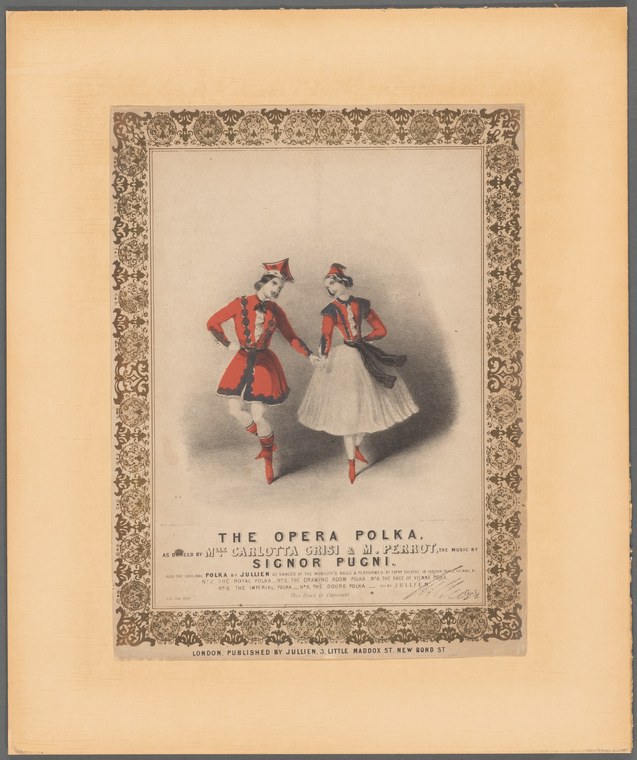
The opera polka, as danced by Mlle. Carlotta Grisi & M. Perrot, the music by Signor Pugni
Unknown artist
- Collection:
- Prints depicting dance
- Source:
- New York Public Library
- Rights:
- Public domain — free to use, share and adapt.
- Recorded as:
- Public Domain
The opera polka demonstrates that mid-19th-century theatrical dance was not confined to classical ballet or pantomime but incorporated social and national dances as vehicles for character and narrative. This print is a rare visual record of how two major dancers of the Romantic period—Grisi, a prima ballerina, and Perrot, a virtuoso male dancer and choreographer—approached a theatrical social dance, and it shows how theatrical lithography created a direct relationship between stage and domestic spaces.
What you are looking at
Two female dancers in bright red jackets with contrasting trim stand center stage against a softly shaded background. Both wear white skirts of mid-calf length and small decorative hats or bonnets. The figure on the left faces right with one hand on her hip in a confident pose; the figure on the right, slightly behind and to the side, reaches toward her companion with an outstretched arm. Their body positions suggest animated conversation or flirtation rather than formal partnering. The composition is intimate and conversational, not a grand ensemble moment. The entire image is framed by an ornate decorative border of repeating foliate patterns in brown and gold, characteristic of mid-19th-century theatrical prints. The print is mounted on a cream ground that extends beyond the decorated border.
The dancing
Both dancers stand upright with weight distributed evenly on both feet—no pointe work visible. The dancer on the left strikes an open, presentational stance with the hip-hand position common to social dance of the period. The dancer on the right leans slightly forward with arm extended in a gesture of engagement or greeting. Neither figure displays the turned-out positions or elevated frame of ballet technique. The relationship between them is lateral and equal, suggesting a conversation between peers rather than a hierarchical dance partnership.
The dance depicted
This is a polka, as stated in the title. The opera polka was a theatrical variant of the popular European ballroom dance, designed for the dramatic stage and likely incorporated into an operatic work or ballet pantomime. The casual, conversational poses and the social dress (jackets rather than tutus) suggest this depicts a character dance or divertissement rather than classical ballet. Carlotta Grisi and Jules Perrot were both prominent dancers of the mid-19th century; Perrot was also a celebrated choreographer. The informality of the depicted moment—two figures chatting rather than executing a formal step pattern—suggests the choreography prioritized character and theatrical storytelling over technical display.
How it was made
This is a hand-colored lithograph, evidenced by the soft shading in the background, the characteristic texture of the decorative border, and the flatness of the color application. The red is a commercial pigment applied uniformly across both jackets, while the faces and flesh tones show subtle shading typical of lithographic hand-coloring. Lithography allowed rapid, inexpensive reproduction, making theatrical prints accessible to urban audiences and dancers seeking souvenirs of celebrated performances. The ornate printed border—generic to the print series—was likely added at the press rather than hand-applied. This object served as a publicity image and keepsake from a specific operatic or balletic production.
About this work
This is a souvenir print of a mid-19th-century theatrical polka performed by two celebrated dancers of the era. The opera polka occupied the boundary between ballroom dance and stage performance, retaining the sociable, flirtatious character of salon dancing while adapted for the dramatic context of opera or ballet. The image captures not a moment of technical virtuosity but a scene of character interaction—two dancers as characters within a narrative, engaging in a moment of social play. It documents how Romantic-era dancers translated fashionable social dances into theatrical language and how prints democratized access to knowledge of celebrated performances.
How to look at it
Observe the arrested gesture rather than the formal pose: the dancer on the right is caught mid-reach, the one on the left mid-response, as if the print has frozen a moment of dialogue. This choice of a conversational rather than a technically climactic moment reveals how mid-19th-century theatrical dance could prioritize character and narrative even in a technical showcase. The red jackets and white skirts are street-wear that had begun to migrate onto the stage as fashionable dancers insisted on wearing contemporary dress in roles that called for it—a theatrical naturalism that challenged older conventions of exotic or abstract costume.
The artist
The artist is unrecorded in the catalogue. The print was published by Julien of Little Madox Street, London, a major publisher of theatrical prints and sheet music in the mid-19th century. Julien's output included thousands of hand-colored lithographs documenting performers and performances from London's principal theatres. The quality and finish of this print are consistent with Julien's commercial theatrical print production of the 1840s–1860s.
The period
The polka arrived in western Europe from Central Europe around 1840 and became an immediate sensation in both ballroom and theatrical contexts. Choreographers rapidly incorporated it into ballets and operatic divertissements, and male and female dancers competed to master its rhythmic, athletic character. Jules Perrot and Carlotta Grisi were key figures in 1840s Romantic ballet, a period when dancers increasingly engaged with popular social forms and when dance was being disseminated through prints and publications as never before. Theatrical lithography was at its commercial peak, and London publishers like Julien supplied an appetite for images of celebrated performers and recent productions.
Where it lives
This print is part of the New York Public Library's collection of dance-related prints, part of a much larger holding of 19th-century theatrical prints published by London and European firms. Such prints were sold as souvenirs at theatres, through print dealers, and by subscription, and circulated widely among performers and dance enthusiasts in Britain and America.
Dance in this work
Questions about this work
Who were Carlotta Grisi and Jules Perrot?
Carlotta Grisi (1819–1899) was an Italian prima ballerina, celebrated for her roles in Romantic ballets including the title role of Giselle. Jules Perrot (1810–1894) was a French dancer, choreographer, and ballet master, renowned for both technical prowess and choreographic innovation. In the 1840s they were among the most celebrated dancers in Europe, and they worked together in major productions in London, Paris, and beyond.
What is the opera polka?
The opera polka was a theatrical adaptation of the ballroom polka, typically performed as a divertissement (short specialty act) within an opera or ballet. It retained the quick tempo and social character of the ballroom dance but was choreographed for dramatic performance and adapted to the capabilities and ambitions of celebrated dancers. Many opera polkas were composed or arranged by leading conductors and choreographers of the period.
Why is this image important for dance history?
It documents a transitional moment in 19th-century performance, when social dances were being adapted for the stage and when theatrical imagery was becoming a major vehicle for disseminating knowledge of dance and performers. It also shows Romantic-era dancers engaging with contemporary popular forms rather than only with classical ballet or historic pastiche.
More dance artwork





