49 works in this view — arrow keys or swipe to move between them.
Dance in Art
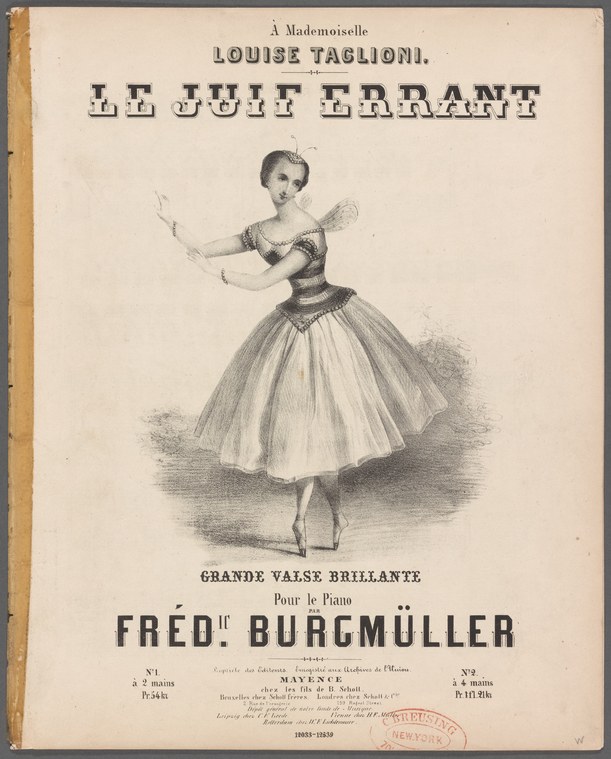
À Mademoiselle Louise Taglioni. Le Juif errant
Unknown artist
- Collection:
- Prints depicting dance
- Source:
- New York Public Library
- Rights:
- Public domain — free to use, share and adapt.
- Recorded as:
- Public Domain
This image is a rare direct portrait of a specific dancer in a specific role, preserving both the costume and the character vocabulary of Romantic ballet at its height. Louise Taglioni was one of the most celebrated performers of the 19th century, and this engraving is evidence of how her fame was mediated and consumed through the commercial print market. For historians of dance, it offers insight into the theatrical presentation of character and narrative in mid-19th-century ballet, and into the role of mime and expressive gesture in a period often mistakenly imagined to be purely technical.
What you are looking at
A young woman in Romantic-era theatrical costume stands alone against a plain background, captured mid-performance in a moment of expressive gesture. She wears a fitted bodice with short sleeves and a voluminous skirt of gauze or tulle that falls to mid-calf, allowing her legs and pointed feet to show clearly. Her posture is upright and her arms are extended in an open, communicative gesture—the left arm raised and turned outward, the right held lower and forward, palms visible. Her facial expression is animated and direct toward the viewer. The image is a black-and-white engraving, skillfully rendered with fine line work and careful shading to suggest the translucency and movement of the skirt's fabric. The composition is intimate and focused: a portrait of a dancer in character rather than a scene of social or narrative action.
The dancing
A single female dancer stands in a vertical axis, her weight seemingly poised on her right leg with the left leg relaxed and visible beneath the transparent skirt. The arms are positioned in an open frame, neither in a closed ballroom hold nor in the symmetrical classical position of academic ballet—instead they suggest spontaneous, character-driven expression. The raised arm and forward-facing posture are consistent with Romantic-era mime and character vocabulary, used to communicate emotion or narrative intent to the audience. The pointed feet and the lightness implied by the gauze skirt suggest training in theatrical dance, though the pose itself is not a standard ballet position.
The dance depicted
This is a portrait of Louise Taglioni in a theatrical character role, almost certainly from a Romantic ballet or pantomime-ballet of the 1840s–50s. The title *Le Juif errant* (The Wandering Jew) refers to a then-popular narrative subject, and Taglioni was celebrated for her dramatic and character roles as well as for her classical technique. The open, communicative arm work and the direct address to the viewer mark this as a moment of character acting or mime rather than pure ballet technique—a reminder that Romantic dancers were expected to be actresses and storytellers as much as technicians. The transparent skirt and pointe-ready feet identify this as theatrical rather than social or folk dance.
How it was made
This is a black-and-white engraving, likely from the 1840s–50s, printed commercially as a portrait or souvenir image dedicated to Taglioni. The technique allows for precise rendering of the dancer's silhouette, the delicate texture of the skirt fabric, and the subtle modulation of her facial expression and gesture. Such engravings were mass-produced and sold to the public and to admirers of celebrated dancers; they served as both documentation of performance costume and as celebrity portraiture. The dedication "À Mademoiselle Louise Taglioni" and the attribution to composer/arranger Frédéric Burgmüller (visible in the lower text) indicate this was a commercial object tied to a specific performance or role, designed for wide circulation.
About this work
This is a commercial engraving portrait of Louise Taglioni, the dominant ballerina of the Romantic era, in the character role of *Le Juif errant*. It captures not the technical vocabulary of classical ballet—the turned-out positions, the symmetry, the formal frame—but rather the expressive, narrative dimension of Romantic dance: a dancer in character, addressing the audience with open arms and a communicative face. The image documents both the costume of mid-19th-century theatrical dance and the aesthetic values of the period: the emphasis on the female dancer as the center of attention, the importance of the transparent, weightless skirt, and the integration of mime and acting into the vocabulary of theatrical dance. As a commercial engraving, it is also a document of how dance was circulated and consumed in the 1840s–50s: not through photographs or film, but through prints that could be bought, collected, and displayed.
How to look at it
Notice the moment the artist chose: not a leap or a turn, but a moment of stillness and direct address. The dancer's arms and face are doing the narrative work; the skirt, though transparent and weightless, is not caught mid-motion but is hanging. This is the vocabulary of Romantic mime—the pauses, the gestures, the direct engagement with the audience—rather than the continuous virtuosic movement associated with Classical ballet. Look at how the engraver rendered the fabric of the skirt: the fine parallel lines suggest transparency and delicacy, which were central to the Romantic aesthetic. The dedication and the attribution to Burgmüller mark this as a commercial object tied to a real performance or role, not an imagined scene.
The artist
The engraving was created to accompany a musical arrangement by Frédéric Burgmüller (1806–1874), a respected composer and pianist active in Paris. Burgmüller wrote extensively for dance and for salon music; his name on this print suggests either that he composed original music for the role of the Wandering Jew, or that he arranged or performed music for a performance in which Taglioni danced this role. The print itself was almost certainly engraved by a commercial printmaker in Paris, where such dance portraits were a standard product. The artist's name does not appear to be recorded.
The period
This image dates to the height of the Romantic ballet era, when European audiences were captivated by ethereal, supernatural, and tragic female characters: sylphs, spirits, betrayed maidens. The Wandering Jew was a Romantic subject of particular intensity—a figure of exile, punishment, and endless wandering—and the role would have called for precisely the kind of expressive, gestural performance that Taglioni was famous for. In the 1840s–50s, narrative ballet and pantomime-ballet coexisted with pure classical ballet; dancers were expected to act as well as to move. The commercial engraving market for dance portraiture was thriving in Paris, London, and other European capitals, allowing celebrities like Taglioni to reach audiences far beyond the theater.
Where it lives
The print is held in the New York Public Library's collection of prints depicting dance. The dedication and attribution suggest it was a commercial product, likely sold in Paris and other European cities in the mid-19th century. Such prints were often bound into albums or scrapbooks by collectors.
Dance in this work
Questions about this work
Who was Louise Taglioni and why does she matter?
Louise Taglioni (1814–1891) was a Swedish-Italian ballerina who became the dominant female dancer of the Romantic era. She was famous for her technical mastery, her ethereal and expressive dancing, and her ability to embody tragic and supernatural characters. Her most celebrated role was the Sylph in *La Sylphide* (1832), which came to define the Romantic ballet. She was also a celebrated mime and character dancer, and this image documents her in that capacity.
What does 'Le Juif errant' mean and what would this character do?
The Wandering Jew (Le Juif errant) is a figure from medieval European legend—a man cursed to wander the earth forever as punishment for mocking Christ. In the Romantic era, this figure appeared in literature, visual art, and theater as a symbol of exile, suffering, and endless wandering. In a ballet or pantomime-ballet, Taglioni would have used a combination of mime, gesture, and movement to convey the character's emotional state and story.
Is this from a photograph or a drawing?
This is an engraving—a print made from an incised metal plate. It is not a photograph (photography existed by the 1840s–50s, but theatrical photographs were rare and difficult to make) and not a direct drawing. The engraver worked from a drawing or painting, translating it into fine parallel lines and cross-hatching. The technique allowed for precise detail and for mass production and wide distribution.
What do the arm positions tell us about the dance?
The open, communicative arm positions are characteristic of Romantic-era mime and character dance. They are not the turned-out, symmetrical positions of Classical ballet, nor are they the closed hold of social ballroom dance. Instead, they suggest narrative expression and direct address to the audience—the dancer is telling a story or conveying emotion through gesture as well as through movement.
More dance artwork





