49 works in this view — arrow keys or swipe to move between them.
Dance in Art
Mlle Levert, rôle de Roxane
Unknown artist
- Collection:
- Prints depicting dance
- Source:
- New York Public Library
- Rights:
- Public domain — free to use, share and adapt.
- Recorded as:
- Public Domain
This print documents the appearance, costume, and carriage of a named female dancer in the Romantic era, preserving visual evidence of how women performers presented themselves on stage and how their performances were marketed and remembered. It shows the integration of narrative drama, balletic posture, and theatrical spectacle that defined early 19th-century ballet, and it demonstrates the central role of the female performer as a vehicle for emotional expression and dramatic character.
What you are looking at
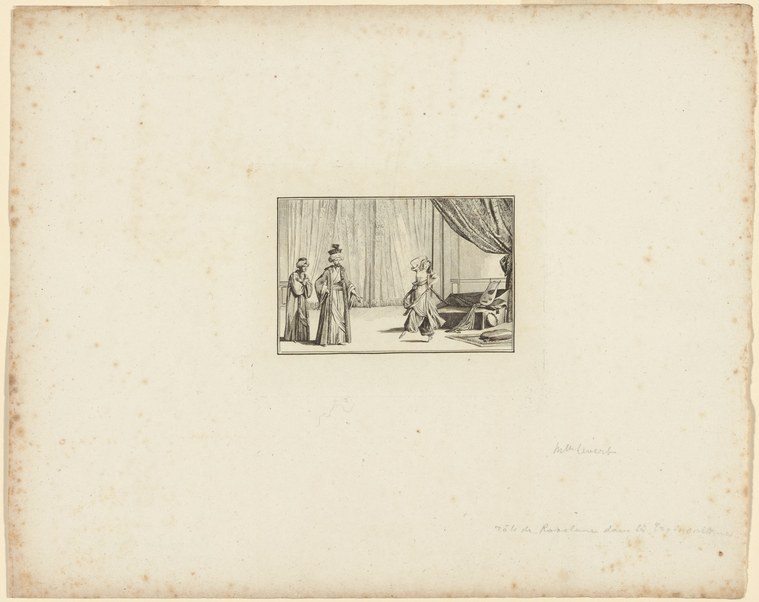
A woman in neoclassical dress stands at center stage in an attitude of dramatic address or supplication, her body angled toward the right. She wears a long, high-waisted gown in the Regency style with a draped shawl or stole across her shoulders, her hair arranged in the upswept fashion of the early 19th century. Two figures in formal dress—likely male courtiers or attendants—stand to the left, observing. The setting is a grand interior with heavy draped curtains at upper right and what appears to be a piano or harpsichord visible at right. The composition is shallow and theatrical, rendered in fine engraved line with careful attention to fabric texture and the fall of cloth. The moment chosen is one of heightened emotion: the central figure's posture suggests she is speaking, pleading, or reacting to news, while her companions attend. The lighting is even and architectural, emphasizing the formal stage space rather than naturalistic illumination.
The dancing
The principal figure stands with her weight balanced, her torso turned slightly to stage right and her arms held in a gesture of expression—one arm appears raised or extended in a rhetorical or supplicating gesture. Her frame is upright and dignified, consistent with the neoclassical ideal of balletic carriage, though this is not a moment of active dance movement but of dramatic pose. The two male figures to the left assume postures of attention and formality, their bodies angled toward the center. All three figures maintain the elongated, refined silhouette characteristic of early 19th-century theatrical representation.
The dance depicted
This image depicts a moment from a theatrical ballet or dance drama rather than social or folk dance. The title identifies the performer as Mlle Levert in the role of Roxane, a character from Molière's *Le Bourgeois Gentilhomme* and other 18th–19th-century theatrical works. The scene is a dramatic tableau—the kind of posed, narrative moment that punctuated Romantic-era ballet and would have been held or moved through as part of a larger pantomime or danced drama. The evidence lies in the formal stage setting, the balletic carriage of the central figure, the theatrical costume, and the compositional convention of representing a named performer in a named dramatic role. This is not action captured mid-movement but the kind of affective, statuary moment—the *pose plastique*—that Romantic ballet valued as a vehicle for expressive acting.
How it was made
This is a fine engraving, likely etched or line-engraved on copper and printed in black ink on laid paper. The technique is characteristic of early-to-mid 19th-century theatrical portraiture and souvenir prints. Engravings of this kind served to document and celebrate stage performance for audiences who could not attend live theater, and to circulate the image of celebrated dancers and actors. The precision of the line, the careful rendering of costume detail, and the formal composition indicate skilled professional execution, probably by a specialist in theatrical imagery. Such prints were affordable and widely distributed, making the dancer's image and role accessible to a broad middle-class public.
About this work
This engraving documents a moment from a theatrical performance by Mlle Levert, a dancer-performer of the early 19th century, in the role of Roxane. The image is a visual record of the Romantic-era ballet-pantomime tradition in which narrative drama, expressive gesture, and balletic technique were woven together. Rather than capturing movement, the engraver has frozen a moment of heightened theatrical emotion—a statuary pose in which the performer's body and face were meant to convey character and feeling to the audience.
The work belongs to the visual documentation of dance history because it shows us how Romantic-era dancers moved, stood, and dressed; what roles women performers inhabited; and how theatrical performance was witnessed, circulated, and remembered in print. It is not a naturalistic image of dance technique but a formal portrait of a named performer in a named role, and it tells us that Levert was celebrated enough to merit a published engraved portrait—a mark of fame and status.
How to look at it
Look at the careful rendering of the dancer's costume: the high waistline, the fall of the drapery, the arrangement of the shawl. These details tell us what Romantic-era dancers wore and how fabric moved on stage. Observe the posture—the upright carriage, the gesture of the arms—which shows the balletic ideal of the period: elongated, controlled, and expressive rather than violent or acrobatic. Note the composition: the central figure is larger and more fully lit than the attendant figures, a convention of theatrical portraiture that placed the celebrated performer at the apex of the image. The moment is not one of active choreography but of dramatic pause—a held pose meant to convey emotion and character to the watching audience.
The artist
The artist is not recorded in the catalogue. However, the engraving is professionally executed in the style of early-to-mid 19th-century theatrical portraiture. Such prints were produced by specialist engravers working from drawings or paintings made after stage performances or from sittings with performers. The anonymous engraver's skill in rendering costume texture, the balanced composition, and the legible facial features suggest work by an accomplished practitioner of the trade, likely active in London or Paris, the major centers of dance and theatrical printmaking.
The period
This image dates from the era of Romantic ballet, roughly 1830–1850, when the female dancer became the central artistic figure of the theater and when pointe work, ethereal costuming, and narrative spectacle defined the aesthetic ideal. Mlle Levert was performing when La Sylphide, Giselle, and La Peri were reshaping dance as an art of illusion and feminine grace. Early 19th-century theatrical portraiture—whether painted or engraved—served to mythologize performers and to make their images portable and repeatable. The engraving as a medium was at the height of its authority for such work; photography, which would later displace it, was still in its infancy when this print was likely made.
Where it lives
The work is held in the New York Public Library's collection of prints depicting dance. The library's catalogue assigns it the era label 'unknown' and provides no medium, artist, or detailed provenance, suggesting it entered the collection as part of a larger acquisition of theatrical ephemera or as a dispersed single print.
Dance in this work
Questions about this work
Was Mlle Levert a famous dancer?
The fact that a professional engraved portrait of her exists suggests she was celebrated enough to merit publication, a marker of status in early 19th-century theater. However, detailed biographical information about her is not available in standard dance histories, possibly because many dancers of the era, especially those who worked in London or provincial theaters, left limited written records. The character of Roxane suggests she performed in comedic or dramatic ballet-pantomime, a major genre of the time.
Is this an image of actual dance movement, or a posed theatrical portrait?
It is a posed theatrical portrait capturing a moment of dramatic action—a held gesture or expression meant to advance a narrative or convey emotion. This is typical of Romantic-era ballet, which alternated between passages of pure dance and moments of pantomime and statuary pose. The engraver has chosen to document the latter: the affective, acting moment rather than the kinetic one.
What can this image tell us about Romantic ballet technique?
The dancer's carriage—upright, elongated, gracefully postured—shows the neoclassical ideal of Romantic-era ballet: a body that was refined, controlled, and expressive. The costume—the high waistline, the flowing skirts, the shawl—shows the silhouette of the era, designed to enhance line and suggest ethereal femininity. The formal stage setting and the inclusion of male attendant figures suggest that narrative spectacle and dramatic decorum were central to how performances were structured and remembered.
More dance artwork





