49 works in this view — arrow keys or swipe to move between them.
Dance in Art
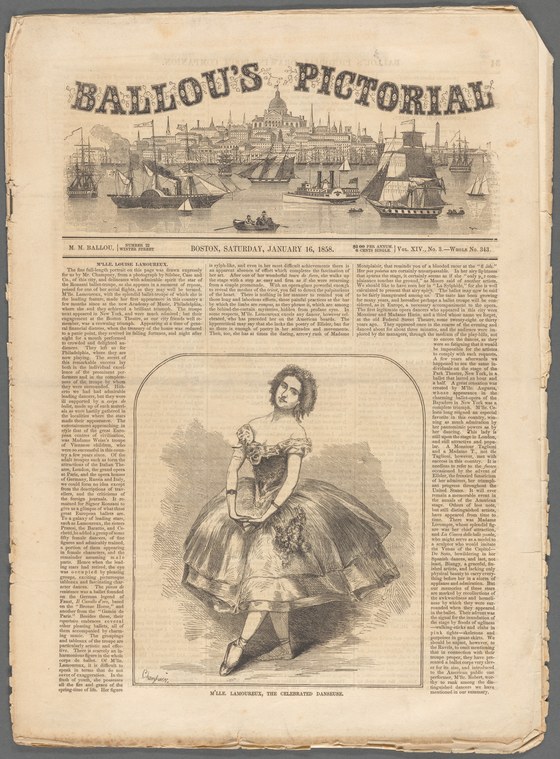
M'lle. [Louise] Lamoureux, the celebrated danseuse [with accompanying article]
Unknown artist
- Collection:
- Prints depicting dance
- Source:
- New York Public Library
- Rights:
- Public domain — free to use, share and adapt.
- Recorded as:
- Public Domain
This image documents how ballet dancers were seen and circulated in nineteenth-century America, and specifically how printmaking technology made the image of the professional dancer a commodity and a form of fame. It also preserves the visual conventions—the pose, the costume, the frontal presentation—that defined how Romantic ballet was imagined and represented in the popular press. For historians of dance, American visual culture, and the history of celebrity, this page is evidence of the precise moment when dance moved from ephemeral live performance into mass-reproducible image.
What you are looking at
This is the front page of Ballou's Pictorial, a Boston weekly newspaper dated January 19, 1856. The masthead features a wood-engraved vignette of Boston Harbor with multiple sailing vessels—clipper ships and steamboats—under full sail, establishing the publication's commercial and maritime focus. Below this, the page is laid out in the dense multi-column format of mid-nineteenth-century newspapers, with extensive letterpress text. Centered within the text is a wood-engraved portrait of a young woman identified in the caption as "M'lle. Lamoureux, the celebrated danseuse." She is depicted in a theatrical pose wearing a romantic-era ballet costume: a fitted corseted bodice with short puffed sleeves and a bell-shaped skirt of substantial length, mid-calf, with what appears to be layered fabric suggesting tulle or similar diaphanous material. Her posture is upright and dignified, one arm resting at her side while the other is raised and bent, suggesting a moment of graceful extension. Her hair is arranged in the period style, and her expression is composed and frontal, meeting the viewer's gaze directly. The engraving is framed in a rounded rectangle, isolating her portrait from the surrounding text.
The dancing
A single figure dominates the composition: a young female dancer in a three-quarter standing position. Her weight appears to rest evenly, with a slight forward inclination of the torso suggesting readiness or poised anticipation. The raised arm, bent at the elbow with the hand positioned near shoulder height, implies an arrested moment of movement—neither fully at rest nor in full extension. The costume's bell skirt and the positioning of her legs (with one leg appearing slightly advanced) suggest classical ballet training, though the engraving's linear technique does not allow precise resolution of footwork or weight distribution. Her bearing is refined and elongated, consistent with the aesthetic demands of the Romantic ballet era.
The dance depicted
This is a portrait of a professional ballet dancer of the mid-nineteenth century, most likely in the Romantic ballet tradition. The costume—particularly the short bell skirt, fitted bodice, and the character of the pose—is consistent with the aesthetics of Romantic ballet as it was performed and circulated in America in the 1850s. No specific ballet role or choreography is identifiable from the image alone, but the pose suggests a moment of classical grace rather than character or narrative dance. The inscription identifies her as "the celebrated danseuse," indicating she held professional prominence. The image documents the visual conventions by which major ballet dancers were presented to the American public at mid-century: as refined, graceful, and essentially frontal presences rather than as bodies captured mid-movement.
How it was made
This is a wood engraving, a relief-printing technique that dominated newspaper and periodical illustration in the nineteenth century. The fine parallel lines (hatching and cross-hatching) visible in the portrait create modulation of tone and texture. Wood engraving allowed rapid reproduction at scale and high definition of detail—suitable for a weekly newspaper with national circulation. The technique's linear vocabulary and reliance on density of mark rather than tonal wash means the engraver has prioritized the clarity of the costume and the grace of the pose over photographic naturalism. The masthead and the portrait are both wood engravings, allowing them to be printed together with movable type in a single press run, which was the technological foundation of the American illustrated press at this period.
About this work
This is a newspaper page—the front of Ballou's Pictorial, a major Boston weekly—that includes a wood-engraved portrait of a professional ballet dancer identified as M'lle. Lamoureux, "the celebrated danseuse." The portrait is embedded within an issue's worth of news, commerce, and editorial matter, demonstrating how dance and dancers were integrated into the visual and textual culture of the American antebellum press. The image is a artifact of the intersection of theatrical celebrity, printmaking technology, and newspaper culture in the 1850s. It shows how a working dancer of the period was presented and circulated to a broad American readership: not as a narrative or a choreographic moment, but as an iconic, frontal presence embodying the refined grace and professional accomplishment of the Romantic ballet tradition. The engraving demonstrates both the technical sophistication of American wood-engraving practice and the centrality of dance—particularly ballet—to mid-century popular visual culture.
How to look at it
Attend to the pose: it is not a moment of action or turning, but rather a moment of stillness and presentation, with the raised arm creating a compositional geometry rather than suggesting a continuation of movement. This reflects a fundamental convention of ballet portraiture in the period—the dancer is shown not mid-performance, but as an idealized, timeless presence. Observe also the costume in detail: the short skirt, the fitted bodice, and the overall silhouette are the visual signature of Romantic ballet. The engraving technique—the linear hatching and the reliance on outline—means the artist has prioritized clarity of form and grace of line over any naturalistic rendering of the body. The frontal gaze and the centered composition make this a portrait in the classical sense, not a narrative image.
The artist
The engraver is not identified in the record. Ballou's Pictorial employed a staff of skilled wood engravers, and the portrait of M'lle. Lamoureux is consistent with the house style of the publication. Wood-engraving in America at mid-century was a specialized craft, with engravers working from drawings (sometimes from photographs or live observation) to translate them into the linear language of the wood block. The quality and finish of this portrait suggests a practiced hand, though individual attribution requires archival research beyond the image itself.
The period
By 1856, Romantic ballet—with its emphasis on the ethereal, the supernatural, and the female dancer as a primary subject—had dominated Euro-American theatrical dance for nearly two decades. Dancers like Marie Taglioni, Fanny Elssler, and Carlotta Grisi had made the art form a mass phenomenon and had traveled extensively in America, generating intense public interest. The 1850s saw the consolidation of professional ballet as a commercial entertainment and the emergence of a celebrity culture around individual dancers. Simultaneously, the American illustrated press was at its height: wood-engraved images in newspapers and weeklies like Ballou's Pictorial brought contemporary culture—including theatrical personalities—into middle-class homes at unprecedented scale and frequency. This convergence meant that ballet dancers achieved a form of visual celebrity through reproduction in the press that could rival or exceed the reach of their live performances.
Where it lives
This object is a single issue (Vol. XIV, No. 3) of Ballou's Pictorial Drawing-Room Companion, held at the New York Public Library. It is a newspaper page, not an independent print or artwork; the portrait of M'lle. Lamoureux is one item among dozens within the issue's contents. Ballou's Pictorial (1853–1859) was a weekly illustrated newspaper published in Boston and distributed nationally, aimed at a literate, middle-class audience.
Dance in this work
Questions about this work
Who was M'lle. Lamoureux?
The record does not identify her beyond the caption "the celebrated danseuse." She was clearly a professional ballet dancer of sufficient prominence to merit a full-page portrait in a major American weekly newspaper in 1856, but her biographical details—including her full name, nationality, and major roles—require research in theatrical archives and period newspapers. Many European and European-trained dancers performed and toured in America during this period; further identification may be possible through cross-reference with theater records and dance histories of the 1850s.
What style of ballet is this?
The costume and pose are consistent with Romantic ballet, the dominant tradition of the 1840s and 1850s. The short skirt, fitted bodice, and the ethereal, frontal presentation are all hallmarks of the Romantic aesthetic. However, the portrait does not depict a specific ballet or role, so it cannot be linked to a particular choreography or school.
Why is this a newspaper page and not a separate print?
This is the front page of Ballou's Pictorial, a weekly illustrated newspaper. In the nineteenth century, newspapers and periodicals were the primary medium for circulating images and information to a broad public. Ballet dancers and other celebrities were featured regularly in these publications as a way to attract readers and reflect contemporary culture. This particular portrait was newsworthy because of M'lle. Lamoureux's professional prominence.
How was this image made?
This is a wood engraving, a relief-printing technique that dominated illustrated newspapers in the nineteenth century. An engraver would cut an image into the end-grain surface of a wood block (usually boxwood), with the raised lines printing ink and the cut-away areas remaining white. This allowed the image to be printed alongside movable type in a single press run. Wood engraving was valued for its fine detail and capacity for rapid reproduction at scale.
More dance artwork





